By Bev Wigney
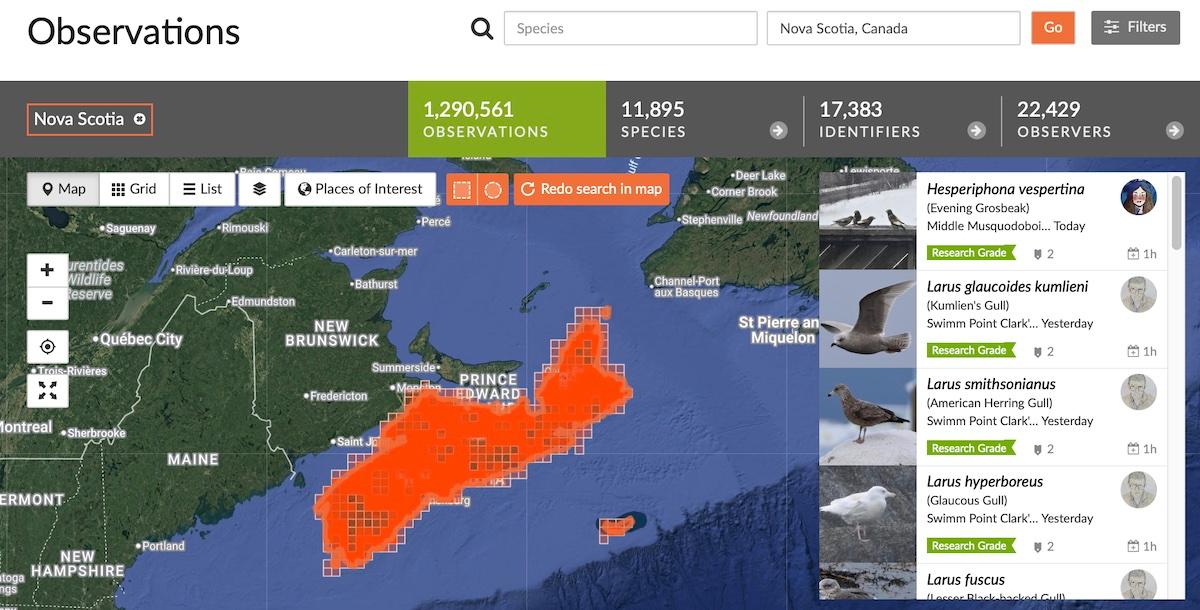
Latest iNaturalists stats for NS , today (Feb 16) up by 2 from Feb. 12, to 22,429 Observers
Adapted from a post on Annapolis Environment & Ecology (Public FB Group) on Feb 12, 2026.
Every so often, I like to check iNaturalist to see how many people in Nova Scotia are adding their nature observations to the database. As of this evening (Feb 12) 22,427 members of iNaturalist have added 1,290,219 observations representing 11,890 species!
Earlier today, I mentioned that, back in 2015 when I first began submitting my own Nova Scotia observations to iNaturalist, I don’t think there were more than about a dozen people who were members and my observations were some of the only ones in the Annapolis Valley region. My how things have changed in eleven years!!
Just for fun, I zoomed in on a section of the province – sort of the central section of the southern part of the mainland. I’m posting that image to show you how many observations have been made in this area.
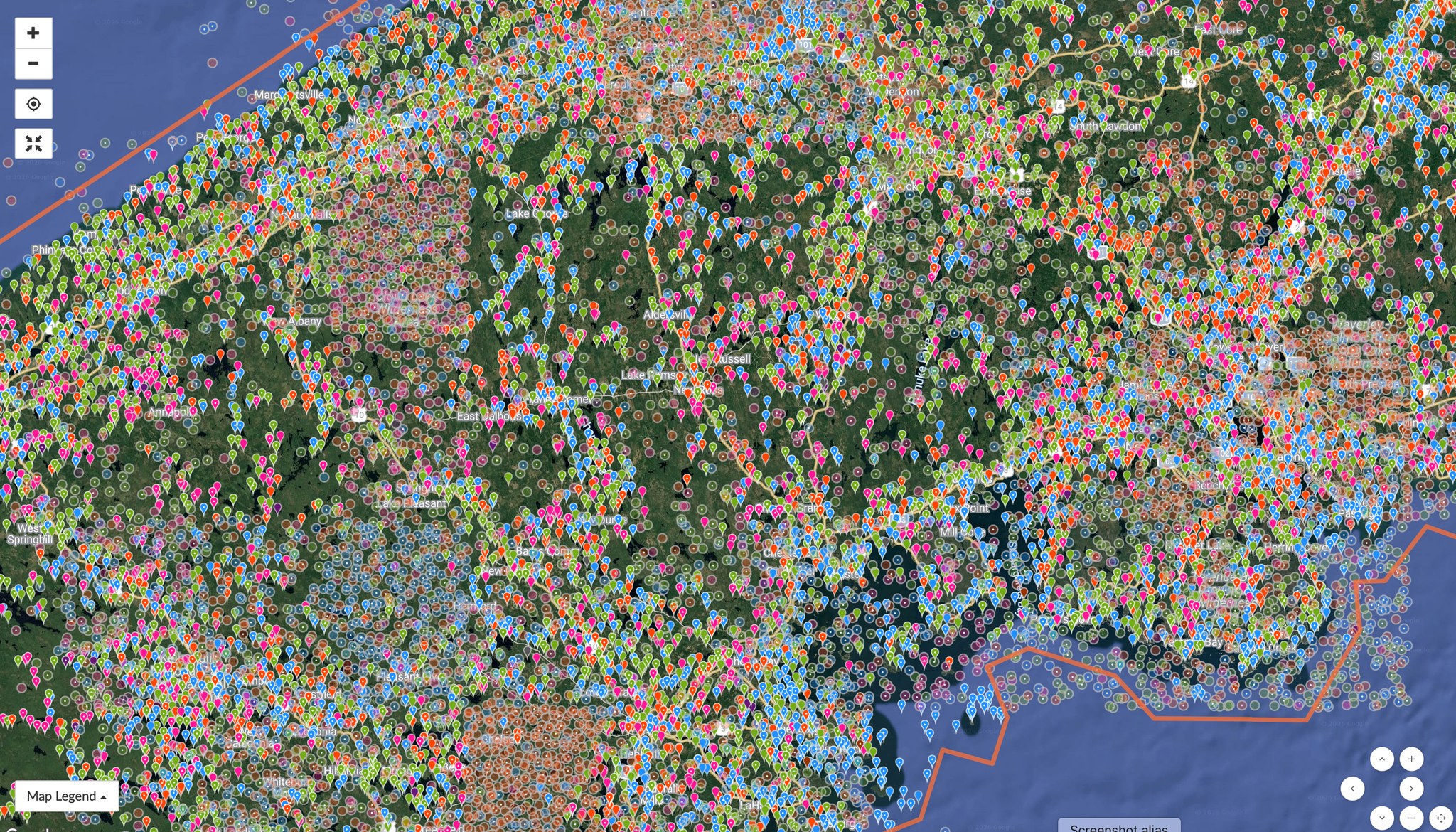
Central section of the southern part of the NS mainland on iNaturalist.Each little dot is an observation. Actually, if we zoomed in even more, we might find dots under the dots in many areas. You can do that if you go to iNaturalist, choose EXPLORE, enter “Nova Scotia” into the place box, and click on GO. Then start zooming in or moving the map around with your mouse. You can click on a dot and see what was found in that spot.
Something that is so interesting and fun to see is how different the observations can be. Some people are doing really a lot of work on recording their observations of birds, mammals, lichen, mosses, plants, bees, moths, dragonflies, fish, etc..
You see, there are people across the province, along with some visiting naturalists, biologists, etc.. who go out searching for whatever they wish to study, and other people who choose a location and visit and revisit it many times recording flora and fauna — something that many naturalists refer to as “bioblitzing”.
I do that wherever I travel in North America – I have submitted observations from many parts of Canada and the United States. There are members of iNaturalist who are scientists who visit remote parts of the world to search for plants, insects, or other organisms and submit their observations into iNaturalist so that other scientists, naturalists, specialists, can view them.
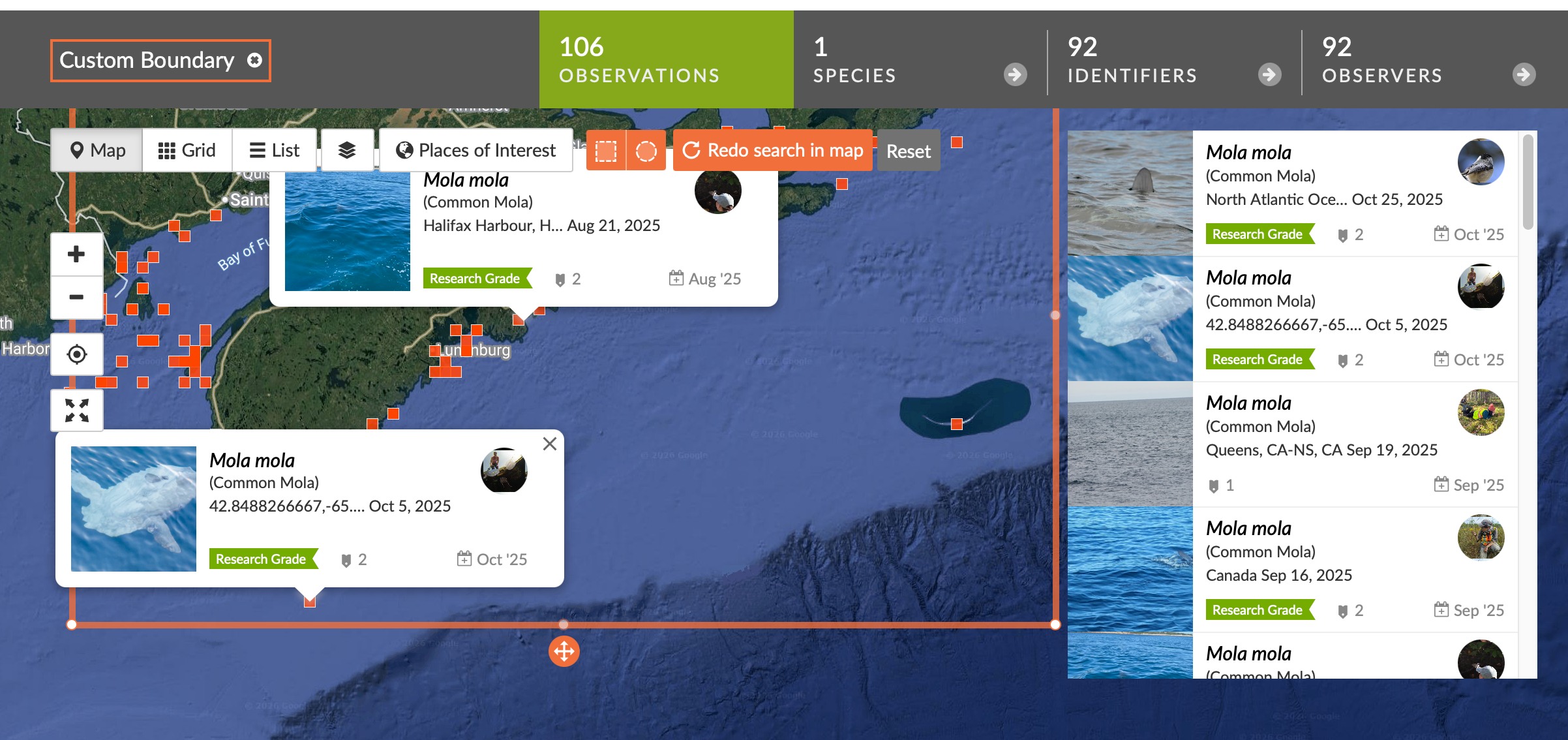
Some of the records for Mola mola in waters off of NS
There are a lot of ways to use the iNaturalist database. I use it in all sorts of ways to discover information.
Just for fun, tonight I drew a boundary which contained a lot of the waters surrounding Nova Scotia. Then I asked to search for records for Mola mola – those huge Sunfish that are sometimes seen floating on their sides in waters off the coast of Nova Scotia.
iNaturalist was immediately able to tell me that, within the orange square (see map above)), there have been 106 observations of Mola mola submitted by 92 observers. Each record is a small orange square on the map which I can click on to see the photo and read notes about the location, date, and any other info the observer wished to submit.
Anyhow, if you haven’t done so already, I encourage all naturalists budding naturalists included) to join – it’s free – and submit your observations to help continue to build a growing database of the flora and fauna of Nova Scotia.
RELATED
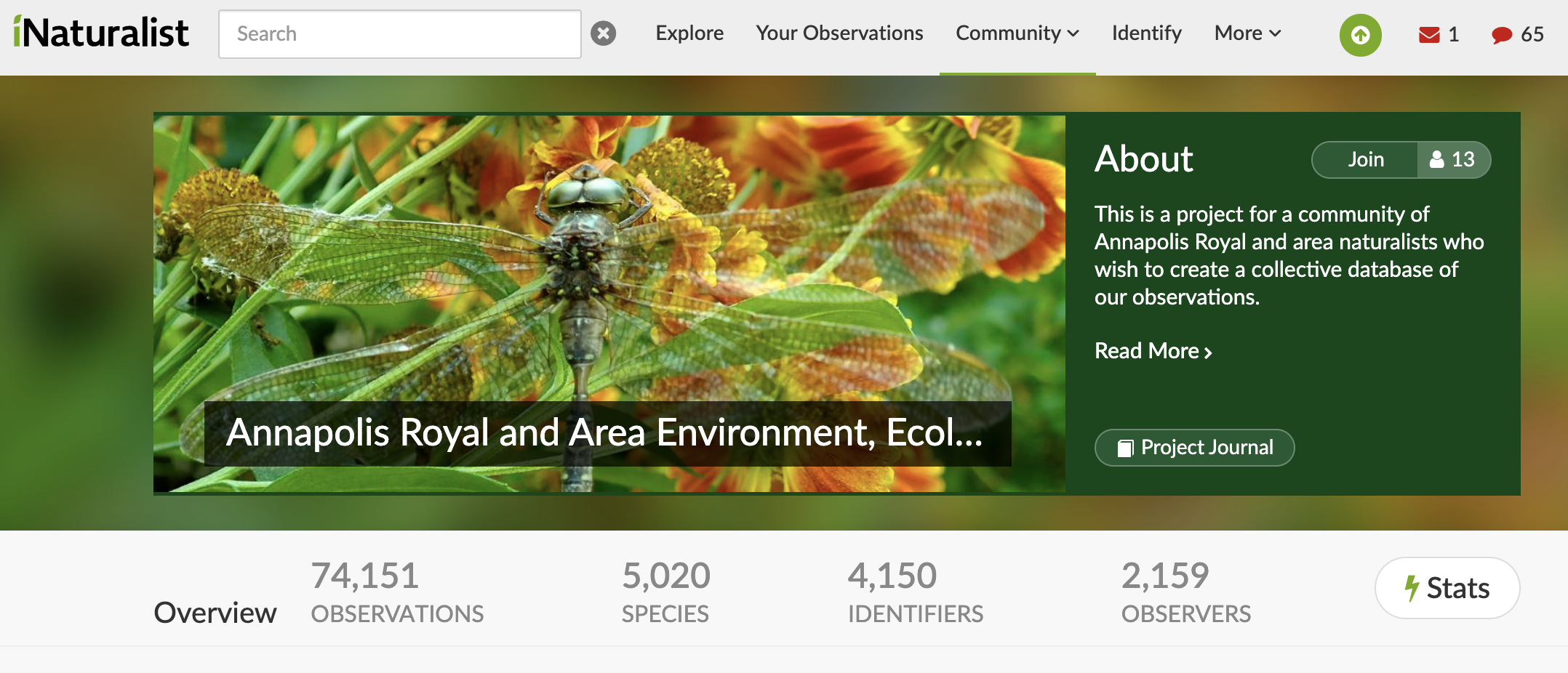
Latest iNaturalist stats for Annapolis Royal and Area Environment, Ecology and Nature (iNaturalist Project)
– Annapolis Royal and Area Environment, Ecology and Nature (iNaturalist Project)
From About: “This is a project for a community of Annapolis Royal and area naturalists who wish to create a collective database of our observations.”
Created by: bevwigney – November 10, 2018 View image at right of this post for the latest stats.
– iNaturalist keeping an eye on Nova Scotia’s forests
Post on nsforestnotes.ca May 21, 2019 “Citizen science comes of age in NS forests”