Navigation: View Fire Ecology & Fire Management, a top level page on nsforestmatters.ca for related pages.
Drafting…
– NS Forest Vegetation Types: Open Woodland Forest Group
Concept: These are open woodlands ecosystems usually with tree coverage less than 30%. They occur on a variety of sites where growth and density are limited by low fertility, lack of moisture, thin soils and/or exposed bedrock. Stunted tree growth, a well developed shrub layer, and at times extensive coverage of reindeer lichens (Cladina spp.) are typical for this group. All Vegetation Types (VT) in this group are found in the Acadian Ecosite group, with some also found in the Maritime Boreal Ecosite group…Vegetation: Pine, black spruce, red maple and red oak are common trees associated with this group…Environmental Setting/Site Conditions: Vegetation types in this group are found on bedrock outcrops, shallow glacial tills, colluvium and sandy outwash plains. Soils are usually dry and nutrient poor...Successional Dynamics: Open woodlands are mainly edaphic climax associations limited by low moisture, exposure and nutrient poor soils. Windthrow and fire are the main natural disturbance agents…
There are 6 VT (vegetation Types in this group). Fire is cited as the prevalent disturbance in VTs OWI, OW2 and OW3.
– Ecology and Land Use of the Barrens of Western Nova Scotia
R. M. Strang, 1972 in Canadian Journal of Forest Research “Abstract
The rocky heathlands of western Nova Scotia cover some 31 000 ha of coarse, bouldery ortstein podzol of granitic origin. The shrubby vegetation, dominated by Gaylussaciabaccata, is closely correlated with topographic position and depth of soil over the impenetrable pan.Pollen analysis suggests that the area has, for many centuries, been a very open woodland and that the present community is a reflection of soil poverty as well as of periodic burning.Because the site is so unproductive it is suggested that wilderness recreation is the best land use.
– 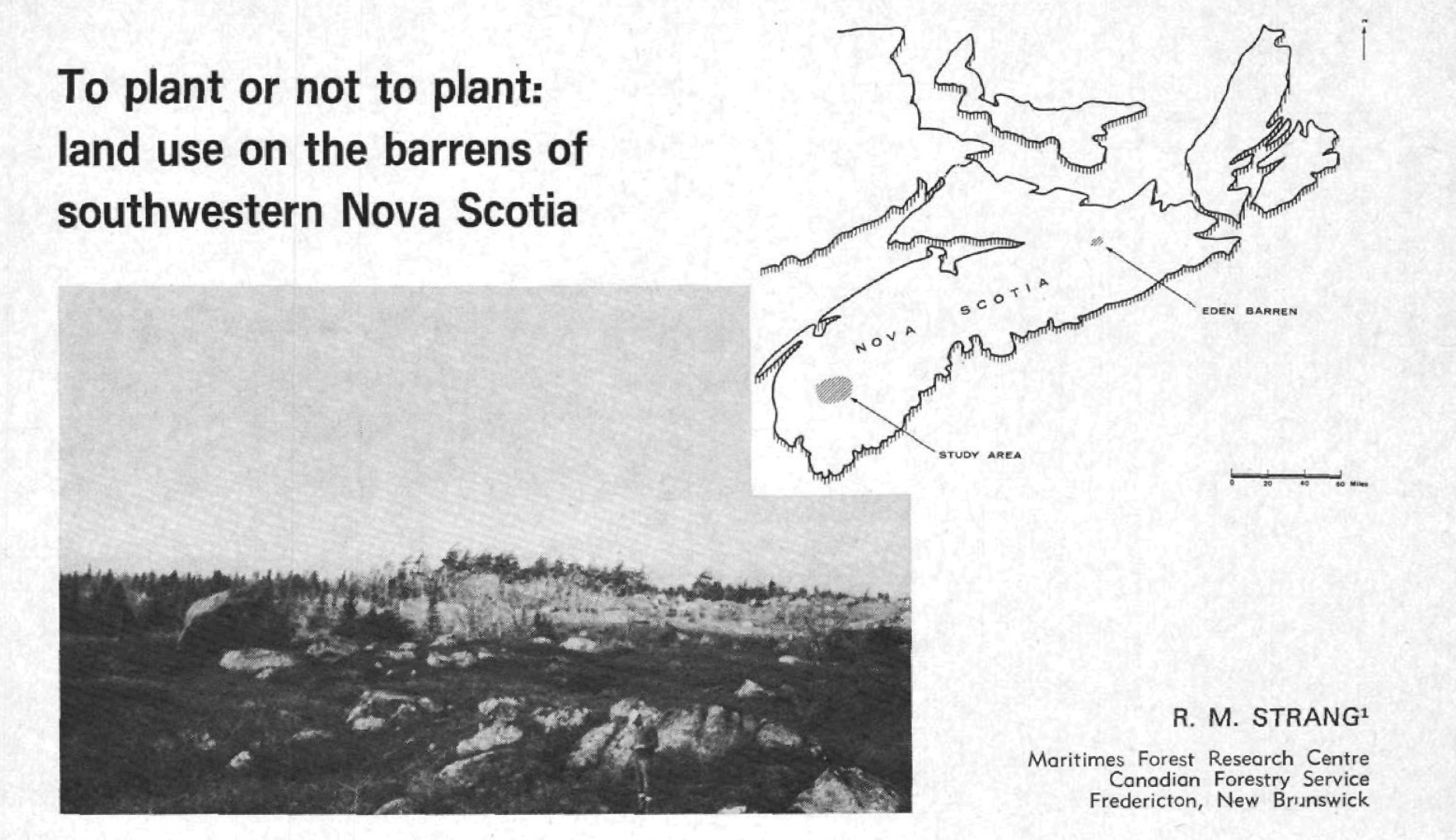 To plant or not to plant: land use on the barrens of southwestern Nova Scotia
R. M. STRANG 1971 in The Forestry Chronicle “These barrens occupy some 34,000 ha (75,000 acres) of Crown land in Digby, Yarmouth and Shelburne counties of Nova Scotia…
– Ecological Landscape Analysis of Western Barrens Ecodistrict 770
Prepared by the Nova Scotia Department of Natural Resources
Authors: Western Region DNR staff, 2014.
– Barrens Ecosystems in Nova Scotia:Classification of Heathlands and Related Plant Communities
By: Caitlin J.M. Porter, Sean P. Basquill, Jeremy T. Lundholm. 2020.
Joint publication of Nova Scotia government and Saint Mary’s University. Nova Scotia Department
of Lands and Forestry, Biodiversity Reference Guide 2020-001