Navigation: This page is a subpage of The Camps, a top-level page on the blog/website Nova Scotia Forest Matters (nsforestmatters.ca)
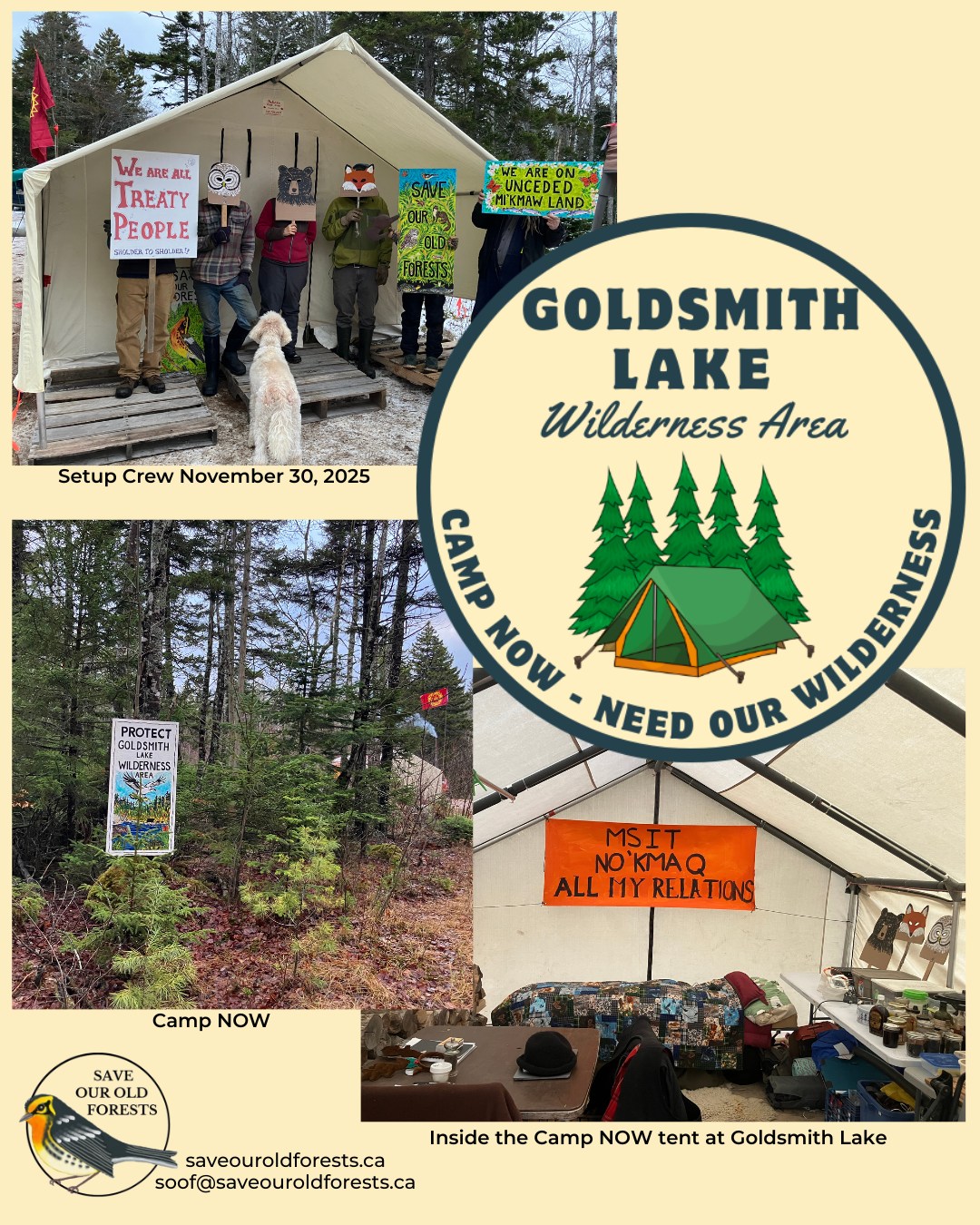 Intro: “Camp N.O.W. – Need Our Wilderness – was set up on November 30th on Crown land in the citizen-proposed Goldsmith Lake Wilderness Area in Annapolis County by Save Our Old Forests’ president Nina Newington and others who have been working to get the area permanently protected since 2022.
Camp NOW is protesting the government’s failure to protect the Goldsmith Lake Wilderness Area or any other new Wilderness Areas on public lands. Progress towards protecting 20% of Nova Scotia’s lands and waters by 2030 has been miniscule, less than half a percent since the commitment was included in the Environmental Goals and Climate Change Reduction Act in 2021. Instead, DNR is approving logging in citizen-proposed Wilderness Areas including Goldsmith Lake, Beals Brook, Ingram River and Chain Lakes. Read more
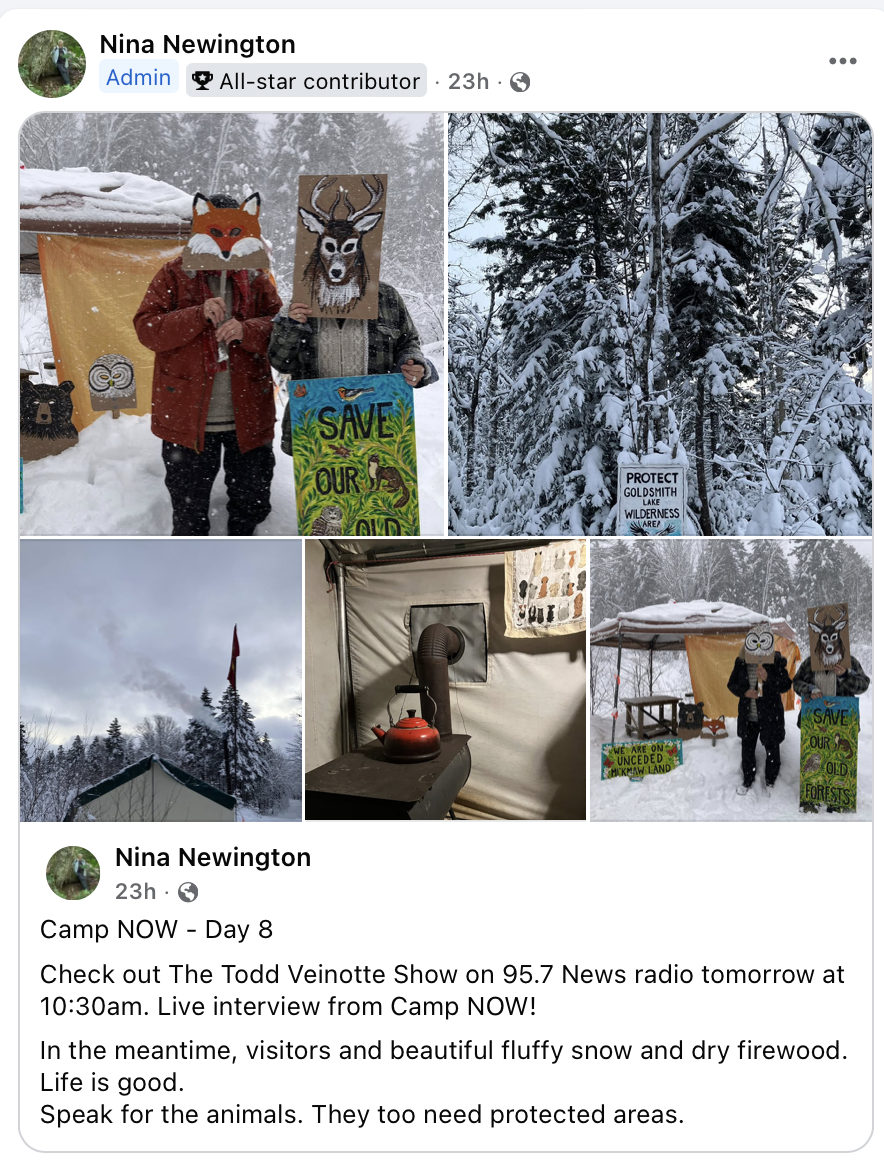 Listen to interview with Nina Newington on Todd Veinot Show, Dec 9, 2025. Todd V asks: Explain the theory behind this camp? Why are Old Growth forests important? Whats the difference between an Old Growth forest and an old forest? Regarding carbon capture, whats the difference between a 30 year old forest and an old forest? Can there be a balance between those that want to log and those that want to protect? The government changed laws on these kind of protests this year – any concern that they might come and shut you down? What would get you out of out of the tent tomorrow? On the last question Nina replies “Well if the government said yes we’re gonna get Environment to do the formal review of Goldsmith Lake Wilderness area so that we’re working towards protecting it and in the meantime will put a freeze on the harvests we have planned for this area that would do it…” Listen to interview with Nina Newington on Todd Veinot Show, Dec 9, 2025. Todd V asks: Explain the theory behind this camp? Why are Old Growth forests important? Whats the difference between an Old Growth forest and an old forest? Regarding carbon capture, whats the difference between a 30 year old forest and an old forest? Can there be a balance between those that want to log and those that want to protect? The government changed laws on these kind of protests this year – any concern that they might come and shut you down? What would get you out of out of the tent tomorrow? On the last question Nina replies “Well if the government said yes we’re gonna get Environment to do the formal review of Goldsmith Lake Wilderness area so that we’re working towards protecting it and in the meantime will put a freeze on the harvests we have planned for this area that would do it…” |
POSTS FROM CAMP NOW
Most recent at top.
These posts are copies of the original posts on Friends of Goldsmith Lake Wilderness Area (Public Facebook Group)
CAMP NOW
Nina Newington Oct 2, 2027
Click on images for larger versions
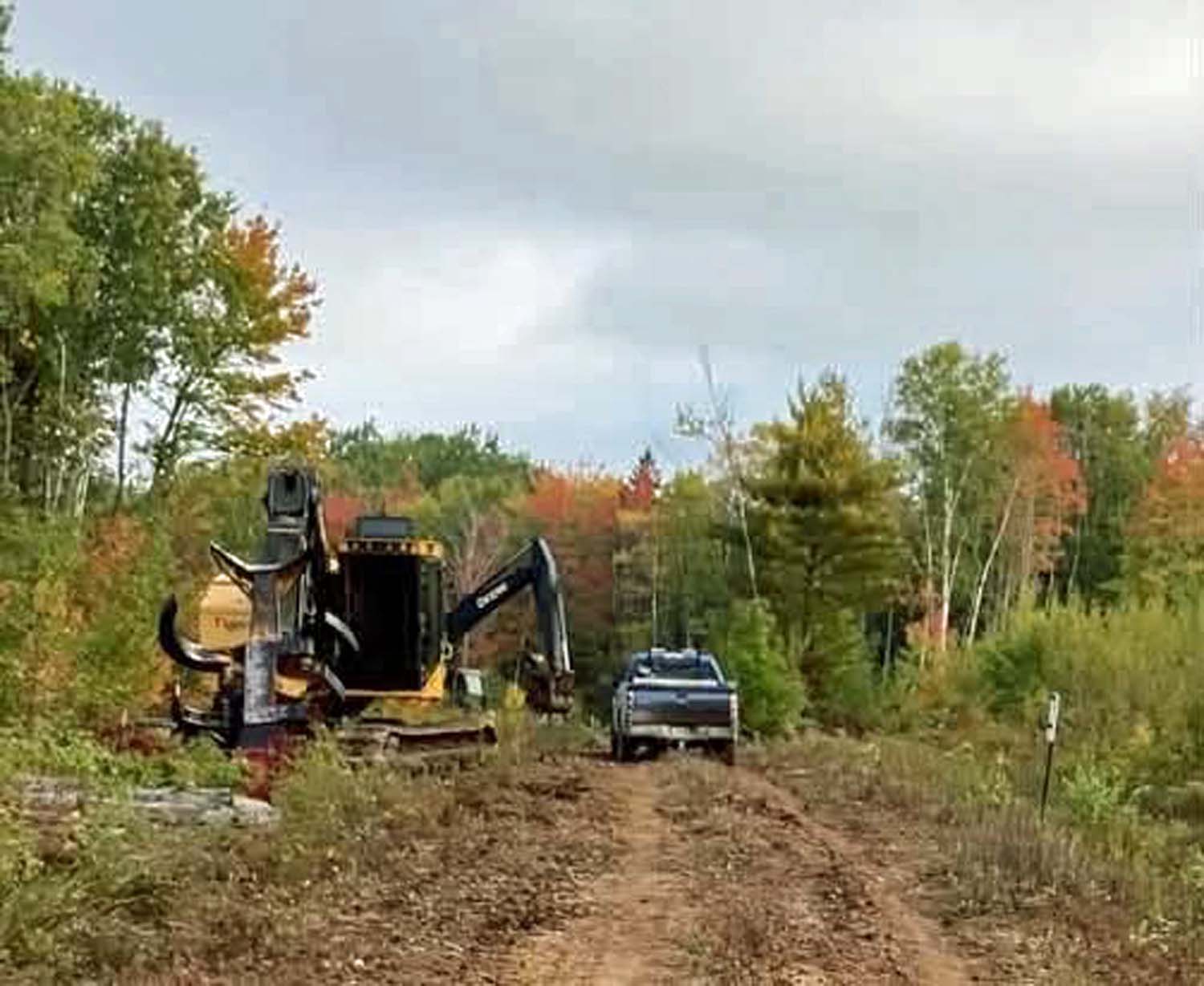
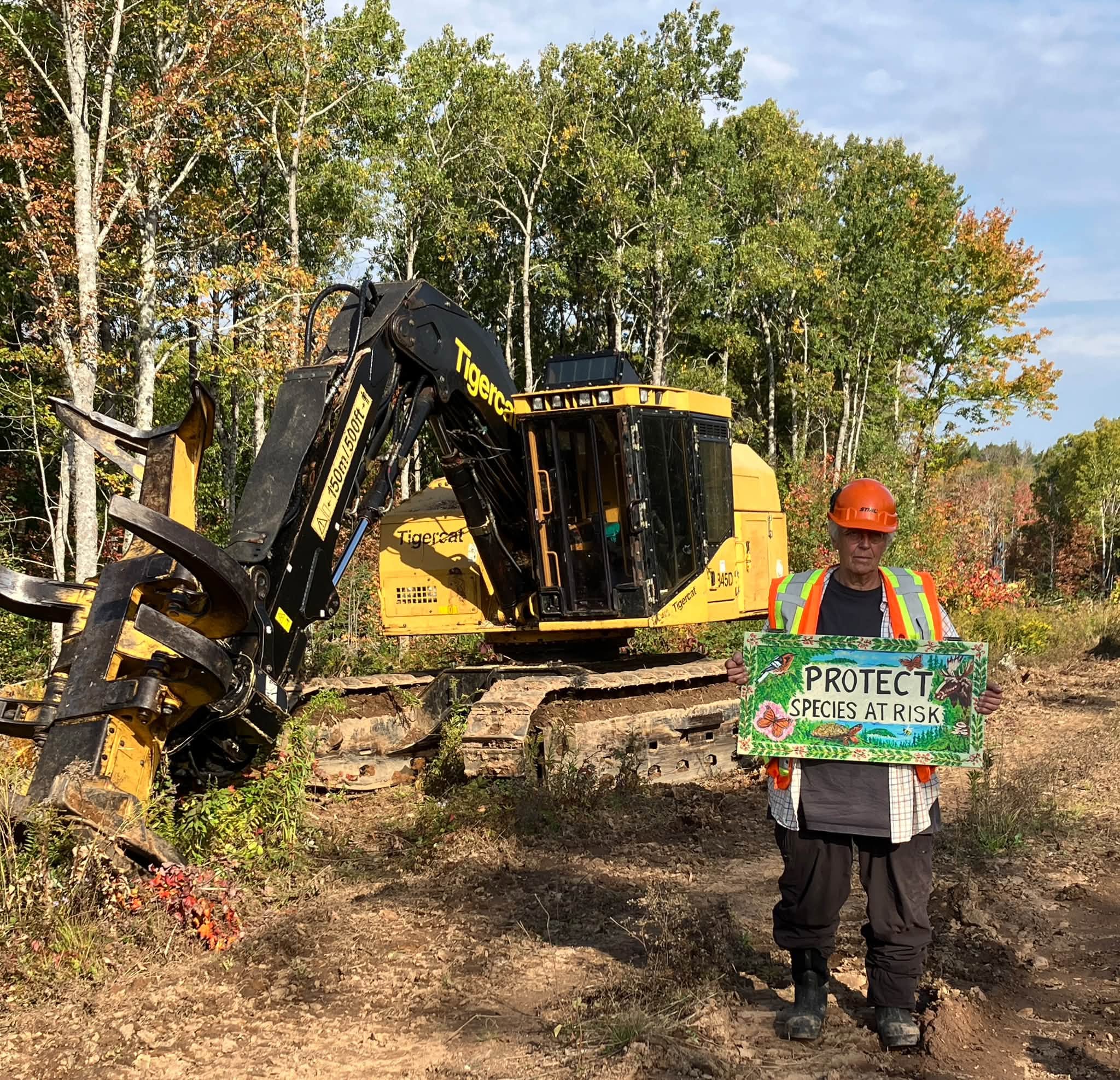
At 7:30 this morning a truck pulled up on the road next to where we are camped on Crown land south of Goldsmith Lake. The driver inquired whether there was other equipment beside the grappler that was nearby. He was looking for the backhoe parked further down.
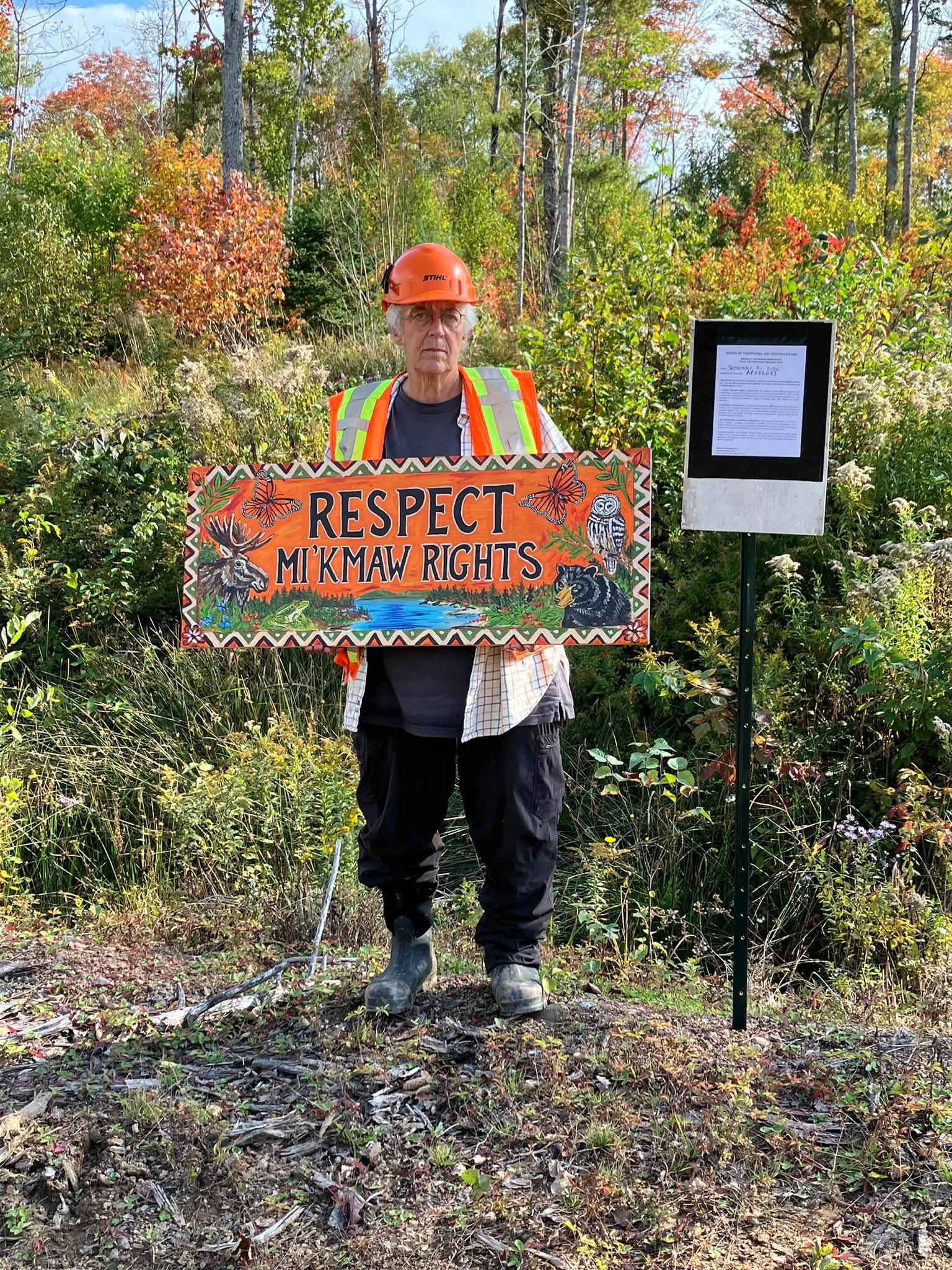
I suggested he should read the notice posted beside the road. I explained that it was a notice requiring a halt to activities including road building in this area as it is a Mi’kmaw Medicinal Harvest area.
He asked what the camp was doing here. I explained that we are here as Treaty partners observing whether Mi’kmaw rights are being respected. We are here too to be a voice for the voiceless, for species whose right to exist is at risk. Our government is failing to follow its own law by ignoring the Endangered Species Act.
I said I was one of the citizen scientists who found the black ash whose buffers this road would violate. He said he had been told about the black ash and that it was okay to put the road through.
I suggested he call his boss and possibly WestFor.
He drove down the road a bit and sat in his truck for 45 minutes, presumably making phone calls. Then he started up the excavator.
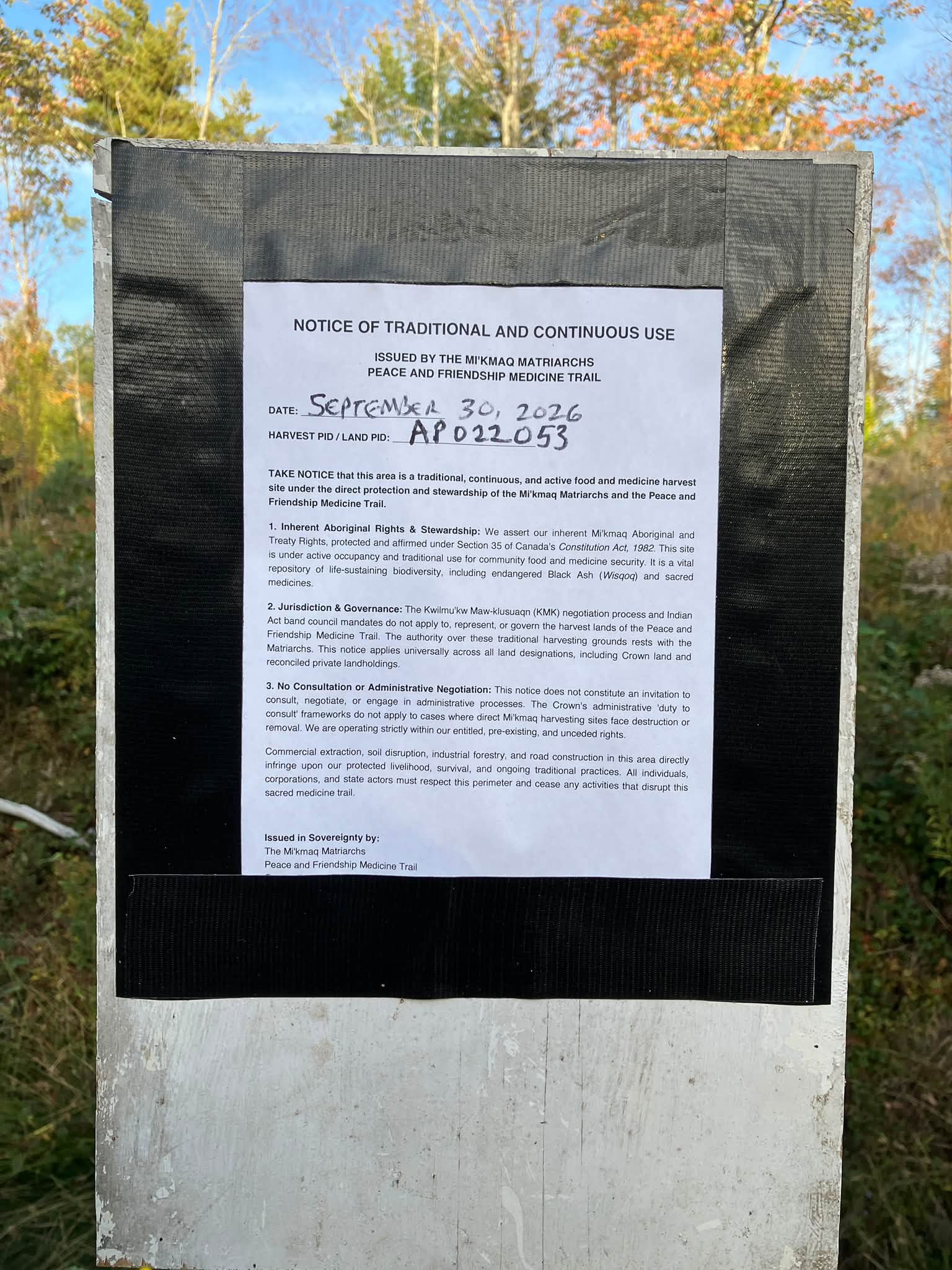
Someone presumably told him it was okay to ignore the notice. The text of the notice is:
 ‘NOTICE OF TRADITIONAL AND CONTINUOUS USE ISSUED BY THE MI’KMAQ MATRIARCHS PEACE AND FRIENDSHIP MEDICINE TRAIL ‘NOTICE OF TRADITIONAL AND CONTINUOUS USE ISSUED BY THE MI’KMAQ MATRIARCHS PEACE AND FRIENDSHIP MEDICINE TRAILDATE: ___Sep 30, 2026 HARVEST PID / LAND PID: APO22053___ TAKE NOTICE that this area is a traditional, continuous, and active food and medicine harvest site under the direct protection and stewardship of the Mi’kmaq Matriarchs and the Peace and Friendship Medicine Trail. 1. Inherent Aboriginal Rights & Stewardship: We assert our inherent Mi’kmaq Aboriginal and Treaty Rights, protected and affirmed under Section 35 of Canada’s Constitution Act, 1982. This site is under active occupancy and traditional use for community food and medicine security. It is a vital repository of life-sustaining biodiversity, including endangered Black Ash (Wisqoq) and sacred medicines. 2. Jurisdiction & Governance: The Kwilmu’kw Maw-klusuaqn (KMK) negotiation process and Indian Act band council mandates do not apply to, represent, or govern the harvest lands of the Peace and Friendship Medicine Trail. The authority over these traditional harvesting grounds rests with the Matriarchs. This notice applies universally across all land designations, including Crown land and reconciled private landholdings. 3. No Consultation or Administrative Negotiation: This notice does not constitute an invitation to consult, negotiate, or engage in administrative processes. The Crown’s administrative “duty to consult” frameworks do not apply to cases where direct Mi’kmaq harvesting sites face destruction or removal. We are operating strictly within our entitled, pre-existing, and unceded rights.Commercial extraction, soil disruption, industrial forestry, and road construction in this area directly infringe upon our protected livelihood, survival, and ongoing traditional practices. All individuals, corporations, and state actors must respect this perimeter and cease any activities that disrupt this sacred medicine trail. Issued in Sovereignty by: The Mi’kmaq Matriarchs Peace and Friendship Medicine Trail |
 |
 |
& AN UPDATE Oct 5, 2026:
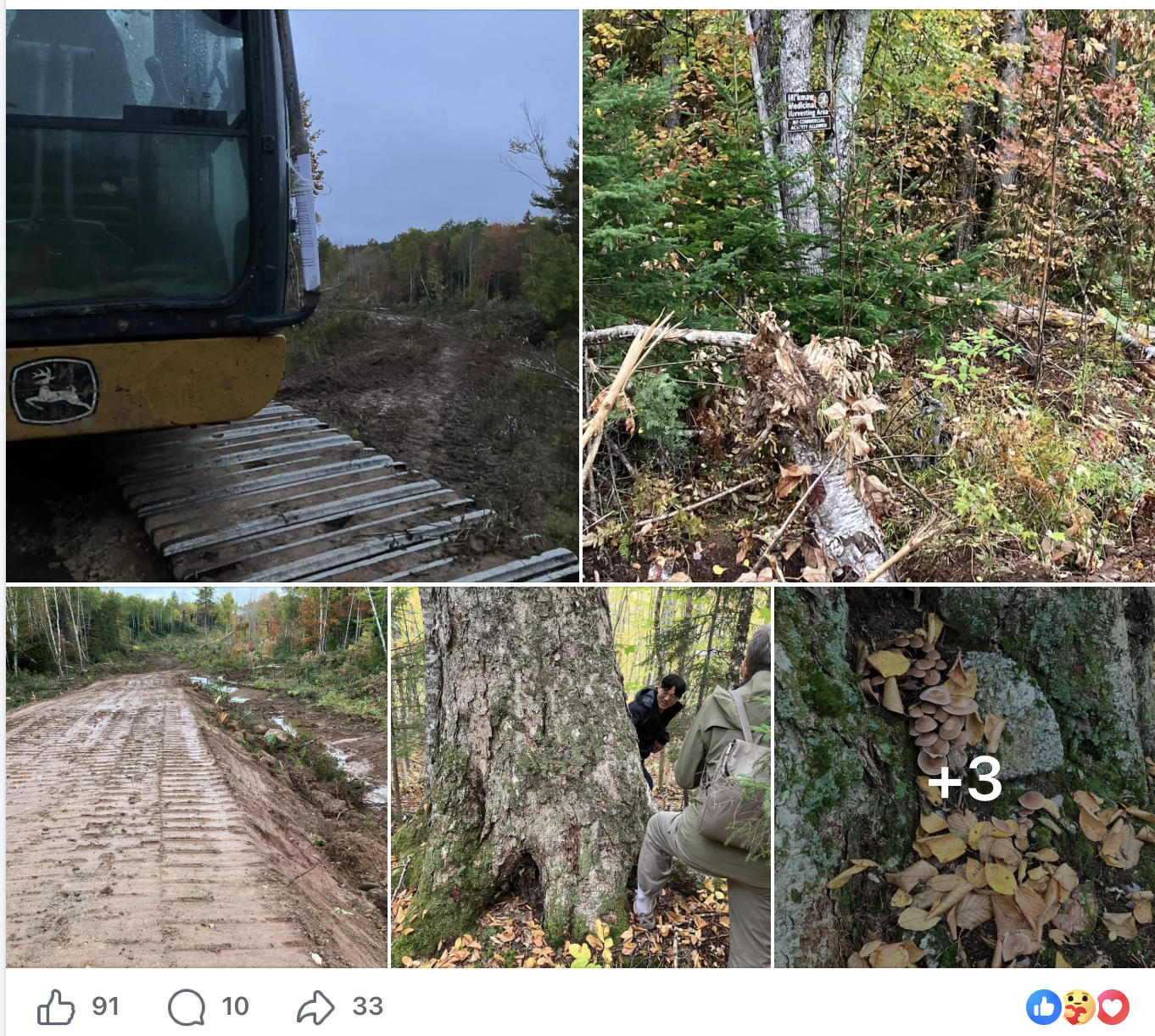 Nobody came at 7:30am this morning to operate the backhoe. No more roadbuilding, for today at least.”
At 10am a rig stopped out on the road. A man hiked in to collect the other piece of machinery, the massive buncher which had done its work of gathering up all the trees felled in the course of clearing a 20m wide roadway. The tree trunks are laid along the side of the roadway, all the way up.
We had a good conversation with this man. The people working to build roads and cut trees are not our enemies. They are part of an industry they know is fading away. An industry that exploits their labour and requires them to follow forestry practices that they know make no sense. Those who have their own woodlots often tend them with great care, taking some, leaving more. Honouring the forest. Loving being in the woods. “I can go in the woods, sit on a stump, be happy the whole day,” said this man.
Yesterday I was in old growth forest in a different part of the area we have been working on getting protected since 2022. Donna Crossland and I were sharing the calm and beauty and intricacy of those few acres with people of all ages, people whose families have been here for several centuries and brand new immigrants.
Meanwhile, back at camp, local Mi’kmaw delivered a copy of the notice asserting treaty rights and demanding that the road construction stop. The notice was taped to a handle by the cab door of the backhoe. This is the same notice of traditional and continuous use we had been asked to post beside the road when we set up camp last Wednesday.
Will this be respected? The demand of people who have been guardians of this land for well over 10,000 years. We’re waiting to see.
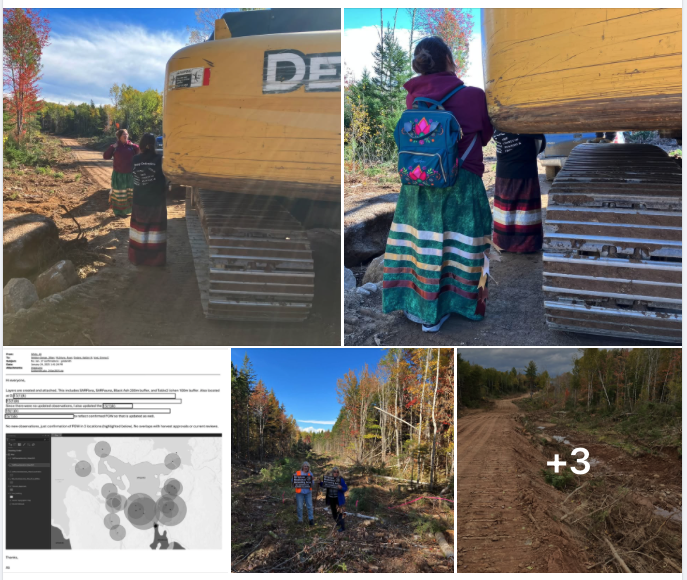 & An UPDATE Oct 10, 2026
Yesterday at 2:30pm Mi’kmaw Matriarchs and Peace and Friendship Medicine Trailpartners walked up the huge new logging road being built.
At camp for days now we have been listening to the roar and clatter of the machine as it has advanced through a Mi’kmaw medicinal plant harvest area towards the overlapping buffer zones intended to protect endangered black ash trees.
The operator was informed of the Notice of Traditional and Continuous use on October 2nd. This notice demanded that road work halt immediately. On October 4th Mi’kmaw tied a copy of the notice to the handle by the cab of the machine. The operator ignored it.
Eisnors Forestry, the company contracted by WestFor to build this road on Crown land, received a flood of emails
on October 4 and 5 informing them of the issue and asking them to stop work. They didn’t.
So yesterday, October 9, Mi’kmaw matriarchs went to serve the notice in person. The operator shut off the equipment and a discussion ensued.
The settler Peace and Friendship Medicine Trail partners walked through the edge of a stand of old growth to come out where the road has not been built. We stood in witness. A filmmaker recorded the interaction.
And then the operator moved his machine back down the road to where he had started.
I checked on my map of the buffer zones and the harvest plan. The road building was stopped right at the boundary of the Black ash buffer zone.
What comes next? We’ll see. The operator insisted — loudly enough for all of us to hear — that the road will be built and the forest will be cut.
Stay tuned and share widely.
& An Update Oct 16, 2026
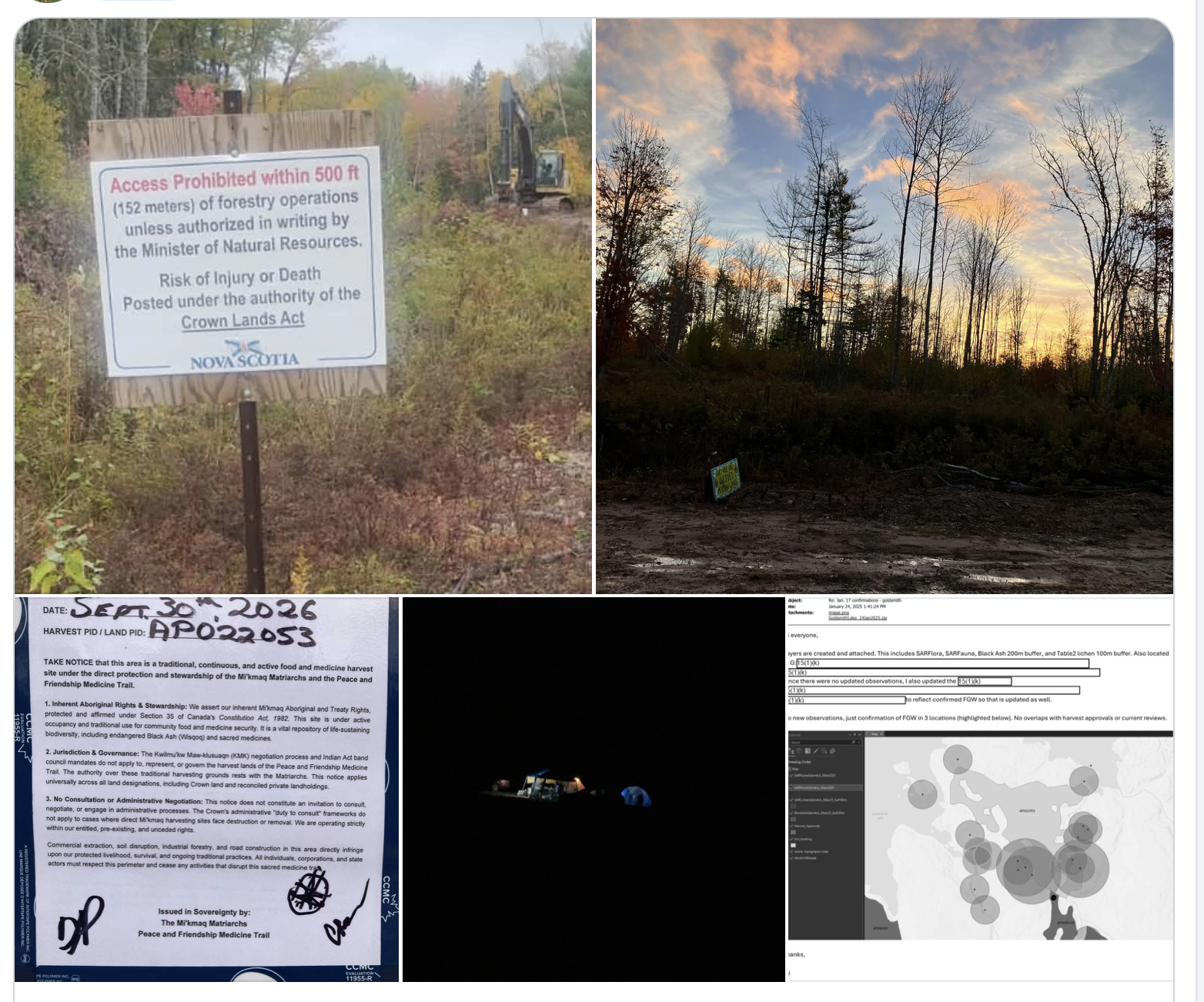 At 6 AM yesterday – Wednesday – two trucks drove past the tent where I lay reading, listening to the rain on the canvas, listening for the backhoe operator to come in. We hadn’t seen him since Friday when two Mi’kmaw Matriarchs served him notice to stop building a road through endangered Black ash buffers. As it happens, the spot where he stopped work was exactly at the boundary of the buffer zone. After some discussion he drove his equipment back down to the start of the new road and left.
Now he was back with a friend.
Presumably there had been some head scratching in the interim. Conversations, probably, among Eisnors Forestry, the contractor; WestFor, a consortium of mills; DNR; perhaps the Department responsible for L’nu Affairs, and the premier’s communications team. There might even be a ministerial briefing note kicking around.
In the rainy dark the backhoe started up.
Clearly the decision had been made to ignore the Mi’kmaw Matriarchs, the Peace and Friendship Medicine Trail, the assertion of Mi’kmaw Treaty rights, and the Endangered Species Act.
We set up this camp — we being a mix of citizen scientists, SOOF members and others working to get permanent protection for the area of Crown land around Goldsmith Lake — as Treaty partners, there to observe and document whether Mi’kmaw rights were being respected. We were there too to be a voice for the voiceless, for species whose right to exist is at risk.
Painful though it was to hear and see the road being made, we weren’t there to block it.
The operator’s buddy drove away. The sound of the backhoe faded into the distance. When it was light out I walked up the 400 m of road that had already been completed. The backhoe was nowhere to be seen.
It was apparent that the operator had not continued the road construction where he left off on Friday. Instead he had driven through the cedar line laid down by a Mi’kmaw Matriarch over the weekend, through the Black ash boundary zone, and continued on down the cleared roadway, presumably to its end on the far boundary of the harvest plan that this road will make accessible for logging.
The conclusion that the operator had gone to the far end of the roadway and was now working his way back towards the Black ash buffer zone was confirmed later in the afternoon when DNR conservation officers showed up at camp. I was not present at the time but people who were there said that DNR informed them that the camp must be removed immediately. In order to stay, they would have to obtain a permit. The officers hammered in a sign that states “Access Prohibited within 500 feet (152m) of forestry operations unless authorized in writing by the Minister of Natural Resources.”
The people at camp were informed that the road would be built through the Black ash buffer zone. Harvesting of AP022053 would take place next year when the road had settled. Apparently neither Mi’kmaw rights nor the Nova Scotia Endangered Species Act will be allowed to get in the way.
We made the unhappy decision that the camp had done what it could within its mandate so we took it down.
Our work is not over. Far from it.
Please do email Minister Tory Rushton mindnr@novascotia.ca. Ask him to stop work right now on road building for AP022053.
While you’re at it, you might ask whether you have to get a permit to be within 500 ft of any forestry or road building equipment parked on public (crown) land? Are signs posted to show the public exactly where and when a ‘forestry operation’ begins and ends?
& Wrote NN Oct 18, 2026, citing a post by Sandra Phinney:
This is happening in the proposed Goldsmith Lake Wilderness Area where citizen scientists have identified 138 species at risk occurrences, including these Black ash trees. All have been reported to DNR. Minister of Natural Resources Tory Rushton is choosing to ignore the Endangered Species Act that he is mandated to uphold. Write to mindnr@novascotia.ca
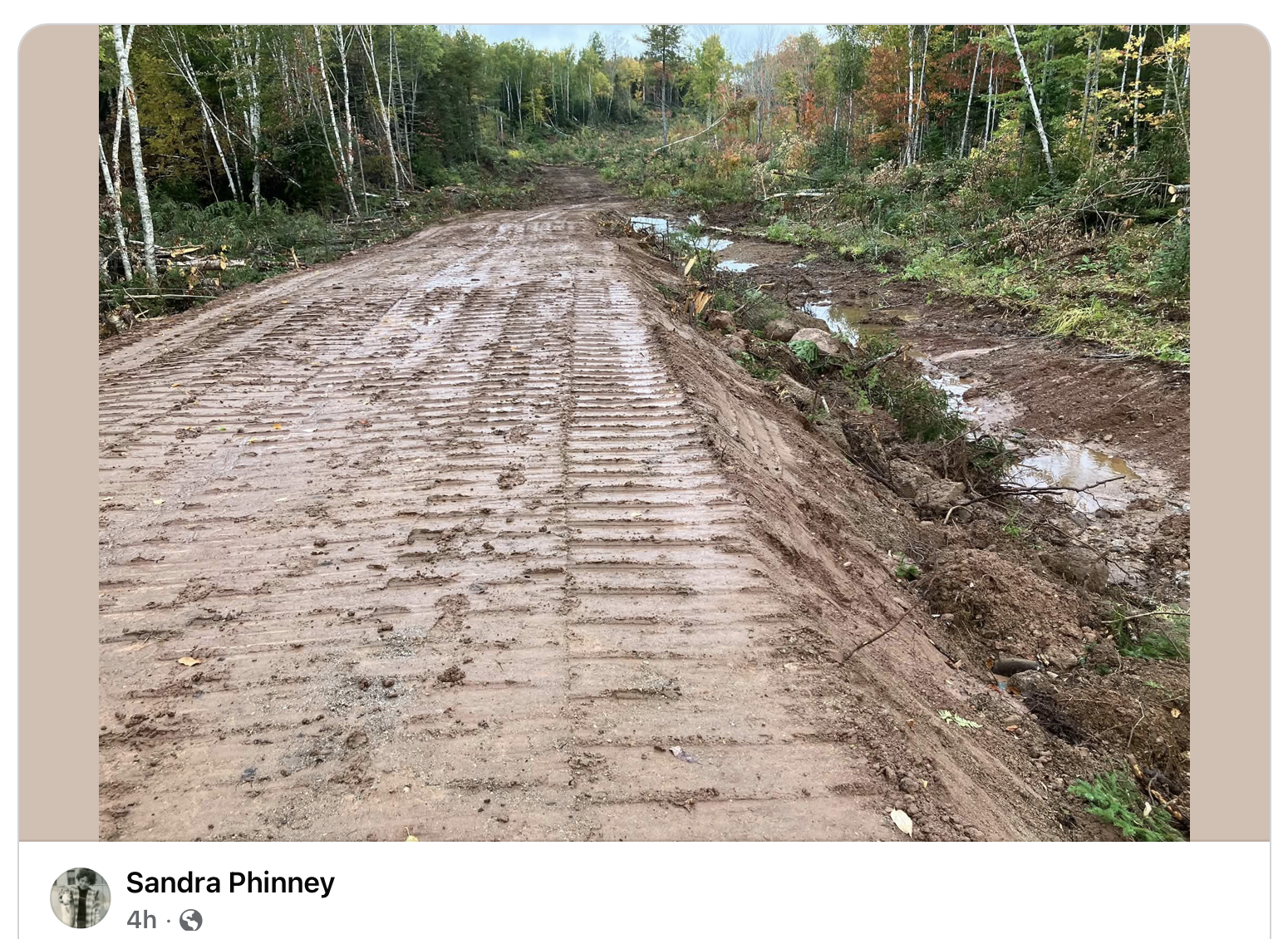 HOW CAN THIS BE? DNR has approved building this road in a known wilderness area with documented Species At Risk … smack through the buffer zone for Black ash trees … an endangered specie! This road is also slashing its way through a previously established Mi’kmaq Medicine Trail. This past Wednesday, forest protectors who’ve been there for the past couple of weeks, although they WERE NOT BLOCKING THE ROAD, were told to remove their tents and belongings. Under the Crown Lands Act, they could face jail terms and fines up to $50,000. Kindly consider taking a minute to send an email to Minister Tory Rushton mindnr@novascotia.ca. Two sentences: Uphold the Species AT Risk Act and Mi’kmaq Peace and Friendship Medicine Trail in Goldsmith Wilderness Area. Stop work right now on road building for AP022053. And share this post far and wide.
 Camp NOW — Day 251
Nina Newimgtom, August 17, 2026
I read an interview yesterday with Bill Darnell, one of the founders of Greenpeace. 55 years later, he is still active.
‘What keeps you awake at night?’ asked journalist Patricia Lane from Canada’s National Observer.
‘The destruction is accelerating. Sometimes, I feel disconnected and powerless. There’s a lot of loss ahead of us. A lot of lives, humans included, will suffer because of the greed of a few and the systems we’ve allowed to support them.’
Bill Darnell’s response caught my attention in part because he solves so elegantly something I struggle with: how best to make it clear that I am not just talking about human lives, human suffering. Human and other-than-human? More-than-human. All my relations. Msit no’kmaq.
‘A lot of lives, humans included, will suffer…’
This keeps me awake at night too.
‘What gives you hope?’ Lane asked.
‘I often felt alone as an activist, the only one concerned about the issue. I’ve grown to value relationships and worked to establish meaningful and lasting connections. I am grateful for my community at my church and the ongoing connections I have with my networks across the province. RRSPs and the government of the day are unstable. My community connections are my solid ground.
Indigenous People’s knowledge and wisdom, learned over thousands of years, can help remind us of our interdependence with nature. They teach us to tolerate uncertainty as we move toward a regenerative future.’
Building relationships between settlers and the original people of this land gives me hope.
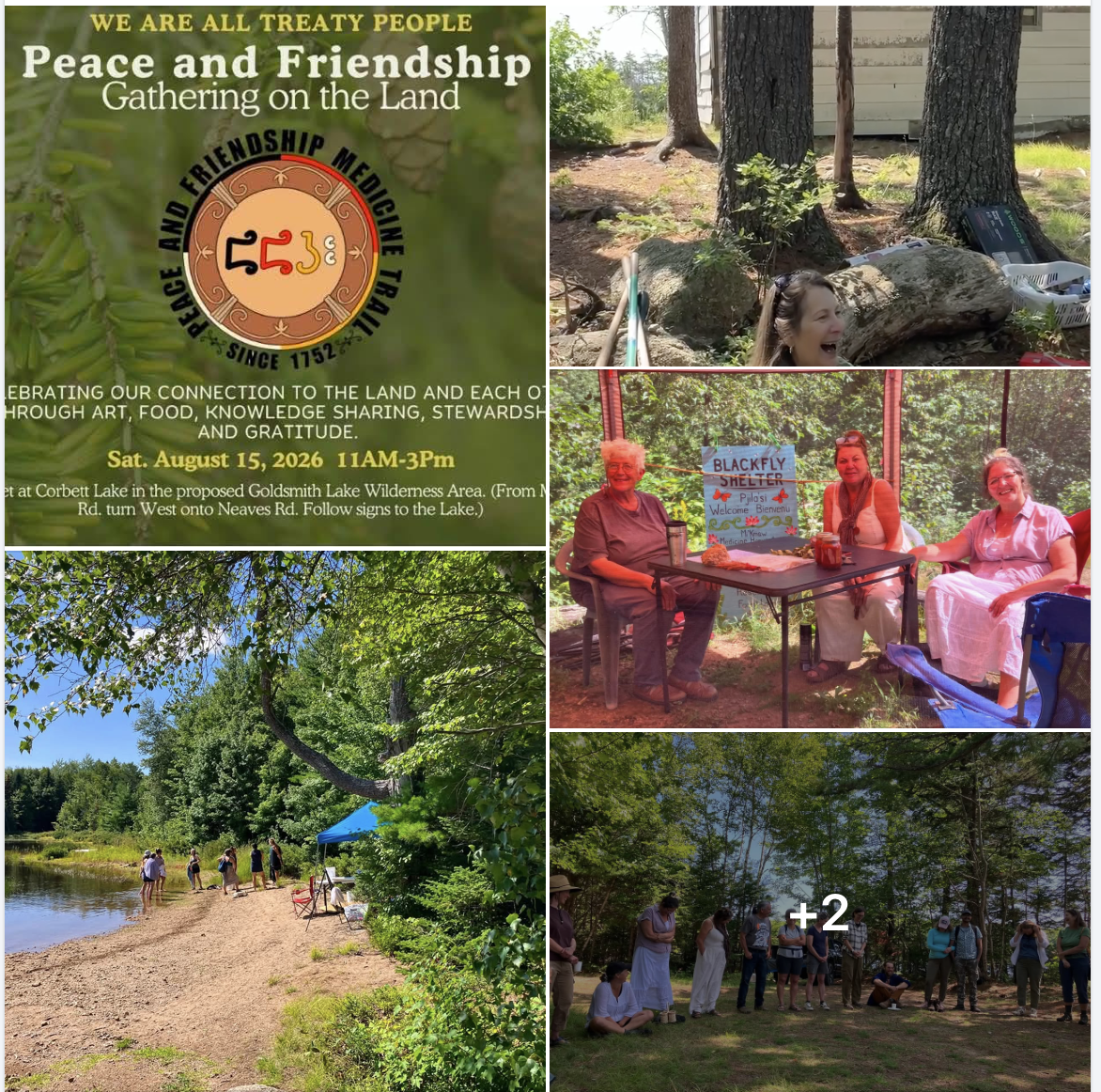
On Saturday, on the shore of Corbett Lake, within the proposed Goldsmith Lake Wilderness Area and a few hundred meters from Camp NOW, 31 people gathered for a Peace and Friendship Medicine Trail event. Erin Todd and Rhonda O’Grady took the lead in organizing the event, with help from Angelika Waldow. Cruzer Meuse from L’sitkuk (Bear River) First Nation smudged everyone. Lorne Julien from Millbrook First Nation brought some of his own paintings and canvas and paints for others to use right where the water from the lake lapped on the shore. Rob Bright from SOOF brought enough chili and bannock for all. We had spruce and white pine tea and Sumac lemonade.
Rhonda summoned the group back together after the meal with a wolf howl so magnificent the coyotes whose tracks I used to see in the snow must have been looking at each other going, ‘What the hell?”
Cheryl Maloney and her friend Francine Pierro, another Mi’kmaw matriarch, appeared at just the right moment for Cheryl to introduce the group to the Peace and Friendship Medicine Trail. She spoke of what is happening in different parts of the province as Mi’kmaw matriarchs and artists come together with settlers on the land, all with the goal of meeting the responsibilities we share under the Peace and Friendship Treaties: responsibilities to steward the land and the water and to uphold the Treaties. An eagle circled for a while as Cheryl spoke. We sat in the shade of several large pines. Cruzer’s daughter darted about like a dragonfly in the circle. The circle felt calm, receptive. It felt like exactly the right place to be.
‘What do you see if we get this right?’
‘I see people living well in their place, part of circles of care. We live in well-connected communities, and although we own fewer things, they are ethically sourced, maintained, and repaired. We are rich in our relationships with each other and all our non-human relations. We understand we are part of the land.’
Camp Now – Day 245
Nina Newimgtom, August 11, 2026
 The climate and nature catastrophe that is bearing down on us is the direct result of an economic system rooted in a particular idea, the idea that we humans are separate from nature and can own, extract from, and abuse the Earth, as we wish.
Can we change our collective mind?
‘We are not alone, we’re not supreme, and we have responsibilities,’ said Robert McFarlane on CBC Radio’s ‘Ideas’ this evening. The episode, ‘How the Anthropocene is Changing the Elements – and Us’, was originally aired on Oct 9, 2024.
He spoke of ‘the disenchantment of water.’ The way instrumentalism – treating the earth as something that exists for us to use – has reduced everything to extraction, consumption, disposal. A dead world.
He spoke of the need for ‘A counter-desecration phrasebook’ and quoted Robin Wall Kimmerer’s call for ‘Grammars of animism.’
He talked with delight about recent moves to grant legal personhood to rivers. He has begun to say ‘Rivers who…’ instead of ‘Rivers that…’
Language matters. Languages matter. We are losing languages in the same way that we are losing species. Macfarlane quotes Wade Davis: ‘Every language is an old-growth forest of the mind.’ It is appropriate that, in the most recent budget, our provincial government, with its exclusive dedication to resource extraction, tried to slash funding for Mi’kmaw language programs.
I learned recently that Gaelic, like Mi’kmaw, is a verb-based language. English, by contrast is noun-based. In verb-based languages, everything exists in relationship to everything else. Noun-based languages tend to see objects, defined by their separation from all the other objects.
‘What would be the expected system of a worldview arising from a realization of the deep interconnectedness of all life?’ That’s a question Jeremy Lent poses in his new book, ‘Ecocivilization: making a world that works for all.’
Jeremy Lent is from Britain originally, as am I. Traces remain there of older land-based cultures rooted in the understanding of interconnectedness, especially among those who still speak Welsh and Gaelic, but nothing compared to the riches to be found in Canada. In spite of the sustained, genocidal efforts of colonial powers, mainly Britain, First Nations across Turtle Island have survived and succeeded in preserving cultures, ceremonies and, essentially, their languages.
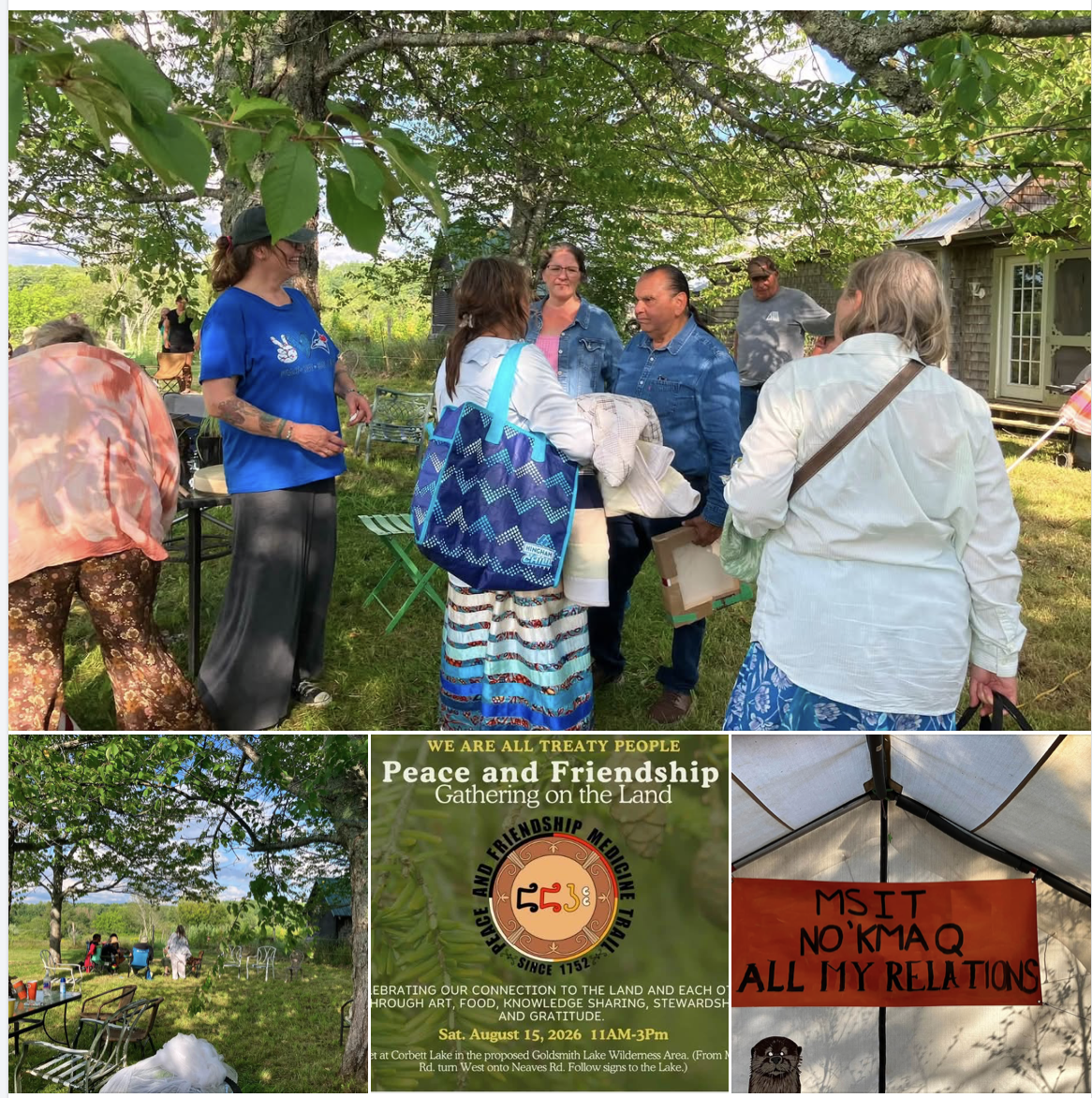
Those of us settlers here in Mi’kma’ki who are trying to imagine what a system rooted in the understanding that we are a part of nature might look like are being graciously invited to learn by L’nu, the original people of this land. The Peace and Friendship Treaties call for all of us to care for the lands and waters. Last weekend saw a beautiful gathering of 30 or so people, L’nu and settlers together, on private land in Hants County, land which is now part of the Peace and Friendship Medicine Trail. We learned some history, ate and laughed together, hugged in a Ceremony of Reconciliation.
This coming Saturday, August 15, from 11-3, there will be another Peace and Friendship Medicine Trail event, this time on the shore of Corbett Lake, a few hundred meters past the Camp NOW Blackfly Shelter. The plan? To celebrate ‘our connection to the land and each other through art, food, knowledge sharing, stewardship and gratitude.’
If you’re looking for some hope, come and join us.
As Sadie Beaton put it in Episode 5 of Stephanie Domet’s podcast, Culture is Critical, ‘I believe that the Peace and Friendship Treaties are a blueprint that can show us a way of relating to each other and the land, to our ancestors and descendants, to the lands and waters, in all these different directions. It’s a blueprint that we already have.(…) A big piece of it too is about building relationships and maybe that’s a beginning baby step. Lots of people are meeting each other differently for the first time, learning what we might be able to do together.’
Camp NOW –
Nina Newington, August 3, 2026
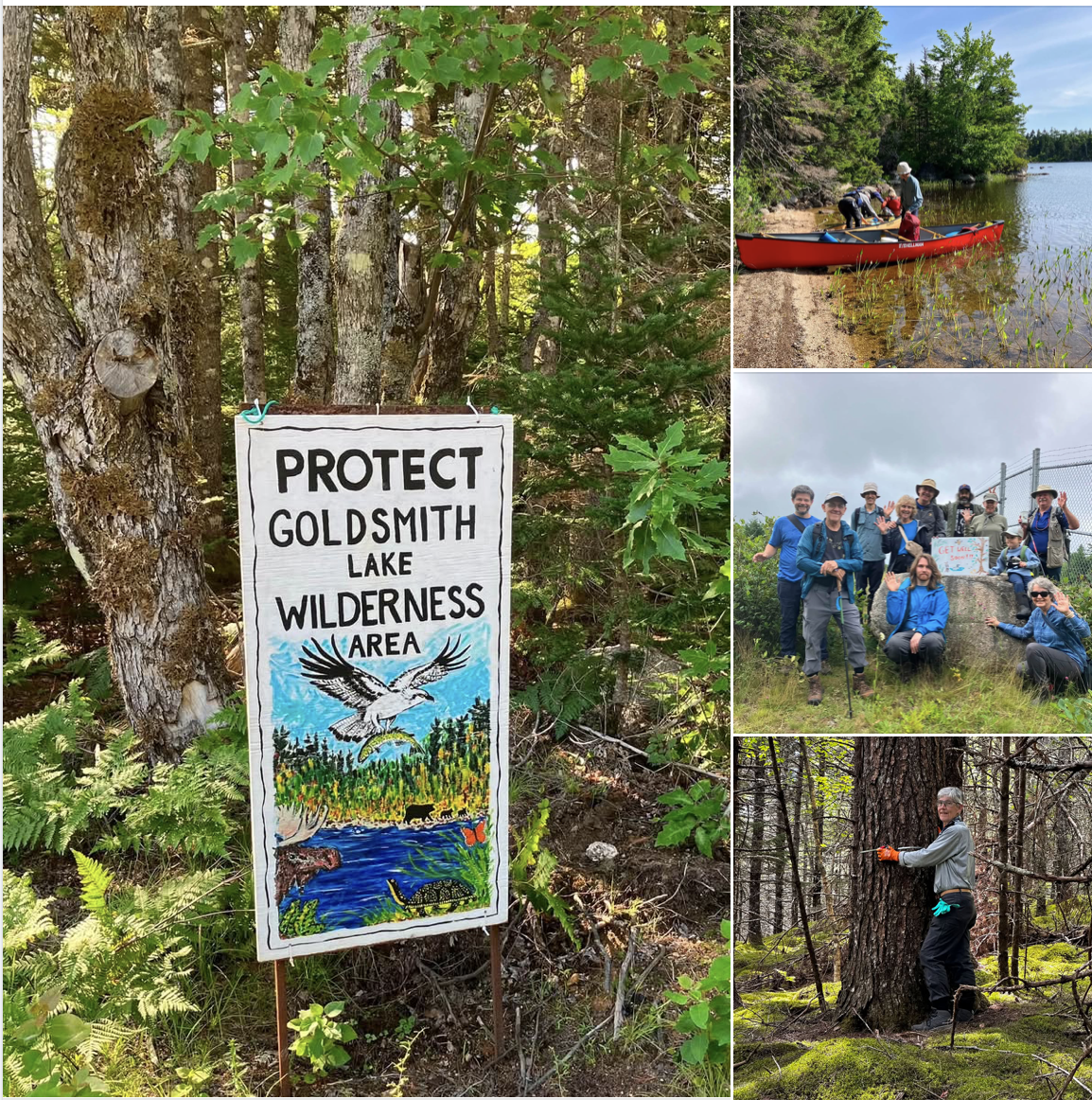 It was a busy week in the (proposed) Goldsmith Lake Wilderness Area. On Wednesday we wrapped up a two-year project, treating the hemlocks in old growth forest on the Goldsmith Lake peninsula. We found some Hemlock Wooly Adelgid (HWA) last year when we were out measuring and marking the trees, but the drought meant the trees were not in active enough growth for effective treatment. Fortunately, the trees were still in very good shape this year. The treatment has bought them 5 plus years, during which time the hope is that biological controls (a beetle and a fly) will get established and control the population of this invasive Adelgid. Both the beetle, Laricobius nigrinus, Lari for short, and the silver fly are from BC where HWA is native. The only thing they eat is HWA. Lari was introduced in the eastern US in 2008 and in Nova Scotia in 2023. The fly is still being studied.
On Saturday, Keith Egger (mushroom guy) and Scott Digweed (bug guy) led a guided hike in old forest close to Camp Now. The hike was part of the Protected Areas Week organized by Nature Nova Scotia and the Ecology Action Centre. By all accounts people had a great time. I had planned to be there, making sure no-one got left behind. I was looking forward to it, having missed Scott’s bug workshop last month. Instead, I was in the ER in Kentville, getting some tests done. Everything is fine and everyone working there was great. I am deeply grateful to the Canadian medical system. But I had an experience in the ER that left me thinking. When I first arrived, I sat across from a room with a closed door. From inside that room, I heard a woman calling “Help” periodically, and “Get me out of here.” I glanced around. Nobody was paying attention. After a while I ignored the calls too.
I found myself thinking later, that’s what we’re doing with the Earth. We’re ignoring her cries, occupied with our own emergencies. And we have a story we can tell ourselves which lets us ignore those cries. Somebody knows. Somebody is in charge. So the cries don’t prompt us to act as they might if we heard them on a dark city street, or even from behind the door of a house. Perhaps too we’re not alarmed enough to act because the distress of the earth is to be expected. The cost of doing business. Extracting resources for profit.
Only now it is getting hard to ignore. Every day I look at the headlines, the Earth is screaming. People are screaming. 700,000 displaced by floods in India. 330,000 forced from their homes in France and Spain by wildfires. Fires in BC driven by 115 km/h winds. How bad does it have to get for us to sound the alarm? Are we waiting for the staff in the Emergency Room? The security personnel at the door? For somebody, for God’s sake, somebody in charge. Somebody responsible.
Well, it’s not happening. I thought it would be Carney. But no. According to Carney we can’t afford to cut emissions. Now I am the one screaming in that room. No-one is coming to save us.
Back in 1979, US President Jimmy Carter gave a speech known as the Grand Malaise. This morning I came across this passage:
“We are at a turning point in our history. There are two paths to choose. One is a path I’ve warned about tonight, the path that leads to fragmentation and self-interest. Down that road lies a mistaken idea of freedom, the right to grasp for ourselves some advantage over others. That path would be one of constant conflict between narrow interests ending in chaos and immobility. It is a certain route to failure.”
The next year Ronald Reagan and Margaret Thatcher were elected, ushering in the era of Neoliberalism where wealth concentrated into fewer and fewer hands, the Market was always right and “Greed is good.” Forty-six years later we are stuck in the “chaos and immobility” that Carter predicted. The current US president, shedding any pretense of decency, fully embodies “the right to grasp for ourselves some advantage over others.”
No one is coming to our rescue. We are the ones who must listen to the Earth’s screams; to the screams of people already crushed by climate catastrophe; to the terrible silence of species gone extinct. It is almost unbearable.
Every morning I thank the Earth, the air, the water. I’m grateful to be alive. I say that I am grateful to be alive at exactly this moment in time. Sometimes it is true. I pray to “the force that through the green fuse drives the flower”. I ask to be useful. I look up at the trees. I’ll do what I can. But it’s not enough.
Greed is not good. It is time to be done with neoliberalism. To be done with an economic system that treats the Earth as something humans are entitled to own and abuse.
The damage can’t be undone, a lot of it anyway. But somehow we must stop making the situation worse.
How do we birth a new system? Start by listening to the wisdom of peoples who know they are not separate from the Earth. People who, in Mi’kmaq Elder Albert Marshall’s words, know that “Nature has rights, humans have responsibilities.”
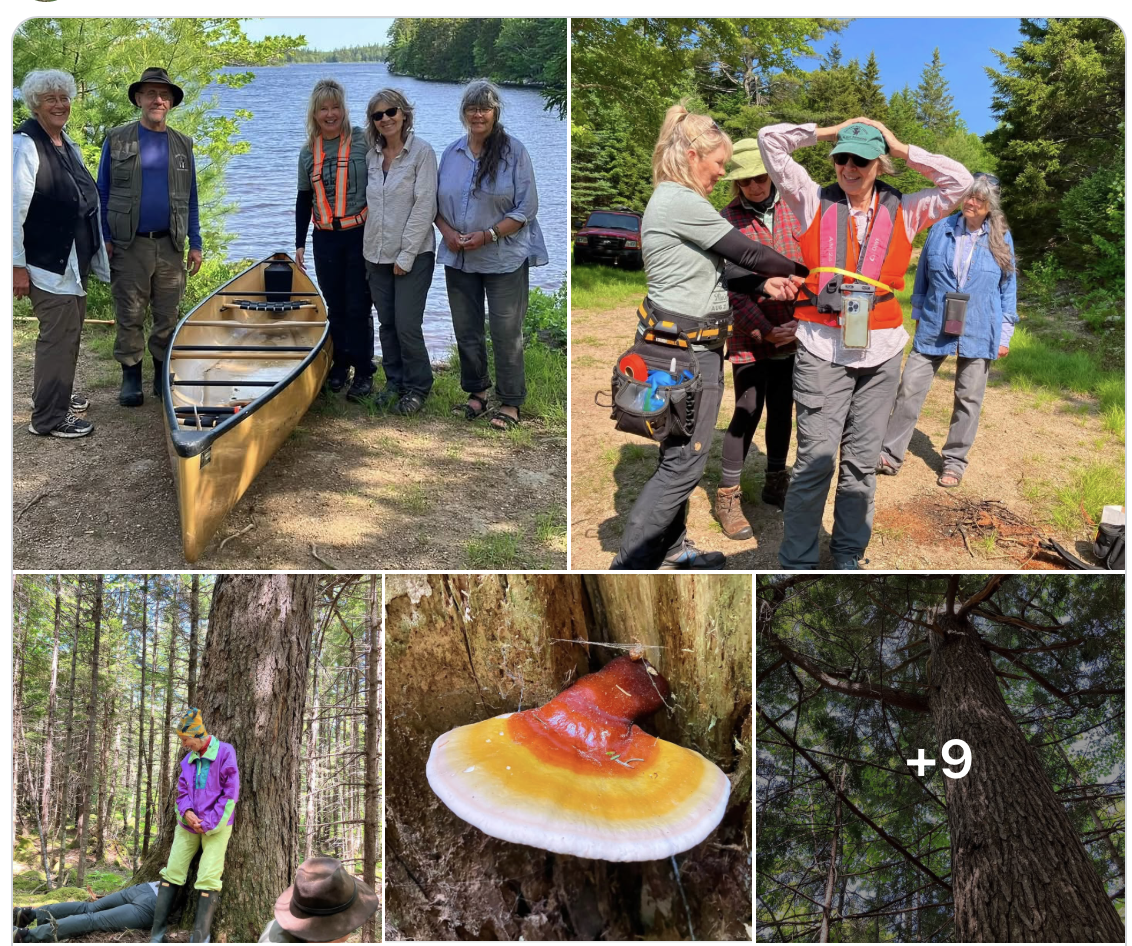 At Camp Now, Aug 1, 2026: Measuring, marking and treating the many magnificent hemlocks in the old growth stands on the peninsula at Goldsmith Lake
by Nina Newington
Big thanks to all the volunteers who came together last year and this year to measure, mark and treat the many magnificent hemlocks in the old growth stands on the peninsula at Goldsmith Lake. Thank you too to the people in the Departments of Environment and Climate Change and Natural Resources who facilitated and authorized this effort.
Last but not least, especially huge thanks to Hemlock Hero extraordinaire, Donna Crossland, who led our teams. She has done more than anyone in our province to buy this ecologically critical species some time.
The struggle is far from over. We need the federal and provincial governments to keep investing in treating hemlocks and developing safe biological controls.
Hemlocks are one of the longest lived trees in the Wabanaki forest. The oldest known tree in the Maritimes — 553 years old — is a hemlock. There are many huge hemlocks on the Goldsmith peninsula, including one that measures 1m in diameter at breast height. The biggest trees are not necessarily the oldest but it’s a safe bet that many of the trees over 70 cm dbh on the peninsula are over 300 years old. The 53 cm hemlock we took a core sample from came in at 276 years old.
In addition to being one of the tree species capable of living a very long time, hemlocks often grow beside streams, low, lacey branches reaching wide, shading the water, keeping it cool for native fish like trout and salmon. Meanwhile their roots protect the banks from erosion. Hemlocks are also better adapted to warming temperatures than many of our other evergreens, notably spruce and fir.
It feels really good to know that all the old growth stands that DNR assessed after we reported them are now permanently protected under the province’s Old Growth Forest policy, and the hemlocks in those stands are safe for now from the invasive Hemlock Wooly Adelgid.
Now to get the rest of the Goldsmith Lake Wilderness Area protected.
Camp NOW – Day 237
Nina Newington, July 25th, 2026
 Thoughts on a beautiful summer’s day.
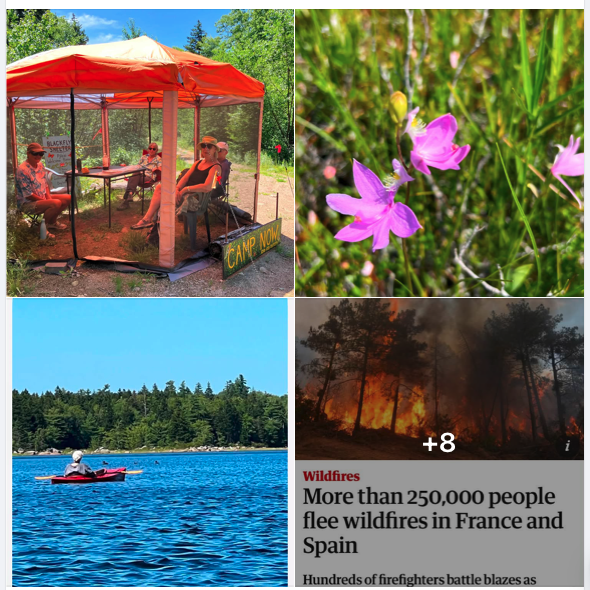
It matters to paddle to the floating bog, exult in orchids, marvel at tiny sundews hiding in plain view, examine the backswept petals of a cranberry blossom. To find the eggs of endangered Monarch butterflies on Swamp Milkweed near the Musquash where endangered salmon smolts swim. It matters to watch a Loon couple, chick between them, floating on the ruffled surface of Corbett Lake. It matters to feel your heart fill with love.
And pain. And fear.
We want to protect what we love. To fail to protect what you love is one of the greatest pains of life. Corbett Lake is only a couple of kilometers away from where last year‘s Long Lake fire raged out-of-control. We had some good rain at Camp NOW on Thursday. But fires are burning all across Canada. Whole communities have been reduced to ashes. Right now, a quarter of a million people are fleeing wildfires in France and in Spain.
“Act as if our house is on fire. Because it is,” said sixteen year old Greta Thunberg, seven years ago.The “adults in the room” – here’s looking at you, Mark Carney — are still not pulling the alarm.
The cost of climate change — in suffering, in impoverishment, desperation, death — is already terrible for humans, and for all of life. It’s going to get worse. The question is how much worse, and when can we stop making it even worse? Nature is powerful and resilient. Life will continue without us. Life will continue without millions and millions of species, but surely we can do better than that.
I believe the seeds for transforming our ecocidal, suicidal system already exist. They are stored in the seed bank of human cultures, primarily in the languages and ceremonies and traditions of Indigenous peoples around the world. They are alive in the minds of people living now.
“It is easier to imagine the end of the world than to imagine the end of capitalism.” That’s largely true for those of us who live inside a system that has colonized our minds as surely as it has colonized the lands and waters. But there has always been resistance. There have always been artists. There have always been rebels. There have always been “crazy people” and “deviants” and quiet, stubborn people who found ways to live on their own terms.
Now our house is on fire. The Earth. Our only home. It’s going to get worse. How much worse depends on us. Because governments like ours are not pulling the alarm.
What does resistance look like?
Well, some of it looks like paddling on a lake with friends on a summer’s day, seeing what’s there and loving it and talking about it and working to protect it and sharing it with other people and reminding people that they too love places, people, other beings that need protection. We can be motivated by love.
We can be motivated by anger too, when we see what we love threatened, harmed, treated as insignificant, as collateral damage.
There is no reasonable doubt now that climate change is happening, that nature loss is devastating, that we are endangering ourselves and every living being by continuing to burn fossil fuels, by continuing to take whatever we want from the Earth. The question now is what am I going to do about it? What are you going to do about it? Most importantly, what are WE going do about it?
Nobody can do everything. Everybody can do something.
At times I feel a strange stillness in the midst of all the disasters. As if we’re waiting for something — someone? – to bring us together. To get us moving. But avalanches begin with tiny slippages. None of us knows the effects of our little acts of resistance. Precisely because of that, it’s essential that we act. That we do what we can, each one of us.
What does resistance look like to you? I’m especially interested in how we come together to resist the destruction of what we love. Can we start a conversation?
Camp Now – Day 218
Nina Newington, July 6, 2026
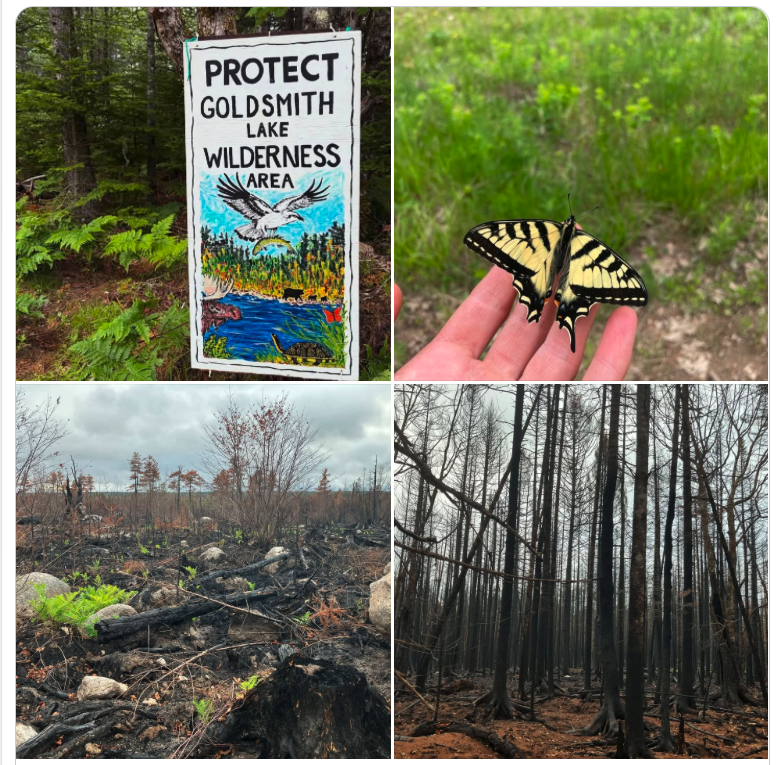 It’s been unusually hot recently. Record breaking. Last year was unusually dry. Record breaking. The fire that burned right up to the boundary of the proposed Goldsmith Lake Wilderness Area burned so intensely it consumed the forest soil, exposing rocks that gleam white as teeth in what used to be forest.
There is no usual anymore. Weather is weirding as a result of climate change. Climate is destabilizing as a result of emissions from burning fossil fuels. But the day before Canada Day our Prime Minister put out a video announcing that our climate targets were ‘too expensive’. So we’re going for higher emissions.
How did the fossil fuel industry end up calling the shots? Can forests survive if wealthy societies like ours refuse to slash our emissions?
Climate change can happen too quickly for ecosystems to adapt. How do you protect a forest?
I spent a lot of time the last few days writing to Mark Carney. Too much time. I set in motion making an appointment with my MP too.
I don’t for a minute think it is enough to meet with elected officials, let alone calling and writing to them. I think it is good to do those things but we need to do far, far more. No one thing is going to turn the ship. If we save ourselves and the living planet, it will require transformation. Social, economic, spiritual. By which I mean a transformation in how we relate to the rest of nature and to other humans. We can each work towards that change. Tzeporah Berman’s work is inspiring. So is Jason Hickel’s ‘Less is More.’ Currently I’m reading Leanne Betasamosake Simpson’s ‘Theory of Water’ and Jeremy Lent’s ‘Ecocivilization: making a world that works for all.’
All I know right now is to find other people doing what makes sense to you and do it with them. I read somewhere that we need people to:
— work to limit the damage
— imagine where we want to go
— create alternatives now
Nobody can do everything. We can all do something.
Camp NOW – Day 203
 Nina Newington, June 21, 2026
Happy Summer Solstice!
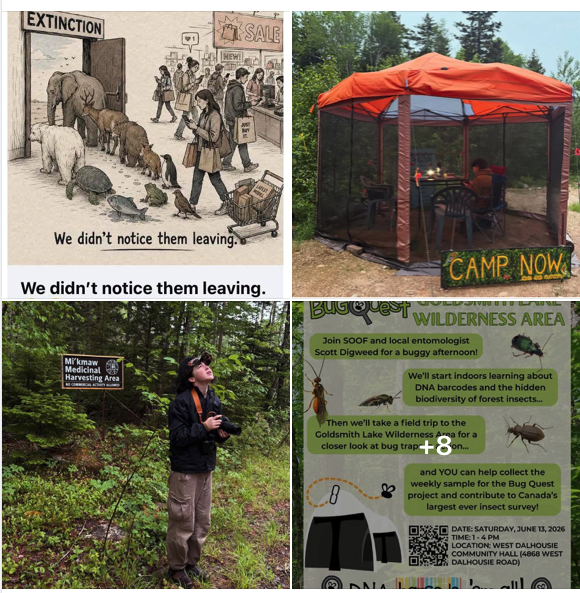
Someone sent me this extinction cartoon the other day. The cold fingers of despair brushed my neck, but then I thought no. In our small patch of this beautiful world, we are not ignoring what’s happening at all. The Camp NOW Blackfly Shelter is getting a workout.
We’re protecting habitat for endangered mammals — the Marten and the Mainland Moose — and identifying species at risk birds on the Corbett peninsula — Canada Warbler, Chimney Swift, Eastern Wood Peewee, Evening Grosbeak and Olive-sided Flycatcher this spring. But it goes beyond the animals. Beyond lichens too. People are studying the fungi and the insects in the old forests here. In addition to the weekly Bug Quest check, Entomologist Scott Digweed is in and out collecting insects. Mycologist Keith Egger is also using modern DNA barcoding to identify the fungi found here. And the team studying post-fire fungi on the Long Lake site are monitoring a control site here.
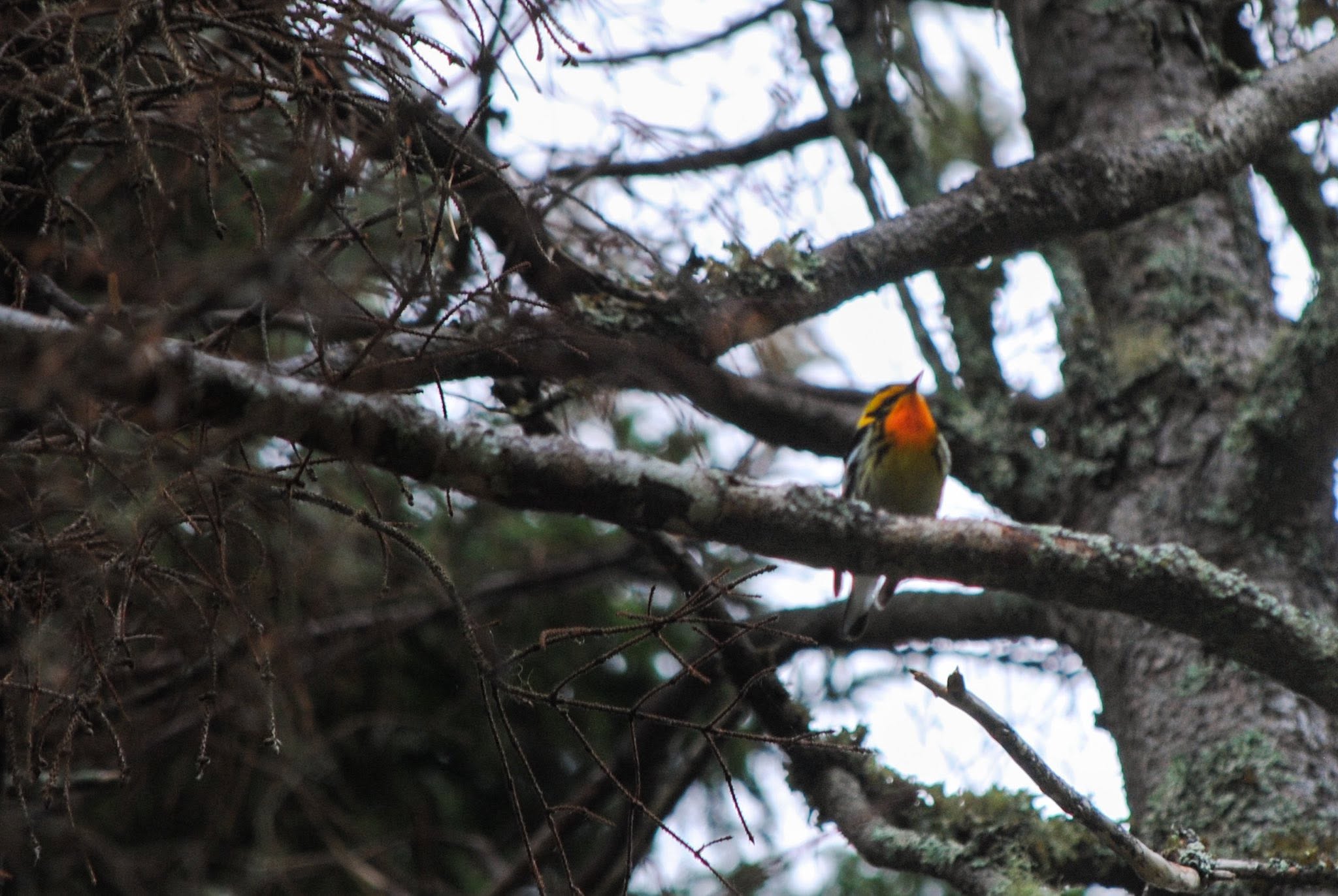
Blackburnian Warbler
Photo credit Ace
Lane
Documenting the variety of life matters. Even with a government that dismantled the Wildlife Division of DNR and fired the Manager of Biodiversity, it matters. No species exists in isolation, including our own. We are embedded in a web of staggering complexity. We know so little, and understand less.
It matters that so many people are involved, and in such different ways. Here’s a shout out to the Goldsmith Guardians who come and paddle around Corbett Lake for the sheer pleasure of it, and to the others who come and sit in the tent for a few hours, reading and listening to the birds.
We look after the forest and the forest looks after us. Msit No’kmaq
Camp NOW – Day 193
 Nina Newington, June 11, 2026
Good news. Birds are nesting undisturbed on the Corbett peninsula and in the rest of the Goldsmith Lake Wilderness Area.
Goldsmith Guardians are monitoring the area. The Blackfly (and Mosquito) Shelter is getting good use.
Birders are birding. A survey yesterday morning observed 44 species –157 individuals — including 2 species at risk Olive-sided Flycatchers plus an American Goshawk. https://ebird.org/checklist/S355560257
Last year’s tally for the peninsula was 37 species – 124 individuals — with 2 species at risk Eastern Wood Peewee. That was on June 23rd. https://ebird.org/checklist/S253641955
Thank you, David Colville and Andrew Bates.
The Birdweather PUC has recorded an endangered Canada Warbler on the peninsula this spring, along with many other birds.
Trailcams are set up too.
Thank you, Karen Achenbach, Lisa Proulx and Bev Wigney for tackling tech and installing and collecting and downloading, oh my!
As ever, we will report all the species at risk to DNR, even though the Manager of Biodiversity was fired along with the head of the Wildlife Division, and the division itself was disbanded. DNR is still keeping track, they say. We also send all species at risk information to the Atlantic Canada Conservation Data Centre. And we’ll add them to our map of the proposed Goldsmith Lake Wilderness Area.
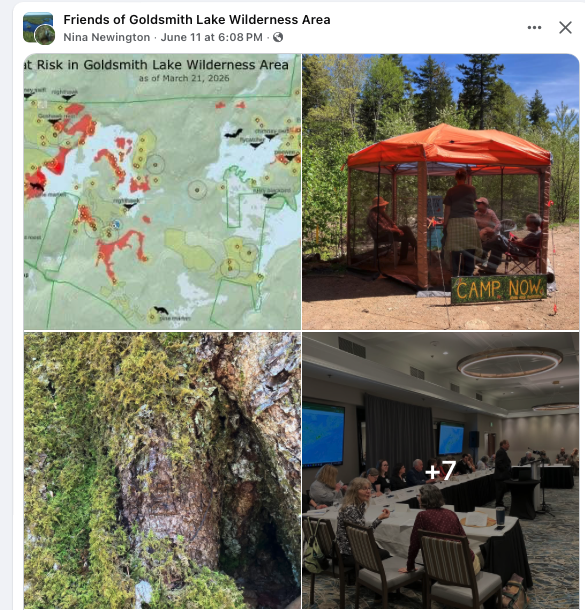
Which brings me to yesterday’s event at the Westin Hotel in Halifax, a press conference marking the launch of an interactive map of all the community-proposed protected area in the province.
Personally, I’d rather be camped on a logging road in a snowstorm than drive into the city for a press conference. The instruction to wear ‘business or business casual’ cast fear into my scruffy heart. At least one other person in the car had to look up ‘business casual’. Four of us carpooled in from Annapolis County. We weren’t alone in heeding the Ecology Action Centre’s call for a show of solidarity. There were reps from 55 different organizations in that hotel conference room. People came from Inverness to Yarmouth, from Cumberland and Pictou to Queens and Lunenberg Counties. We came because we share the same frustration. The government claims it is till committed to protecting 20% by 2030, but where’s the action?
Six reps got to speak, briefly. (It was a press conference, not a conference…) Here’s most of what I said on behalf of SOOF and, by extension, the other community groups who have been working for years to make the case for protecting specific areas.
“Back in 2021 it looked as if this government was committed to (addressing climate change and nature loss together). Since then, although we’ve had Fiona, floods, droughts, wildfires, the government has done less than nothing to protect nature. Miniscule gains in adding new areas are offset by threats to existing parks and protected areas.
The Collaborative Protected Areas Strategy, when it came out in 2023, included the results of a public consultation. People said they wanted “urgent action, a collaborative approach, and a transparent process.” That’s still what we want. What we have gotten instead is a brick wall.
But we haven’t given up. I’ll speak from my experience as part of Save Our Old Forests and as one of the Citizen Scientists of Southwest Nova Scotia who originally proposed the Goldsmith Lake Wilderness Area for protection. I know that community groups working to protect areas of Crown land all around the province have come up against the same wall.
The Collaborative Protected Areas Strategy lays out good, science-based criteria for identifying areas to protect. Our group of volunteers has gathered so much evidence for the conservation value of Goldsmith it’s getting ridiculous. 138 species at risk occurrences. 33 stands of old growth recognized by DNR. American Marten. Black Ash. Endangered Atlantic salmon smolts in the river fed by Goldsmith Lake.
Every step of the way we have tried to collaborate with the government. We are not even asking them to approve the area for protection. We are asking them to evaluate it. The process already exists for doing this. We have strong public support. Letters from Annapolis County Council, from the towns of Middleton and Annapolis Royal. But the government won’t even commit to evaluating the area for protection. And yet they keep assuring the public that they are not going back on their commitment to protect 20%. What exactly are they planning on protecting, if they won’t even look at an area like Goldsmith?”
That question haunts me. Expect trickery.
Back to the hotel.
After the speakers, there was a press scrum. Donna Crossland, speaking for the Healthy Forest Coalition, had introduced the new interactive map, a map that allows one to see where areas have been approved for harvest within proposed protected areas. Https/nspubliclands.ca.
(NB, the harvest plans approved for the Corbett peninsula are not visible on DNR’s Harvest Plan Map Viewer, so they don’t show up here, even though Freedom of Information requests make it clear that the approvals exist and WestFor still plans to cut on the peninsula.)
In her interviews after the conference, Donna (who, yes, was once a teacher) commented, “Premier Houston is almost like that child you had in school that was making good grades, and now, suddenly … their grades are going down and they’ve fallen in with the wrong crowd.”
Keeping with the teacher theme, she addressed the rather tired charge that environmental groups have put the No in Nova Scotia. “We prefer to say the No should be K-N-O-W – knowledge, knowing first.
“Mines can come and go. Forestry industries come and go. But we still need clean water and clean air and wildlife habitat.”
What brought representatives from 55 different organizations to a hotel room on a beautiful June morning when we could have been out listening to the birds is acute frustration. This is the worst government for nature in the memory of people who have been working to protect our home for many more years than I have. Ray Plourde, EAC’s Senior Wilderness Coordinator and MC of the yesterday’s event, has been at it for 8, maybe 9 governments.
It’s hard not to just rail at the sheer stupidity of pretending we can have an economy, or human health for that matter, without healthy natural systems. It matters to come together. To keep speaking for nature.
Mi’kmaw Elder Dr. Albert D. Marshall had been scheduled to come and speak at the press conference. At the last minute he was unable to make it. But I found myself thinking of his words in a video from a few months ago. They accompany drone footage of massive clearcutting on Hunter’s Mountain: “Our inherent responsibility is to be the eye, the ear, and the voice for those that cannot defend themselves…. Our number one responsibility is to ensure our natural world is loved, appreciated and protected.”
Msit No’kmaq
Camp NOW – Day 180
Nina Newington, May 29, 2026
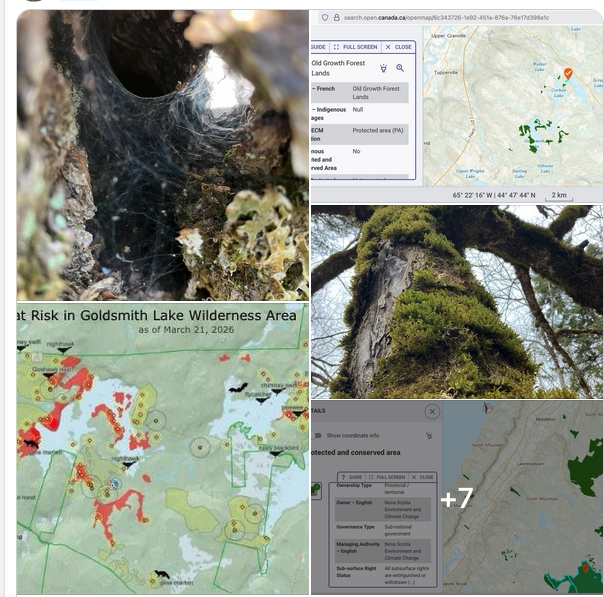 On Wednesday the provincial government announced that they are adding 836 ha to Nova Scotia’s Protected Areas, plus they are opening public consultation on protecting another 1,946 ha.
This is good news but it is not very good news. It is good news for the people who raised the money to buy an island on Lambs Lake, near the existing Lambs Lake Nature Reserve and the popular Mickey Hill Provincial Park in Annapolis County.
It took an extraordinarily long time for the province to accept the gift these good people were trying to give the people of Nova Scotia. Now at last the addition of the one hectare island to our Protected Areas is up for comment. Please write in and support this and the other 12 areas up for comment by July 28.
The not good news is that yesterday’s announcement represents miniscule progress. IF all 13 areas that are now up for consultation are permanently protected, the total protected area added by this announcement – 2,782 ha – will move the dial from the current 14.55% to (wait for it) 14.6%. In other words, we still won’t have met the 15% interim target the province agreed to reach by the end of March. As in two months ago.
The semi-good news is that Houston and co have clearly read the recent polls. Including the one that shows that two-thirds of Nova Scotians want to see more areas protected. The government continues to claim that it will meet the target of protecting 20% of our lands and waters by 2030. The now-former Minister of Natural Resources, Kim Masland, recently assured concerned citizens that she was ‘confident’ they would meet that target.
The question is how?
I wish I could say that the government has announced it is opening consultations on community proposed wilderness areas like Chain Lakes, Ingram River and Goldsmith Lake. For a little while last spring, letters to several constituents from our MLA here in Annapolis County, David Bowlby, suggested that Goldsmith was being formally evaluated for protection and the proposal would be open for public consultation. We were elated. But then the spokesperson for the PC caucus announced that MLA Bowlby had made a mistake. The area was not being formally evaluated. There would be no public consultation.
A year on, with 33 stands of old growth forest now recognized by DNR and a current tally of 138 species at risk occurrences confirmed, the question remains, ‘Why not?’
It may come as news to some of you that, in April, the Houston government did add 148 hectares of the proposed Goldsmith Lake Wilderness Area to the Canadian Protected and Conserved Area Database (CPCAD). You can check it out for yourself.
This Wednesday’s announcement about protecting 2,800 ha was typical for this government: a tiny commitment of land announced with lots of fanfare. April’s announcement of the addition of over 40,000 hectares to Protected Areas – an addition that got us from 13.77% to 14.55% — on the other hand, was low key and, it turns out, inaccurate.
Back then, Minister Halman did not announce any specific areas that had been protected, nor did he announce any public consultations for areas that were being evaluated for permanent protection as Wilderness Areas or Nature Reserves. Instead, he said the areas being added to the tally of protected areas fell under the heading “Other Effective Conservation Measures” (OECMs). This is a far sketchier category, one that, if the forestry industry gets its way, can include any area where they can’t log. Wet areas, steep slopes, stream buffers.
Oddly enough though, when you check the federal map that shows all the protected areas in Canada, it appears that these new additions to Nova Scotia’s Protected Areas weren’t in fact added as OECMs. They are all classed as Protected Areas. Halman, perhaps, had confused himself. Or maybe the staff who briefed him were confused. In any case, a good proportion of the 40,000+ ha in Nova Scotia that had just been counted as Protected Areas were stands that DNR had included in its Old Growth Forest Policy for Nova Scotia.
But just how protected are forests covered by our Old Growth Forest Policy?
Stands where DNR or its contractors have gone out into the forest and determined that the stands in question meet the criteria for old growth have substantial enough protection under the Old Growth Forest Policy to really qualify as being protected, in the sense that neither DNR staff nor the Minister can just decide to make them available for development or logging after all.
But that is not true for two other categories of forest covered under the policy. There are stands covered by the Old Growth Forest Policy that have never been formally assessed. They appear on the provincial map as “Status Undetermined”.
There are also stands classed as “Old Growth Restoration Opportunities.” These can include young recovering clear-cuts with no pretensions to being old growth. Neither of these two categories has any serious protection under the Old Growth Policy. In spite of this fact, they have been added to the inventory of Protected Areas. They can be used to meet the Protected Areas target even though they are not really protected. On the Canadian Protected and Conserved Area Database map, no distinction is made between these different categories of Old Growth Policy protected forest. They all appear as “Old Growth Forest Lands”.
Of the 34 stands within the proposed Goldsmith Lake Wilderness Area that are covered by Nova Scotia’s Old Growth Policy, 33 have actually been assessed as old growth. As DNR puts it on the Provincial Landscape Map Viewer, “Stand has been confirmed as old growth forest using DNR assessment protocol”. The other one, a 4 ha stand of 43 year old spruce we never asked DNR to assess, shows: “Confirmed as a restoration opportunity using DNR assessment protocol and other data”. So 144 ha of the 148 ha added to the Canadian Protected and Conserved Area Database is really protected. 144 ha of the 3900 ha proposed Goldsmith Lake Wilderness Area. It’s a start.
Except there’s another wrinkle, one which I only spotted while writing this post. On the Canadian Protected and Conserved Area Database map, the Subsurface Rights Status for areas of Nova Scotia that have been formally protected as Wilderness Areas or Provincial Parks is consistently given as “All subsurface rights are extinguished or withdrawn (…)” The Subsurface Rights Status for “Old Growth Forest Lands”, on the other hand, states “Surface access may occur (…)” There is no mention of subsurface rights.
Just how protected are old-growth forests that have been assessed as old growth and added to our provincial Protected Areas? What does “Surface access may occur” mean?
What about subsurface rights? Are they ‘extinguished or withdrawn’ when areas are added to the provincial list of Protected Areas? If not, why not? When does protected actually mean protected?
It’s going to take some digging to answer these questions. It’s time for a break in the woods to visit the shivering wildflowers and listen to the valiant birds. The forest goes about its forest business, absorbing carbon, making food and sharing it with the myriad lifeforms that make up the incredible, gorgeous world we live in. Lots of species are devious but I am quite certain that humans are the only species that produces the mounds of bureaucratic obfuscation we just waded through.
We are also the only species that is busy destroying forests at scale and rendering the planet unlivable. But not all human societies are as crazy as ours. We need to create a saner system inside the stinking wreckage of our current system. And on the way, we need to save what we can.
If that means plumbing the depths of Old Growth Forest Policy, so be it. The Chimney Swifts and the bats need the big old yellow birch. The martens need the old spruce. The salmon and the trout need the cold streams and the pure, deep lakes. The forests need our help and we need them
Camp NOW — Day 175
Nina Newington, May 24, 2026
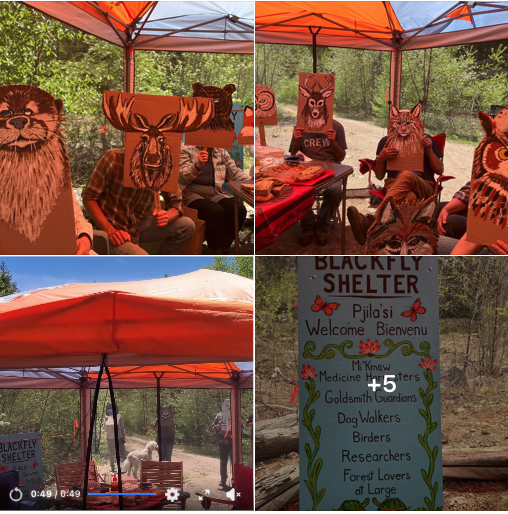 After a festive lunch, the animals decamped. Headed into the woods for a while. But they’re still watching.
We’ve scaled back Camp Now for nesting season but don’t worry, we’re not going away.
In fact we have lots of plans.
You can help to protect this area by coming out to enjoy the birds, swim in Corbett Lake, kayak to the floating bog. Or just come and sit in the Camp NOW Blackfly (and mosquito) Shelter. Enjoy the company of the trees without ponying up too much blood.
Make your ‘work’ a little more formal by joining the Goldsmith Guardians. Details to follow.
And save August 15th. More on what’s happening then in a few weeks.
Camp NOW – Day 171
Nina Newington, May 19, 2026
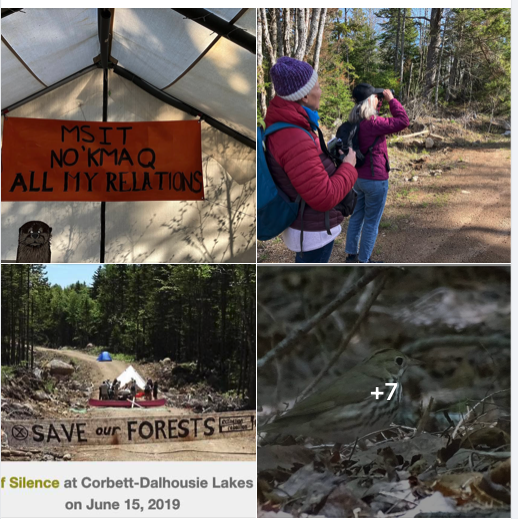 “It would be inevitable that nests are destroyed” if harvesting during nesting season went ahead, Marcus Zwicker admitted on CBC‘s Information Morning on June 12, 2019. The general manager of WestFor at the time, Zwicker was answering questions about the logging that was supposed to have started on the peninsula between Corbett and Dalhousie Lakes. A handful of us were in the way, camped out on the logging road into the peninsula, close to where Camp NOW is currently set up.
I remember waking up in my tent the first morning, ears thrumming with the dawn chorus. I lay and listened, marveling, but then, soon, I was thinking about birds returning to familiar forest from their long migrations, only to find their nesting grounds cut. It felt good to be there, on that logging road, doing what I could, and even better when the birders began to arrive. They recorded the presence of endangered chimney swifts — bats too — and, day after day, they combed the woods for nests.
Why nests? Because there is a law against harming nesting birds, their nests, their eggs and fledglings. The Migratory Bird Convention Act has been on the books since 1917. It covers many non-migratory birds, as well as the migratory ones. This law, an international convention, has only been patchily enforced, but it is on the books. Any company with a genuine claim to be doing ecological forestry stays out of the woods during the peak nesting season (roughly May 21 to July 21 for Nova Scotia). Why? Because, as Marcus Zwicker said, “it would be inevitable that nests are destroyed” if harvesting is done during nesting season.
Earlier in the interview, when asked whether WestFor could delay the harvest till after nesting season, Zwicker replied that they could and did change the harvesting schedule for snowmobiles but not for birds. A couple of years later, when I met with Stephen McNeil, who was my MLA as well as the premier back then, he commented that it was not the birds that stopped the cut at Corbett, “it was that interview.”
The Minister of Lands and Forests (as DNR was called then), Iain Rankin, refused a request by Annapolis County to put a freeze on logging the peninsula, but a few days later — two days after the CBC interview, to be precise — he reversed course and placed a temporary hold while species art risk concerns were investigated.
Freedom of Information requests show that the hold that was put on logging the Corbett peninsula stayed in place till September 2024. Then, under sustained pressure from WestFor, it was formally lifted by the Minister of Natural Resources, Tory Rushton. Harvest plans were approved, then amended to reflect multiple species at risk lichen occurrences reported by citizen scientists, as well as the three stands of old growth forest that DNR somehow decided existed in spite of years of vigourous denial. The revised plans were approved in March 2025. Fresh flagging went up, marking the largest cut block on the peninsula, in November.
Will WestFor’s contractor try to cut this nesting season? My best guess is they won’t. Last April, responding to a constituent outraged by the logging taking place in a different part of the proposed Goldsmith Lake Wilderness Area, our MLA, David Bowlby, assured her that:
« All operations adhere to federal migratory bird regulations, including seasonal restrictions to avoid nesting periods. »
A month or so later, in response to a direct question on Facebook as to whether the harvesting would stop for nesting season, the contractor, Josh Morse, said yes. By May 25th the logging equipment had been removed.
It’s possible that the contractors are more tuned to their legal obligations, public sentiment and perhaps even the needs of wildlife, than WestFor. Back in 2019, CTV reported that Stephen Saunders, the contractor at the time, stated “logging at Corbett-Dalhousie Lakes would not be starting until later in the summer and that they follow strict guidelines”. Marcus Zwicker, on the other hand, hastened to say that the delay was related to weather, not to concerns about nesting birds. You wouldn’t want to set an inconvenient precedent by following the law.
As for DNR, with the Wildlife Division disbanded and the Manager of Biodiversity, Dr. Donna Hurlburt, fired, it falls on us, the public, to stand up for the birds. Sorry to do this to you but please, picture a tiny Ovenbird clinging to her nest on the forest floor, unwilling to abandon her babies, as the massive metal tracks of the harvester come closer. The operator will never know what he has done but the destruction is entirely predictable. WestFor knows this. DNR knows it. It is “inevitable that nests are destroyed” if harvesting takes place during nesting season.
DNR and WestFor must also know that the Corbett peninsula will be swarming with birders over the next two months. Save Our Old Forest’s upcoming Birding By Ear workshop filled up weeks ago. Citizen scientists are installing multiple monitoring devices to record the different species of birds that are here. The more people who visit the peninsula the better.
You don’t have to be an expert these days to identify an astonishing array of bird species. Install the free Merlin app on your phone and sally forth, alone or in impromptu birding groups. Save and take screenshots of your sound recording lists and post them on social media with a little note saying you visited the Corbett Peninsula. Share them to the Friends of Goldsmith Lake Facebook group. If you don’t use social media, send the best shots to soof@saveouroldforests.ca
And if you record or photograph any species at risk birds, please let SOOF know asap. Namely: Canada Warbler, Chimney Swift, Common Nighthawk, Eastern Wood Peewee, Evening Grosbeak, Olive Sided Flycatcher, Rusty Blackbird.
Currently the blackflies are serving an all you can eat buffet for the birds. The best time to be out is before about 8:30 AM, but they’ll quiet down soonish. And there is a screen tent at Camp NOW that everyone is welcome to use.
Birders helped to save the forest on the Corbett peninsula seven years ago.
Join us now in protecting this forest for the next seven generations of humans as well as for the birds and all our other relations.
Camp NOW – Day 165
Nina Newington, May 13, 2026
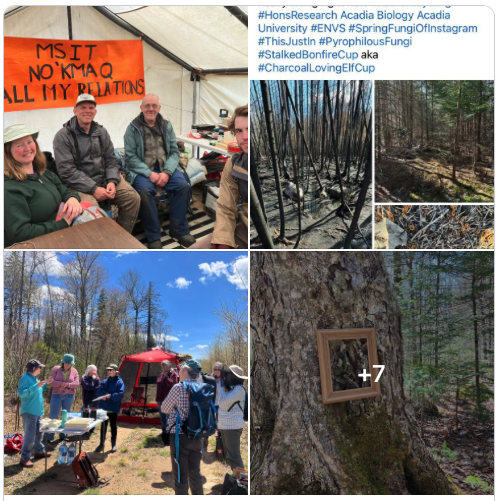 Yesterday a team of fungi researchers stopped in for tea. They’re studying post-fire fungi, had just been out to last year’s Long Lake fire site. The cup fungi that specialize in burned areas were already up, a profusion of orange covering the charred forest floor. Had they been biding their time in the soil or did they grow from spores freshly parachuted in?
The researchers came to the Corbett peninsula to identify an unburned control area. We talked about looking – for specific fungi or lichens – and the brain’s uncanny ability to lock onto a ‘search image.’
But then it’s not so easy to shift your attention. I described how, in the woods west of Goldsmith Lake, in April 2025, I went looking for a Northern Goshawk’s nest in the old growth forest where I had been divebombed by a pair the previous spring. The Goshawks are unusual for hunting inside the forest canopy. They build biggish stick nests about 2/3rds of the way up a tall tree. My eyes kept travelling to the lower trunks of maple and yellow birch, looking for the damage that creates the conditions where tiny Frosted Glass Whisker lichens can grow.
‘Look up,’ I told myself, ‘Look up’, but my eyes wandered downward. It was only when I stopped and closed my eyes and summoned the photograph I had seen of a goshawk nest up in the crotch of a hardwood tree that something changed. I looked at the image in my mind’s eye in detail then opened my eyes and started looking. Two minutes later I saw an odd bulge high up in an old yellow birch. Circling for a better view I saw it was indeed a nest of sticks set between a branch and the main trunk. The birds weren’t back yet but there was the nest.
What you’re looking for shapes what you see.
Marcus Zwicker, General Manager of WestFor back when we first camped on the logging road into the Corbett Peninsula, now General Manager of Freeman Mills, is known for his ability to look at a forest and calculate how many board feet of lumber will come out of it. Or is it metric tonnes of fibre? You get the picture.
Last Sunday SOOF held a lovely event, the Artful Forest, just down the logging road from camp, an event calling for a different kind of looking. Lisa Proulx and I dreamed this one up. Participants took empty picture frames into the forest, accompanied by flute and fiddle. They went, not to learn the names of lichens or tree species, but to see what beauty caught their eyes. Frames were laid around patches of moss, propped to display a bright medley of lichens, hung with pushpins to draw attention to an arrangement of bark.
When people meandered back out to the logging road, artist Bonnie Baker showed us how to capture still life images on photographic paper using the light of the sun and a developer (I think) made of spruce gum. It was magical to watch the images emerge and change and change again. All the while, musicians Karen Achenbach and Carolyn Buck played Irish tunes from inside the screen tent they had wisely brought and set up on the logging road.
Then we went on a short gallery tour in the woods, admiring and retrieving frames.
It was fun, the event. Intentionally unproductive. We advanced neither scientific understanding nor the task of adding species at risk lichens with buffer zones to the map of the peninsula. Art is, at least as it is defined in western culture, intentionally useless. (Otherwise it is craft, but let’s not go down that rabbit hole.)
But art is only useless from the point of view that values forests in board feet and metric tonnes.
Art teaches us how to see. Artists do the work of shedding what we already know, what we expect to see. It takes much less effort to glance at the world through familiar lenses than it does to shed those lenses, those habits of seeing. It’s the job of artists in every genre to let go of what is known – what we already know how to see – and instead come freshly to the world. To see, as much as possible without preconceptions. To allow the unknown to become visible. The unknown may be new, but it can also be ancient. The point is to be open.
The best parallel I know in nature to the role of artists in western society is the role of the eccentric bees in honeybee hives. When a scout bee returns to the hive and dances directions to a nectar source, almost all the bees follow the directions and fly to the apple tree in blossom, or the bramble patch. Whatever it may be. But a few, the eccentric bees, fly off in other directions. Their job is to find sources of nectar that aren’t yet known.
If ever there was a time when we need eccentric bees, this is it.
The huge, extractive system we are in has spread around the planet. It is in the process of destroying our only home. But many of us are so used to being inside this system, to seeing the world according to its operating system, that it is hard to imagine other ways of being. “It is easier to imagine the end of the world than it is to imagine the end of capitalism.” I forget who said that, but I keep coming back to it.
It matters enormously that, here on Turtle Island, and elsewhere around the world, Indigenous peoples have, against dire odds, preserved entirely different ways of seeing the world. Learning about these helps to unsettle our settler vision. But we cannot appropriate our way to a new understanding of our place in the living world. We need artists. Artists in the broadest sense of the word. The people who choose to shed the old habits of seeing, or, often, can’t help but see differently.
And the art they make, in all its different forms, reaches different places in us, wakes us up to possibility. As much as we are straining to see the answers, the way forwards out of this deadly mess, part of the answer may be to let go of those “sight images.” To let go of focused searching. To loosen our vision, pay attention to the margins, the little image that draws us, notes that haunt. That’s the way of the eccentric bee. Don’t go to what we know.
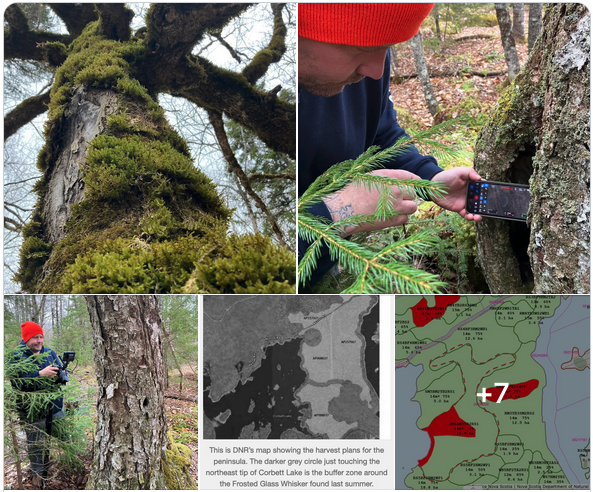 Camp NOW – Day 160
Nina Newington, May 9, 2026
Last week someone who’s making a short documentary about old forests and people working to protect them came out to camp. He ‘d visited before in the dead of winter and again in mud season to do some interviews. This time we went into a stand of old growth forest close to camp, down near the far end of the logging road that bisects the peninsula between Corbett and Dalhousie Lakes.
It was a very short walk into the old growth. We were among matronly yellow birch and red maple, a scatter of red spruce, and, on drier ground, moss-clad beech, wild arms reaching for whatever light makes its way through the forest canopy. The ground was littered with fallen limbs and trunks in varying stages of decay. There were seedlings and maidens, matrons and ancients. “It’s all here,” I said. “Can you feel it, the wholeness?” Zack was nodding, looking. Not filming, just absorbing.
“If I can find it again, do you want to see one of the Frosted Glass Whisker lichens we found here?”
In short order I found the one Lisa Proulx had discovered at the same moment I found another nearby, back in 2024. ‘Woohoo,’ she cried. ‘Found one,’ I called, our voices overlapping. That was a cold day, a week before Christmas. We had just discovered, through a Freedom of Information request, that a long-standing hold had been lifted on logging the peninsula. WestFor was pushing for quick approval, and DNR was in the process of giving WestFor what it wanted.
There were no signs of any old growth forest stands in the harvest approval paperwork, nor any species at risk occurrences other than one Ashlea had found in the summer while checking out forest just north of the peninsula.
Zack came over to where I crouched, shining a light into a cavity near the base of a red maple. Inside, a squadron of pinhead-sized stubble lichen occupied a patch of heartwood, perhaps an inch by an inch. There must have been fifty of them, no more than an eighth of an inch tall, each with a round pinkish head.
He looked into the tree then straightened and looked around.
“It’s not as hard as it seems,” I said, “finding something so small in a forest. You’re looking for habitat first. The right tree species with the right kind of damage somewhere with the right conditions – old forest conditions. Humid, shady, sheltered from wind.” He nodded. “The kind of conditions that are destroyed when they put in a logging road like that.” I pointed out to where we were parked. “Fortunately, the cavity on this tree is low down and facing away from the road in a pretty wet area. Still, this lichen was lucky.”
We went further into the forest, where the forest floor was less stony and the pit and mound pattern was completely visible. The pale dead leaves of beech carpeting the ground somehow made it easier to see the contours. In the distance a pileated woodpecker hammered on a hollow trunk.
When I checked Avenza (a free and very handy mapping app), Zack and I were standing on the boundary of one of the three stands of old growth forest that mysteriously appeared on the map of the peninsula in March 2025, four months after the day Lisa and I found the two Frosted Glass Whiskers. I looked to my left into old growth (official) and to my right into what appeared to me to be old growth (unofficial.)
“I wonder,” I said, “how they decided where the old growth stand ended? It’s quite small, the bit they recognize. Just over 3 hectares. According to DNR maps, it’s part of a much bigger stand. 16.9 ha. The Provincial Landscape Viewer map shows the stand is a mix of classic long-lived tree species: sugar maples, yellow birch, red spruce plus red maples. With a height of 14m. Just where you might find old growth, if you were looking. Back in 2018 they put in that logging road and cut 20 hectares south of where we are now. A partial harvest, not a clearcut, but enough to destroy the old growth characteristics. They were coming back for the rest in 2019. The part we’re standing in now. That’s when we set up camp at the head of this logging road for the first time.”
Zack nods. We stand in the cool spring air, looking around at the forest. “This part,” I wave my left hand, “is protected now. But this part,” we look to the north, “they still plan to cut. It’s full of old yellow birch. Beech. Maple.
“Back in 2023, DNR’s old growth team came out to Goldsmith Lake. They taught a bunch of us citizen scientists how they assess old growth. First thing they said was they go with the stand boundaries they already have on their map of the province. Based on aerial photographs. Each stand has a particular mix of species. The old growth team won’t assess part of a stand. It has to be the whole thing. The assessment is based on computer generated random points within that stand, usually three per stand. Whoever is doing the assessing goes to each of those points, measures, collects data, selects a tree to age — the second biggest tree captured in a prism sweep (google it). Then they average the ages of the trees they sampled. The average age for the stand has to meet a certain threshold. For this hardwood forest it would be 140 years old. It’s all oh so scientific.
“Except then they break their own rules. Why didn’t they assess the whole 16.9ha stand? One answer is they’d already cut part of it by the time local people started shining a light on what was happening here. It’s a good bet that the part they cut would have qualified as old growth. When you look at the map that shows the new old growth stands, there’s a skinny strip stretching south along the shore of Corbett Lake. That’s the 20m buffer they had to leave between the cut and the water. The buffer has now been assessed as old growth. Too late for the rest.
What’s still standing is the northern half of that same stand. And somehow most of it doesn’t qualify as old growth. It makes no sense.”
“So what are they after in here?” Zack asks, resting his hand on a yellow birch.
“Not the hardwoods, as far as I know. Softwoods are the money trees.” We look around. “Like that little knoll that’s almost all spruce. You know, that might be exactly the reason why the official old growth stand ends here. So they can harvest that.” We hike up to it. Find in the middle the remnants of a giant yellow birch, trunk draped across the ground. “They’re probably 40 years old, these spruce. Just what the sawmill ordered.”
Zack got the footage he wanted and headed out. I sat in the tent, drinking coffee, thinking about the disconnect between what it feels like to be in old growth forest and the process by which it is formally assessed by DNR. About the charade of objectivity created by choosing random points in forest that, by its nature, if it is old growth, is as far from uniform as a forest can get. I kept coming back to the image of standing on a boundary that existed only on a map. A boundary that was not rooted in the nature of the forest, and yet a boundary with life and death significance for the forest and its inhabitants.
The next day I headed into Halifax, to catch Dr. Suzanne Simard’s talk and book signing. It was an inspiring evening in the company of 300 people drawn to hear from the woman who has done so much to challenge not just forestry practices but also the underlying assumptions.
This is from Joan Baxter’s interview with Dr. Simard in the Halifax Examiner.
HE: In your book, you write affectionately about many of your Indigenous research partners and your students. One of them once said to you, “There’s the truth that’s Western science, and then there’s truth that is wisdom … What’s the wise way forward?” What is the wise way forward?
SS: We came from Mother Earth, and we needed to be living in balance with Mother Earth. If we provided for Mother Earth, she provided for us. All the food systems, art and culture, governance, were all aligned with how Mother Earth was doing. And that’s a really wise way forward; looking at the whole picture and seeing it’s not just for us. It’s for future generations as well. The Anishinaabe talk about seven generations, looking at the future.
So do the Haudenosaunee. Western culture is about the here and now, and extracting from the land to feed shareholders. There’s no responsibility back to the land. And that’s been supported by Western science, where we do these short-term studies. We come in as the outside objective observer, and do our satellite imagery, not to pick on them at all, but you know we don’t live in the land. We’re not responding in the land. We’re looking on from the outside in
Camp NOW — Day 151
Nina Newington, Apr 29, 2026
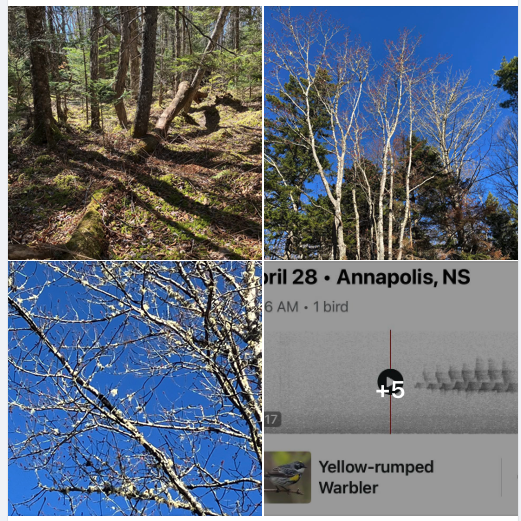 A new bird sang yesterday morning, high up in the red maples. The first flower buds are opening, summoning pollinators. The bird flitted from branch to lichen-tufted branch, blue, blue sky behind. Warbler, I guessed, but it took Merlin to specify yellow-rumped.
It was too cold at dawn for the hermit thrush to sing, but the hardy little Winter wren trilled away. Under the song, though, came a near constant drone. Highway 101. I suppose the sound is always there but masked by wind in the treetops or carried off in another direction. Yesterday was unusually still. Today is too.
It’s been one of the joys of this camp, how rarely one hears the highway. The busyness of transporting people and stuff, the high-pitched rolling of tires on blacktop, the throatier rumble of diesel igniting, all seem blessedly far away. I’d rather relax into the percussion of woodpeckers, the chamber music of wrens. Sometimes I do. But the purpose of Camp NOW is not to escape. It is a place to hold both realities in mind at the same time. The beautiful whole, the extravagant interconnectedness of life, and the deadly simplification of extraction coexist on the side of this logging road.
The forest where I am camped is threatened with logging because we have a premier who appears to have abandoned a commitment to protect 20% of our lands and waters in favour of keeping every inch of crown land available for mining. The Mining Association of Nova Scotia – MANS, aptly enough – has the premier’s ear. MANS vigorously opposes protecting anywhere, arguing that for every 10,000 exploratory holes drilled, only one will become a mine. So nowhere should be off limits. Just in case. It doesn’t matter how strong a case you make for protecting a particular place. The mere possibility of resource extraction trumps everything, according to Houston and co. That is an old story. But it is not the old, old story.
As Robin Wall Kimmerer puts it, ‘Those whom my ancestors called relatives were renamed natural resources.’ She writes then of ‘Replacing the aboriginal idea of land as a revered living being with the colonial understanding of land as a warehouse of natural resources.’
In order to treat the land differently, we have to imagine the land differently. We have to tell a different story. And we’re beginning to.
In her new book, ‘The Beginning Comes After the End,’ Rebecca Solnit writes:
‘The rise of Indigenous influence, the shift in scientific understanding, the return to a view of nature as essential and omnipresent, the move toward more equality and inclusion, brings into focus the change in how we tell the overarching story of the last five hundred years and more. Rather than telling it as the triumph of European and Christian civilization, we increasingly narrate it as one of destruction and division, the result of a worldview driving a society that was tremendously powerful and also tremendously harmful.(…)
‘What if this civilization was not a pinnacle or a conclusion of cultural evolution, as was asserted again and again for centuries, but a detour from a widely shared understanding?’ (p.118 – 119)
How do we move forward then?
‘We are the ancestors of tomorrow,’ said Madonna Thunderhawk, an Indigenous rights activist since the 1960s, ‘so we behave accordingly.’
The birds that return to this forest each year are the ancestors of tomorrow.
Tomorrow. The trucks keep rumbling down the highway towards tomorrow. Towards catastrophic climate change. This is a time for me of increasing desperation, watching a man who understands the climate crisis become Prime Minister, and set about weakening climate legislation and increasing fossil fuel production. I know he’s in a hard place, keeping the country together. Others will point out he’s always been part of the neo-liberal establishment, and no doubt I should’ve been more cynical, but still I find it hard to bear the disappointment.
On the other hand (constitutionally I am an optimist), finally, in coal producing Colombia, right now, 60 countries are gathering — it had been 55 but five more just asked to join — 60 countries are gathering, along with scientists and civil society groups and Indigenous peoples, for the ‘First Conference on Transitioning Away from Fossil Fuels.’ After COP resolutions where fossil fuels weren’t even mentioned, it’s a relief to have an open discussion about how exactly to transition away from them. “The question is not if we phase out fossil fuels,” says Johan Rockstrom, director of the Potsdam Institute for Climate Impact Research. “The only question is: will we be too late?”
Among the many sectors at this conference is a substantial presence of Indigenous peoples who came ‘at the invitation of the Katanzama, a community of the Arhuaco people living near the “Corazon del Mundo” (Heart of the World). To open the conference, the local Indigenous delegation pressed all representatives of all countries to reconnect with that heart, “to reseed it, to regrow it and to reforest our hearts.”’ (Chris Hatch, Canada’s National Observer.)
Tzeporah Berman, also at this conference, writes, ‘The question is no longer should we phase out fossil fuels, but who is ready to lead? History is made by those who show up.’
Across Nova Scotia, people are showing up. In the wake of rallies at the legislature that drew thousands of people, people are keeping up the pressure in opposition to ill-advised budget cuts. On Facebook there are so many well-thought out and researched posts critiquing this government’s extractivist projects, it’s hard to choose what to repost. Hundreds of people showed up for, and called out, fake consultations around fracking. The Assembly of Mi’kmaw Chiefs has unanimously refused to accept fracking on these unceded lands. Mi’kmaw water protectors and settler residents are challenging the siting of gas plants in Pictou County, and the Municipal Council voted to ask the province for a new review process, one that would be open to non-fossil fuel technology options.
Simply typing this list is cheering.
Solnit writes, ‘As Jonathan Shell once wrote of how revolutions unfold in the imagination first, “Individual hearts and minds change; those who have changed become aware of one another; still others are emboldened, in a contagion of boldness; the “impossible“ becomes possible; immediately it is done, surprising the actors almost as much as their opponents, and suddenly, almost with the swiftness of thought – whose transformation has in fact set the whole process in motion – the old regime, a moment ago so impressive, vanishes like a mirage.” Not always. But sometimes.’ (p.27)
Climate change won’t vanish like a mirage. Nor will nature loss. But a contagion of boldness has come upon us here in Nova Scotia. Time to reforest our hearts.
Camp NOW — Day 145
Nina Newimgton. Apr 23, 2026
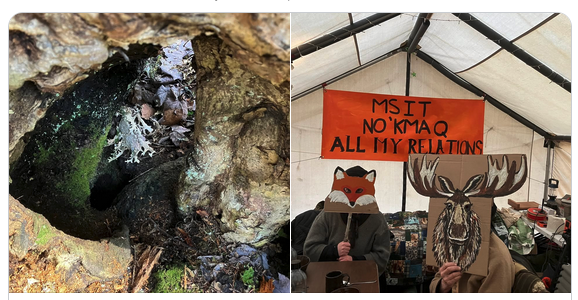 The day after Earth Day.
One of the joys of camp is waking to birdsong, only it’s been too cold the last few mornings. The hermit thrush has abandoned melodious courtship in favour of a single harsh note. If it’s this cold now, it might not be warm enough by the time the female is laying her eggs, not warm enough for dinner to be up and about: insects, worms, snails. Better hold off on the mating.
Timing is everything for wild creatures, and I worry more about timing going out of kilter than anything as the climate changes. I fear for the beings I love and the ones I know nothing about. I fear for the intricate, gorgeous web, the synchronized sprouting and hatching, the precision of caterpillars, plants and birds. It feels to me as if the capitalist system, based on extraction, greed and the delusion of infinite growth, is taking a sledgehammer to the foundations of life. The whole delicate edifice shudders as the sledge is swung again and again.
And what is the sledgehammer? There are a few. The fossil fuel industry wields the biggest. Burning fossil fuels is heating the planet at a pace far beyond the capacity of natural systems to adapt.
These chilly days of April are within the normal range of climate variability. The hermit thrush will sing again when the mornings warm up, but I am left with that grim image of intentional destruction. No doubt the two hours I spent on Tuesday in the Subsurface Energy R&D Investment Program’s Virtual Open House, being misinformed by the province about the benefits and safety of fracking, have something to do with this.
To listen to Kim Doane, the province’s Executive Director of Energy Resource Development, you would think that no one had ever questioned the portrayal of methane as a benign transitional fuel. But then our Premier/Energy Minister is so oblivious to the severe danger posed by methane — a gas that is 84 times more effective than CO2 at trapping heat within our atmosphere — that he has bragged that we have enough methane to burn for 200 years.
I went to sleep for half an hour after that two-hour virtual meeting. It felt more like passing out. (Yes, the cold that’s been going around finally got me.) I woke up thinking about fracking. Hydraulic fracturing. The actual process: drilling holes into the ground and ramming them full of water and chemicals and sand for the purpose of cracking the surrounding bedrock, forcing the release of what is sometimes called ‘tight gas.’
This ramming of sand and water into holes in the earth is done with such force it routinely triggers earthquakes.
Fracking was described in such chirpy words in that Virtual Open House — opportunity opportunity opportunity — but what we are talking about is the acme of extraction and greed. A brutal process that is, by design, repeated as long as there is gas worth taking because here is the thing nobody talked about. In a conventional oil or gas well, you drill down into an underground pool of oil or gas and poke the equivalent of a straw down into that pool so you can suck the oil or gas up to the surface. Fracking, on the other hand, is a method of releasing gas trapped in the pores and veins of rock. There’s no reservoir to draw on.
A fracked well yields the most gas on its first day. Production is all downhill from there. Some wells can be fracked again to release more gas from the bedrock. But sooner rather than later the old well is abandoned and a new well is drilled nearby. More roads, more concrete well pads. The original well, we were assured, will be plugged. With more concrete. Fracking industrializes a landscape in short order.
The energy from the sun is freely given. It has powered life on this planet for millions of years. This energy is harvested every day by plants. Instead of going to violent lengths to extract the fossilized form of that energy, we now have affordable ways to harvest solar energy ourselves. And we have ways to store that energy so that it is available when the sun doesn’t shine.
No mining is kind to the Earth. Certainly not the mining for copper or bauxite or lithium or rare earth minerals that we need to get off burning fossil fuels, but at least what you mine is durable. It is used for a long time and can be recycled. Whereas methane, you mine it, you burn it, it’s gone. Then you do it all over again. There’s no end to the assault on the earth, and no end to the planet-heating emissions.
Sitting at camp, listening to the ticking of something between rain and snow on the tent, I think about leaves. The astonishing power of trillions of leaves just doing what they do, harvesting the sun and the air, making the food that fuels every living being.
We have choices to make, collectively, individually. This is a somber moment. It can be a turning point.
I came across these statements in a post by a woman unknown to me, Sarah Steed.
‘You don’t need malice to cause harm at scale. You just need a structure that decides from the top whose testimony counts as real.’
‘Harm doesn’t stop if it doesn’t have to. It just needs blindness that is passed down through a structure that decides whose pain is worth counting.’
Whose pain is worth counting?
The longer I spend at Camp NOW, sleeping each night under a banner that reads ‘Msit No’kmaq All my Relations’, the deeper my commitment to speaking for those who can’t speak for themselves.
Yesterday was Earth Day. Today is Earth Day. I’m grateful to be part of this beautiful whole. I’m happy to do what I can each day. I’m honoured to learn a different way from the original guardians of this land. And I am so glad to see how many people, Mi’kmaq and settlers alike, are speaking out against the Premier’s fracking agenda. There is a better way. We’re choosing it.
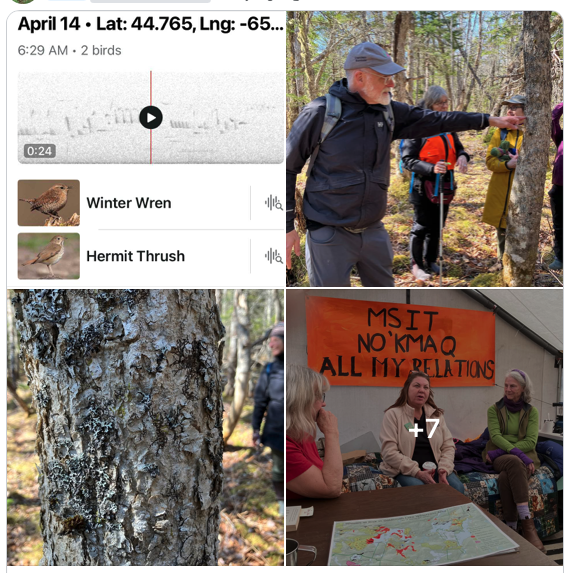 Camp NOW — Day 137
Nina Newimgton, Apr 16, 2026
My last post was Day 140. And now we’re at Day 137. Although it does feel as if the government is turning back the clock on environmental progress, this was really just bad maths earlier in the month.
Now that the wrinkle in time has been ironed out, spring is accelerating. Barred owls call, night and day. A Hermit thrush has arrived and greets the dawn. Winter wren is singing too. Joy in the tent, lying in bag while the canvas overhead brightens, listening. Listening, and then recording on Merlin for the pleasure of the songs’ tracks across the page. Well, screen. The hermit thrush’s song is a series of extended notes, a simple, melodious set of steps, but the wren’s song is baroque. Or perhaps late Gothic. A 15th century pillar carved by a stonemason who knows that he will not live long enough to see the cathedral completed. At the top of the pillar, he carves details of daily life — faces, birds, plants. Beings loved and known.
Why am I lying in a tent at dawn thinking about mediaeval stonemasons? About detail, intricacy, the Winter wren’s song. About attention and its rewards. The fluency of a mason carving, not copying from nature, but knowing in muscle and bone the form of a frog, a beak, a leaf.
On Sunday morning, some citizen scientists headed into the swamp near Mickey Hill Provincial Park to learn more about identifying Black Ash. Wisqoq, as it is known in Mi’kmaw, is an endangered species, long valued by Mi’kmaw basket makers. The teaching began with where not to look: dry land, wetland with only softwoods, fast moving streams, places with no white ash.
You have to choose where to look because the search will be slow. Very slow. You’ll be scanning every tree trunk, identifying the known in order to notice the unknown. Finding no mysteries, you move on three or four steps and repeat. Unless you have all the time in the world, and an afterlife, you can only slow down that much in the most promising spots. So first you find those. Swamp or the toe of a slope. White ash. Cinnamon fern.
You’re looking for the tree you don’t recognize. At least, that’s what you do at the beginning.
It does help though to have seen a Black ash or two in person. To spend time absorbing the presence of the tree, not because that will be enough for a convincing identification but because it helps to enlist the subconscious. You still have to go through the checklist, and it’s tricky with Black ash, especially when it’s not in leaf. But you’re also meeting the whole being, not just its bark — flaky — nor its buds – ‘white is tight, black is slack’, meaning that in black ash there’s a little gap between the last bud on the twig and the two buds that come next. (Usually.) The more time I spend in the woods, the more potent and mysterious it becomes, this meeting the whole being of a tree, which you can only do with your whole being.
With practice (and a reminder card in your pocket), the brain retains the details, but it has other powers too, notably pattern recognition. Anyone who picks berries knows how your eyes begin to find them. I enter a delightful sort of trance when I’m berry-picking, the trance that has led so many children — and especially girls — in stories to wander on and on until they are lost deep in the woods where they quite often encounter a magical being.
On this particular Sunday, there was no getting lost in the woods for me. I made the acquaintance of the first black ash our teacher brought us to, then headed out to meet Cheryl Maloney and her sister April in Bridgetown. They were coming to the Corbett peninsula for a second visit to connect with Mi’kmaw medicinal plants growing in these forests, notably the grandmother Yellow birches.
Along with their friend Sue and Joan who was visiting camp, we walked into old forest a couple of hundred metres down the logging road. I took an unfamiliar route in and met a very old beech, moss covered as they often are, but far taller than usual. Most of the beech in Nova Scotia have been stunted by the bark blight that arrived in Halifax via European beech Queen Victoria presented to the Public Gardens. The blight spread fast through our forests a century ago. But this beech had clearly grown well up into the forest canopy before the blight stalled out its growth, making it most likely at least 200 years old. For a crown it had the thick right-angled branches typical of old growth. It grew on a mound, as did all the other old trees, pits and mounds patterning the forest floor.
We met huge Yellow birch and little Goldthread, its roots under the forest duff a vivid orange yellow. We didn’t travel far, stopping to greet certain trees and to delight in the leafless forest on a sunny spring day before the emergence of black flies. The forest felt whole, with dead snags and fallen trunks, seedlings and maiden trees and trees in graceful middle-age, as well as the old and the ancient.
“This isn’t recognized as old growth?’ Sue asked in disbelief. It turns out she worked for DNR for many years.
‘No. As a matter of fact, it’s been approved for harvesting.’
‘What on earth would they be cutting in here?’
‘There are a few spruce,’ I said, ‘but really all they can do in here is harm. If they leave it alone it will meet DNR‘s criteria for old growth in a decade or two.’
‘If it doesn’t already,’ said Sue.
‘Looks like a good place for harvesting medicines,’ said Cheryl, looking around.
The day after that visit I came across this quote from Jeremy Lent in a Substack post by Robert Reich, the former US Secretary of Labour under Clinton.
“A civilization built on a different foundation would start from an acknowledgment that the deep interconnectedness of all life is not romantic aspiration but scientific fact — confirmed by complexity science, systems biology, and Earth science, and affirmed by wisdom traditions of cultures that never lost that understanding.
From this recognition, different goals follow: not perpetual growth but setting the conditions for all people to flourish on a regenerated Earth. Not maximization of returns on capital but the kind of reciprocal, mutualistic relationship with living systems that makes long-term human wellbeing possible.
There is no blueprint that will save us. No one person or group can design in advance what such a civilization will look like in its particulars. But a framework of core principles can orient us — the way a distant horizon orients a traveler moving through unmarked terrain.
You may not yet see the exact path, but knowing the general direction changes everything about which opportunities you embrace and which you recognize as alluring detours.
The trance that keeps us from seeing this is powerful. But it has been broken before. Every paradigm that once seemed like reality itself — the divine right of kings, the natural inferiority of women, the Earth at the center of the universe — turned out to be a myth that was shattered.”
It feels to me as if we have just entered a time where great change is possible. A time to pay close attention. To identify promising conditions. To look for the tree you don’t recognize. To let the old myth crumble.
Camp NOW – Day 140
Nina Newington, Apr 8 2026
 After a busy week and a bit, some of the time spent in Halifax — hardly the big smoke but a city nonetheless — it felt good to get back to a simpler rhythm, quiet but for the wind in the treetops and returning birds. Oh, and the news.
The madness, the mayhem, the badness. It’s overwhelming, even with patchy signal.
The small fights matter. The little overreaches of power by a government threatening lifetime bans for people who dared to sing in the legislature. A government instructing RCMP to raid and seize goods from Treaty protected truck houses on unceded land.
But then there’s the man at the head of the world‘s most powerful military, threatening to bomb a civilian population “back to the stone ages.” To wipe out an entire civilization. A man who toys with terror, craves adulation, and knows no limits. He seems utterly aberrant and, at the same time, weirdly apt. In a system that favours people unconstrained by empathy, Trump is the acme. But Trump is just a symptom.
More than ever, I hunger for intellectual clarity, integrated emotion, plain speaking. When I find it, I spend time with it. So I read and reread these paragraphs I found on Facebook. Their starting point is the Windigo, the cannibalistic monster of Anishnaabe storytelling, a creature of infinite hunger.
*The Monster Is the System*
“This metaphor offers a chillingly accurate diagnosis of the dominant system that came to engulf the world. At its heart lies a mode of seeing that objectifies humans and nonhumans alike. Forests become timber reserves. Animals become livestock. Oceans become fisheries. People become labor inputs or human resources. Once the living world is reduced to a stockpile of exploitable assets, moral limits dissolve.
Consider the structural logic of our economy. A corporation that prioritizes its workers’ wellbeing over quarterly returns will find itself outcompeted and eventually eliminated by rivals that don’t. An investor who chooses ecological stewardship over maximum profit will lose out to one who doesn’t. A political leader who proposes genuine limits to growth will be outspent and defeated by interests that profit from the status quo. The individuals change; the behavior persists.
That is the hallmark of a systemic pathology – not aberrant actors, but a structure that produces the same destructive outcomes regardless of who occupies its roles. »
With the best will in the world — and I had the pleasure of working with a very good MLA until the most recent election — politicians can only do a little to restrain such a system. Our current government in Nova Scotia does not have the best will in the world. It is actively and aggressively working to undo the progress made in protecting nature in our province over the last 50 years. There’s a hideous familiarity to the author’s next paragraph:
« This is what I call Windigo Inc.: the institutionalization of insatiable hunger as the organizing principle of our civilization. It isn’t a conspiracy. It doesn’t require villains (though it produces them). It’s a self-reinforcing system that rewards extraction and punishes restraint, that transforms every living thing – forests, aquifers, human relationships, the Earth itself – into resources to be consumed in the pursuit of endless growth. »
I found these paragraphs on the Facebook site Collective Evolution. The author, Jeremy Lent is writing about his upcoming book, ‘Ecocivilization’, publication date May 26.
‘Ecocivilization’ promises to be about the cure as well as the disease. George Monbiot, a Guardian journalist I admire greatly, greatly admires Lent’s work. I’m eager to read the book. In the meantime, I avoid watching videos of missiles blowing up buildings and bridges, videos that make destruction a game and numb the watcher. Instead, I watch again the drone footage of the clearcut carnage visited on Hunters Mountain by Port Hawksbury Paper, the mill that is supposedly using better forestry practices to manage these crown land forests. I cry, seeing the devastation from the air, the skinny buffers along watercourses, the ludicrous moose clumps scattered about vast clearcuts, token acknowledgements of the real needs of the animals whose home this is, or was.
And I listen in the voiceover to the words of Mi’kmaw Elder Doctor Albert D Marshall,
“Our inherent responsibility is to be the eye, the ear, and the voice for those that cannot defend themselves.… Our number one responsibility is to ensure our natural world is loved, appreciated and protected…. Let’s come together and create an alternative that will allow nature to flourish.”
The choice is stark. “Once the living world is reduced to a stockpile of exploitable assets, moral limits dissolve.” The alternative is to care for each other and for the rest of nature, recognizing that we are all part of the beautiful whole. We can begin by changing our minds. By refusing the language of resource extraction. By listening to the wisdom of people who lived on this land for at least 13,000 years without devastating it. But it’s not enough to think and listen and talk. It’s time to speak up. To stand up. To stand with. Shoulder to shoulder.
The link for the Hunters Mountain video:
Link
Camp NOW – Day 131
Nina Newington, Mar 30, 2026
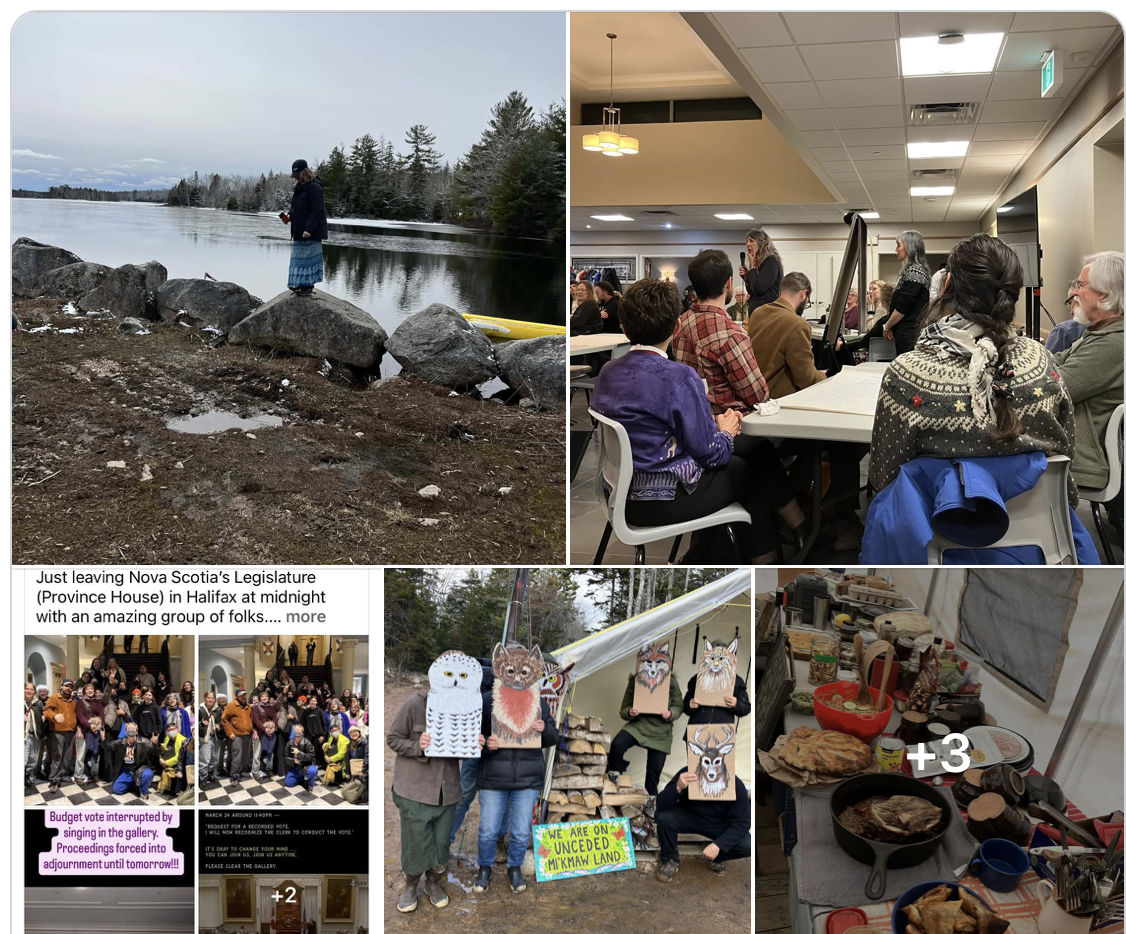 Last night after dark a big truck drove up fast to camp, stopped near the door of the tent. I stepped outside. The driver signaled to a low-slung sedan that had come up behind the truck, and they headed down the dead-end logging track that runs southeast from camp. None of them looked at me. Not long afterwards (no surprise there), they came back out and continued down the ‘main’ road. It seemed the height of idiocy to drive that icy, rocky, muddy road in a low car.
Half an hour later I heard one vehicle come out. They parked a little past camp. I stayed in the tent, heard voices joking around then the vehicle drove off. What about the other one? I imagined it was the car, stuck somewhere down the road, hung up on the big slab of ledge perhaps.
I knew another truck would be coming out, or trying to, because the driver had stopped at camp earlier, on his way in. Then I cheerfully greeted him by his buddy’s name. He was planning on frying up sausages at a camp down the road, for him and his son. So I didn’t feel obliged to go and look for the stuck vehicle. Sure enough, an hour later, I heard repeated revving and a voice saying, “Steady, STEADY.” The big pick-up truck I’d seen go in with the little car emerged and drove off.
The sausage-fryer’s truck stopped for a chat, the driver shaking his head. “I had to tow him out, that big old truck. Had to teach him how to drive.” He talked about how good the sausages were, with fried onion and donair sauce in a wrap. Then he asked how camp was going. We talked about the flagging that went up in November. “They want the big old trees in here. That’s what they want. I love that forest,” he said. “I’m glad you’re doing what you’re doing. I’m on your side.”
Over the years of camping on logging roads, I’ve heard many similar expressions of support. In Digby County, back in 2020, there was a strikingly common refrain from hunters who would stop by camp to check us out and stay for a coffee. They would talk of the woods they grew up in, woods they hunted, woods their fathers and grandfathers hunted. “I knew it like the back of my hand and then one fall I went back and it was gone. They took it all. I got lost. I knew it like the back of my hand and I got lost.”
There was another phrase we heard a lot. “I one hundred percent support you.”
This government seems to assume that guys in pick-up trucks in the woods will automatically support their resource extraction agenda, but from what I’ve seen, that’s not true.
Many of us know instinctively that we’re a part of nature, especially people who grew up with woods and shores to roam. It hurts us to see forests destroyed.
Maybe we know deep down too that we are all connected. It’s a foundational teaching of Christianity after all: “Whatever you do onto the least of these, you do unto me.”
This morning I found myself thinking about all the different ways that we connect. How we touch each other, how we touch the Earth. I felt so grateful it made me cry. The last week or so has been rich in connection, beginning with the Water Ceremony with Mi’kmaw Grandmothers down by Dalhousie Lake. These Ceremonies have taken place everywhere we’ve set up camp over the last 6 years. This time was different for me, the bond to this place deepening.
And then the next day, in the city, in a room across the road from the Legislature, there was Coral Maloney getting ready to present to the Public Bills Committee. She sat down in front of the mike, planted her feet squarely on the floor, as if they were bare, as if the floor were ground. Only then did she open her mouth and sing in Gaelic, a whole beautiful song, about the mountains, about the enduring bonds between people in a particular place. Most of the PC MLAs sat stony faced, but one couldn’t help moving his head in time to the music.
A few minutes later it was my turn to try to connect with those MLAs, with reasoned arguments. The PCs sat, stolid, unswayed it seemed. But I’ve learned these presentations are not a waste of time. Whether or not the bill is changed, the comments go on record. They can be helpful to the opposition MLAs. Perhaps even more importantly, they reach all the people who listen to the committee proceedings — a surprising number. It’s a way we find each other. The effort put into refining one’s argument is part of how we collectively develop our understanding of what is happening politically. It’s not everybody’s gig, but if you can do it, it matters.
The next day I was at the Many versus the Money gathering in the Anglican Cathedral. It was a vigorous mix of 130 or so people, from young to old. I was meant to take part in a panel discussion but really there was just time for us each to talk briefly. To connect, this time emotionally. I wanted to remind people we can do what we love to do. Standing up for the Earth and each other doesn’t have to be penitential. It’s not a terrible sacrifice to let go of a shitty system. We can feel more alive, more connected, working together to change that system.
Next, possibly fueled by a big cup of coffee earlier, I went to the legislature, even though it was 9:30 at night. I sat in the west gallery, a row of fresh-faced students in front of me. Together we sat and listened to the proceedings until, at last, the vote was called for the budget. Then people began to sing, in the east gallery, in the west gallery, a song reaching out to the MLAs below. “It’s OK to change your mind.” Our voices joined and blended under the domed ceiling of the legislature.
Yes, at the end, after it was announced that the vote would be delayed, singing gave way to cheering. A few people shouted. Passion has its ragged edges. But that song, the voices gathering, it touched so many people. People cried, they told me later, hearing the singing begin on the official livestream before it was turned off. “It’s OK to change your mind.” Encouragement not denunciation. Encouragement with a side of humour. It was a wonderful surprise, the singing. I wouldn’t have missed it for the world.
After all that, I got to spend a few days at home, time with my wife and our dogs, the chickens and sheep, snowdrops and crocuses. I got to listen to the wicker of a ewe to her lamb, felt the flick of the lamb’s tail on the back of my leg as we fed the skittish first-time mother morsels of grain to distract her from the unfamiliar sensation of something suckling. Later, friends came and played music around the stove while I packed the cooler.
Back at camp we had a potluck, connecting people from near and far, all of us doing what we can to protect this forest, other forests, our beloved Earth. Several of the people, although they live in the same rural county, met each other in person for the first time. We ate and talked and laughed and strategized, elbow to elbow in the tent.
It was after they all left that the big old truck and the little car drove by camp and down the perilous road. I think about the car that managed to get back out. I imagine they paused to check whether the truck was coming out too but it didn’t, and after a minute they drove off. Perhaps that was the plan. Perhaps they were going to get help. I was glad they didn’t come knocking (or whatever you do to a tent door.) I didn’t want to drive down that road in the dark, let alone in reverse, knowing there would be nowhere to turn around. I probably would have if they’d asked.
Camp NOW – Day 114
Nina Newington, Mar 23, 2026
 What a strange contrast between yesterday and today.
Yesterday, fifteen of us stood beside the waters of Dalhousie Lake in Ceremony. Tears flowed as Dorene Bernard led the Water Ceremony, assisted by Patsy Stephens and Joey Brooks. Hearts were open.
Dorene has come and done Water Ceremonies at all our camps here in Kespukwitk — beside the Caribou River in Digby County and by Beals Brook, Goldsmith Lake and Dalhousie Lake in Annapolis County. We are not alone in our work to protect the lands and waters. L’nu — the people of this land — and the animals, the trees, the ancestors, Mother Earth, settlers who recognize our responsibilities, we are in this together.
The feast afterwards swung between solemn (briefly) and hilarious. There was so much joy in that crowded tent.
Today, well, today I spoke at the Public Bills Committee. I spoke of recommendations and clauses, of trickery and absurdity (though not quite so bluntly.) It felt hard in that flat fluorescent room with the unquestioning government MLAs (bless the opposition ones) to say what matters most: forests are inherently valuable. They cannot be valued by what you extract from them. They are part of the Beautiful Whole, as are we all.
Wonderfully, though, into that room came a woman named Coral. What was her last name? Maloney? She sat, feet firmly planted, and when it was her turn to speak, she sang, in Gaelic. She sang Chi Mi Na Morbheanna by John Cameron (1856).
She sang:
Oh, I see, I see the great mountains
Oh, I see, I see the lofty mountains
Oh, I see, I see the corries
I see the peaks beneath the mists.
One of the PC MLAs was gently swaying by the end.
Here’s the far more prosaic last three paragraphs of my presentation:
‘Forest resources must not be defined solely as resources available to the forestry sector. The value of forests far exceeds the value of the fiber removed from them.
Studies cited in the Nova Scotia government’s own materials estimate the value of ecosystem services of forested land at up to $5,800 per hectare annually, including flood protection, carbon storage, and water filtration. Old, natural forests provide the highest value. The cost of losing these services is felt in every municipal budget.
As anyone who balances their household budget knows, a dollar saved is a dollar earned. Costs avoided must be added to income earned when considering the economic use of forests. Support for active forestry at the expense of other uses of the forest is outdated. It suggests a government that listens to industry lobbyists, not scientists and economists. It certainly indicates a government that has no respect for the deep ecological knowledge of the Mi’kmaq, the traditional guardians of these lands and waters.’
Wela’lioq Dorene and Patsy and Joey.
Camp NOW – Day 111
Nina Newington, Mar 20, 2026
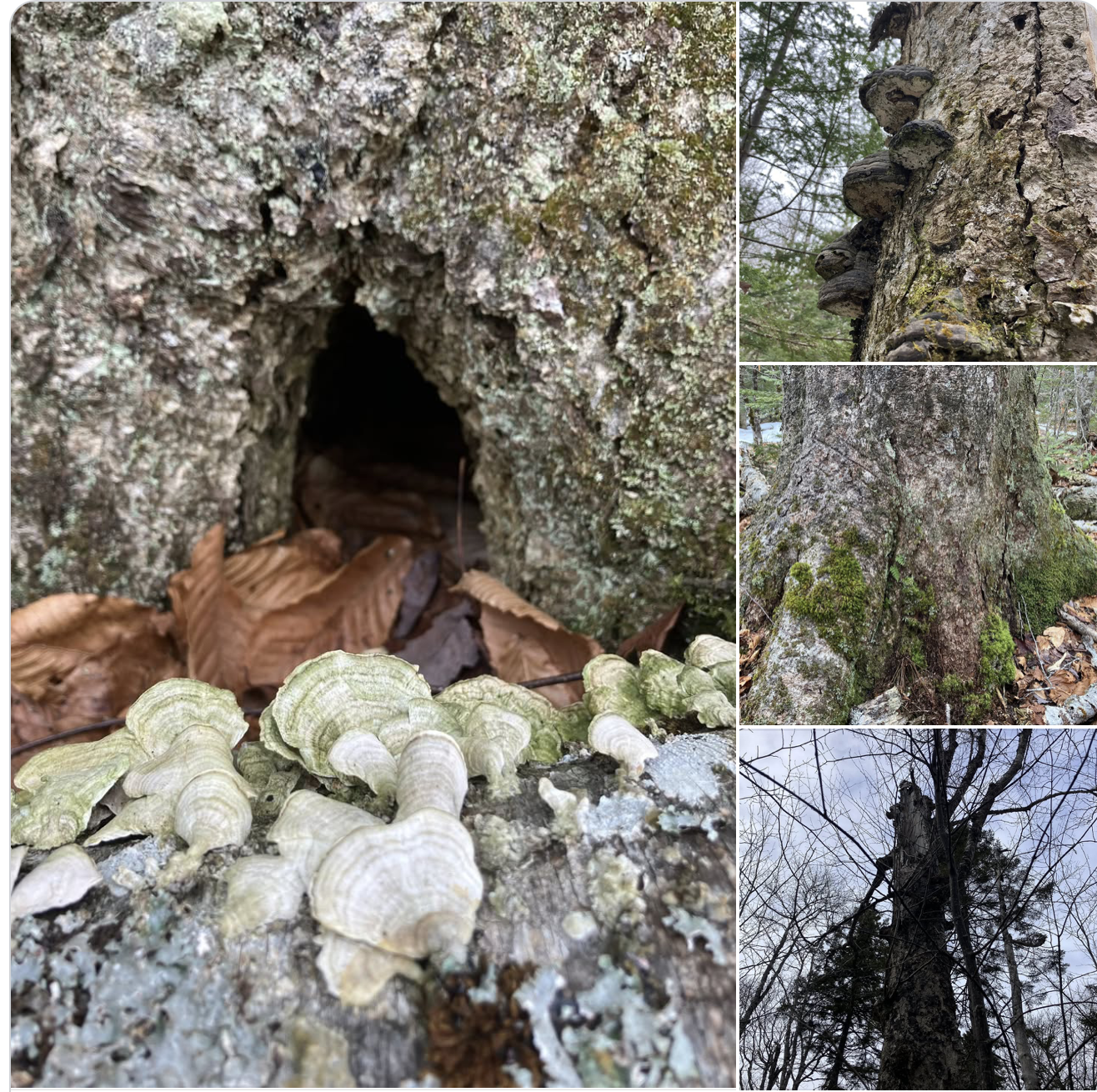
I sat in the tent most of yesterday, whittling down my presentation to the Public Bills Committee next week. What can you pack into 5 minutes? Should you spend any of it pointing out how anti-democratic and disrespectful it is to roll so many unconnected bits and pieces into a bill that is ostensibly about the budget?
Why, for example, include an amendment to the Crown Lands Act that would allow WestFor to get a 10 year license to manage western Crown lands? Under the law as it stands, they have to renew their license every year.
Back when Nova Scotians campaigned – successfully — to Buy Back the Mersey lands from the Bowater-Mersey mill after it went bankrupt in 2012, hopes were high. As William Lahey put it in his Independent Review of Forest Practices in Nova Scotia,
“The acquisition of the Bowater lands by the province created opportunities for a new and more inclusive approach to the management of forested Crown lands in Nova Scotia, one more strongly grounded in community and less exclusively situated in the industrial model of forestry.”
But in 2016 the Liberal government of the day created WestFor, a consortium of mills Lahey describes as “very much an industrial forestry entity”, to manage the Bowater lands and other Crown land in western Nova Scotia. Old-timers who worked for Bowater in the woods have told me that WestFor has been greedier and more ruthless in its practices than Bowater ever was.
What I’ve seen around Goldsmith Lake rather confirms this view. Bowater left old and old growth forest along pretty much the whole west side of the lake. DNR’s maps show the stand details – the heights of the trees and the proportions of different species. Tall old long-lived trees grow all the way to the southwest tip of the lake. Only they don’t. The map is based on 2012 data, the year Bowater went bankrupt. In its first couple of years of operation, WestFor went in and clearcut a big swath of that old, probably old growth forest that Bowater had left alone for the 50 years they owned the land. It haunts me, the thought that the entire western side of beautiful, pristine Goldsmith Lake could have been old-growth forest.
One of the Lahey Report’s 45 recommendations, #36, states: “A land use planning process to be conducted by an independent person or panel should be established for the western Crown lands.”
A land use planning process would identify areas where there should be no forestry, areas whose ecological value is so high they should be left alone. Decisions about where to cut would not be – should not be – left up to a consortium of mills.
Recommendation 36 has not been implemented. There is no independent person or panel looking at the big picture. And there won’t be if this amendment to the Crown Land Act, Clause 56, stays in the Bill and Bill 198 passes. Instead WestFor’s grip on these lands will tighten. Rather than having to renew their license every September, they will get a 10 year license. They will continue to take bites out of the most intact areas of forest left in the province, putting in huge logging roads, fragmenting the best of what’s left.
When they came to power in 2021, this government committed to implementing 44 of Lahey’s 45 recommendations. They now claim to have implemented 95% of them. Meaning they only have two to go. But it’s not true. There are at least 7 they haven’t even started on. Including #36.
In a 5 minute presentation you can’t explain any of that. But you can’t help thinking about it. I can’t anyway. It makes my head hurt. It makes my heart hurt.
So in the afternoon I went for a walk in the woods south of camp. Just a little wander now that the snow is almost gone. In the distance, a pileated woodpecker drummed on a hollow trunk. Look for cavity trees, I reminded myself. They aren’t supposed to cut those. There was a magnificent snag with tinder conks, as I call them, black polypore fungi, sticking out like balconies on an apartment building. And then I saw a huge yellow birch, the top broken off maybe 7 metres up. You could see the trunk was hollow. The tree measures 80 cm in diameter at breast height. Perfect for endangered chimney swifts. Such trees are a rarity.
Forests like this one would not be approved for logging if an independent panel was doing land use planning. If. If. If.
It was time to get back to work.
Today is the Spring Equinox. The first robins showed up at camp two days ago. Whatever else, for however long, this forest is still standing. A place for the birds to return from their long migrations.
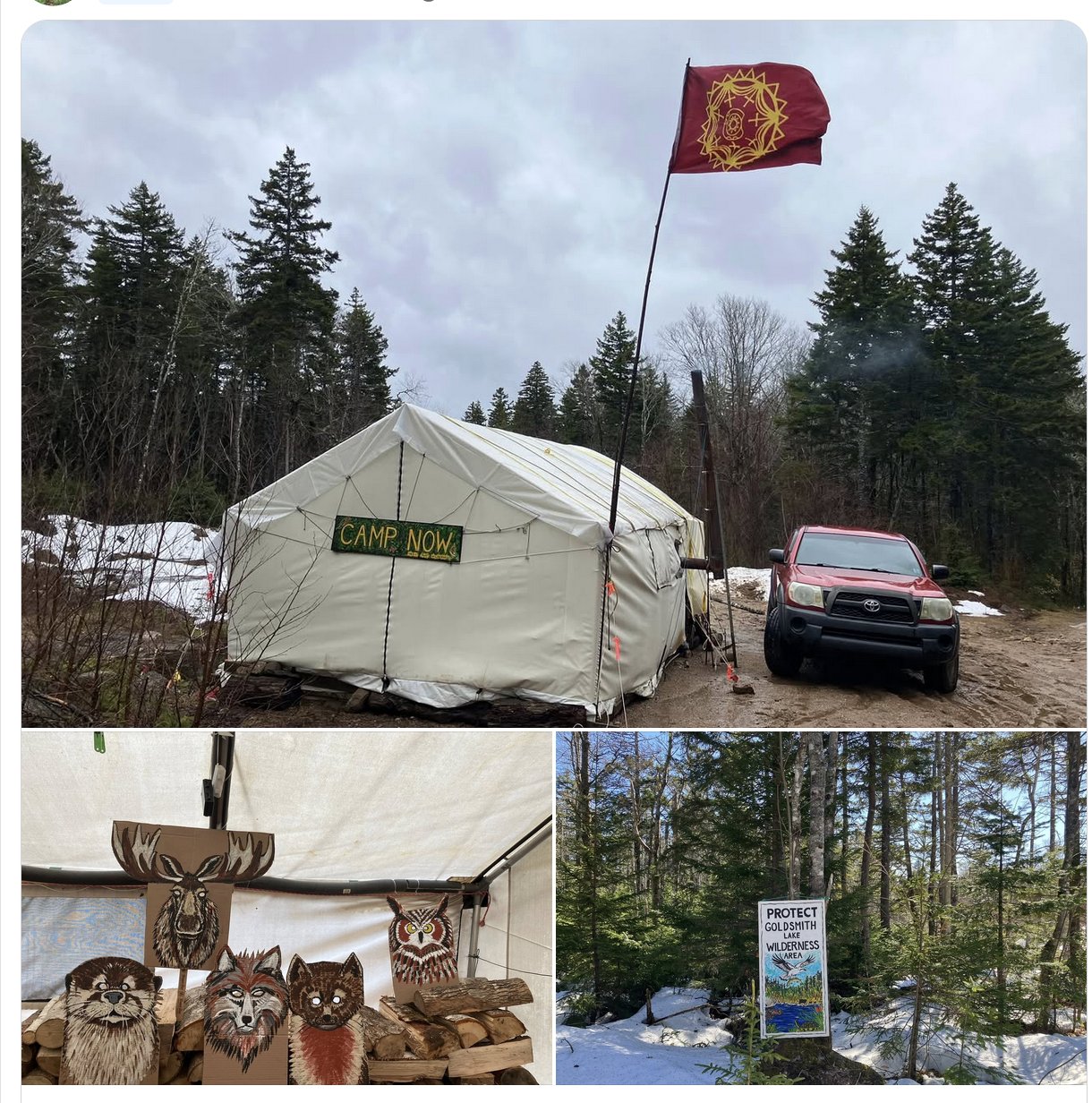 Camp NOW – Day 108
Nina Newington, Mar 17, 2026.
In the early hours the tent jumped and shuddered
as if it might lift,
unfold great white wings,
flap away,
angular and elegant as an egret.
And the animals gathered by the foot of the cot,
they would depart into the forest,
otter and moose,
coyote and marten.
The owls might perch,
observing the featherless, furless
human holding her arms to the sky,
laughing in the rain,
baptized
Before the scramble to save
laptop and lantern,
battery, books,
the keys, the hat.
It didn’t happen.
The tent settled, a little crooked,
tethers loosened,
peg pulled out of the thawing ground.
A promise?
Camp NOW – Day 100
Nina Newington, Mar 9, 2026.
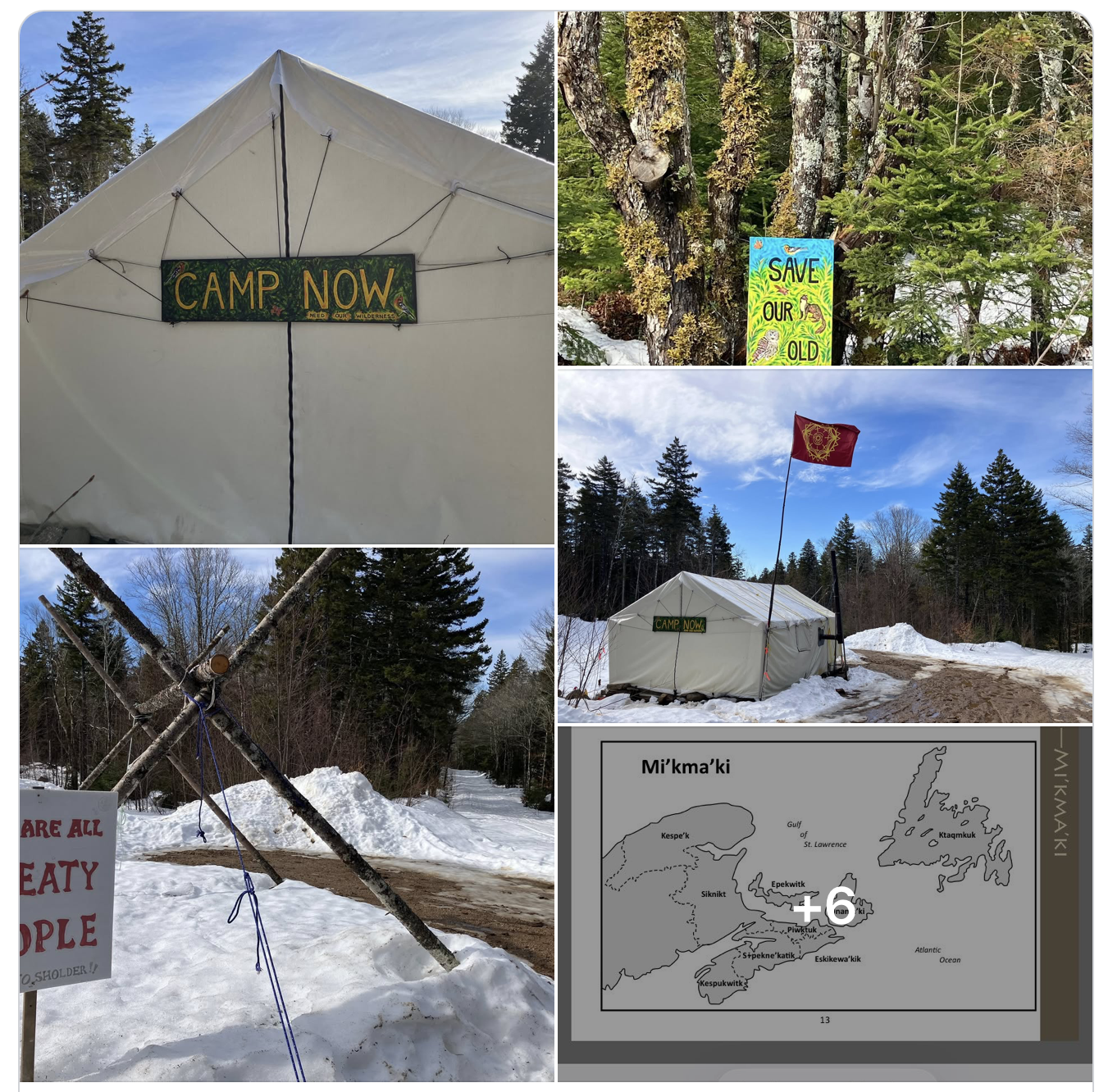 Mud season is here, snow mountains shrinking, coyotes chorusing. I lay in my sleeping bag, listening to barred owls hoot from the southeast and the southwest and the north. From forests we’re protecting.
It’s hard these days to take it all in. Savage budget cuts, harming everybody. All my relations. The destruction of the division at DNR that was created to protect wildlife. The firing of the woman we reported our species at risk finds to. Bill numbers chase each other through my brain. Bill 198. Bill 193. That’s a scary one too. And meanwhile Ukraine. Gaza. Epstein. Black rain in Tehran. Refineries burning. Desalination plants bombed. Climate change. Climate change. Climate change.
My mind is so busy. Making phrases, rearranging points, writing, writing, writing. Because I must do my part. A friend sent me some of President Obama’s eulogy for the Reverend Jesse Jackson. Jackson’s life “inspires us to take a harder path. His voice calls on each of us to be heralds of change, to be messengers of hope…Wherever you have a chance to make an impact… not for fame, not for glory, or because success is guaranteed, but because it gives our life purpose, because it aligns with what our faith tells us God demands, and because if we don’t step up, no-one else will.”
God, Nature, the Beautiful Whole. I really don’t care what you call it. I used to. But now it’s simply something I know. It’s not about belief. And yes, it demands. As part of the Beautiful Whole, I have responsibilities.
And so I sit at camp and write letters to politicians.
In between, I read ‘Goliath’s Curse: The History and Future of Societal Collapse’ by Luke Kemp, a senior research associate at the Centre for the Study of Existential Risk at the University of Cambridge. Yup, there is such a Centre and the book is brilliant, even comforting in a weird way. Of course I am only quarter of the way through.
According to Kemp, under certain conditions, humans, who usually resist being dominated and are quite good at creating non-hierarchical, egalitarian societies, end up in Goliaths. Large, hierarchical, concentrated settlements with a few rich and many poor. There have been quite a few Goliaths in the history of humanity around the world, and they have all collapsed — well, except the one we are in right now which seems to be meeting all the preconditions for imminent collapse. Sometimes it is a matter of decades, sometimes centuries. Sometimes people vote with their feet. Sometimes they revolt, smash the statues, burn the palaces. The more concentrated the wealth, the more fragile the Goliath. And yes, a change in climate often plays a part: prolonged drought. The Little Ice Age in the 1200s. Anything that affects the ability to produce all that storable food.
I read in the wildly flapping tent. Air has mass. A mass of warm air is moving in. Sometimes the frame of the tent shudders. Walls billow in and suck back out. Meanwhile the flag of the Seven Traditional Districts of Mi’kma’ki flies overhead. Gary Metallic Sr sent us this flag last year when he noticed that the original one was getting a bit frayed. Gary is the 7th District Tribal Chief, covering Kespe’k. The original flag was a gift to the Last Hope Camp from the 1st District Tribal Chief, Marilynn Leigh Francis, covering Kespukwitk. It has flown over every camp since.
As Gary reiterated when he sent the replacement, this flag represents both an invitation to be on this unceded territory and thanks for our sacrifices in protecting the land and water and the creatures that live there.
From the little I know of Mi’kmaw traditions, they are designed precisely to avoid Goliath’s curse. Traditional governance structures would make it very hard for power to concentrate in the hands of a Trump, or even a Houston. Listening to the flag snap back and forth overhead, I think of the fragility of empire, the resilience of small egalitarian human groups. Resilience in the face of genocidal colonialism. Which is not to underestimate the damage done.
One of my first friends in Canada after my wife and I immigrated here in 2006 was a Cree woman, Debbie Lafferty. We were living in Edmonton at the time. I was talking about climate change, nature loss, my fear of what was coming. She looked at me for a moment then said, “We’ve had our apocalypse. Now we’re just doing what we can.”
There is an afterwards.
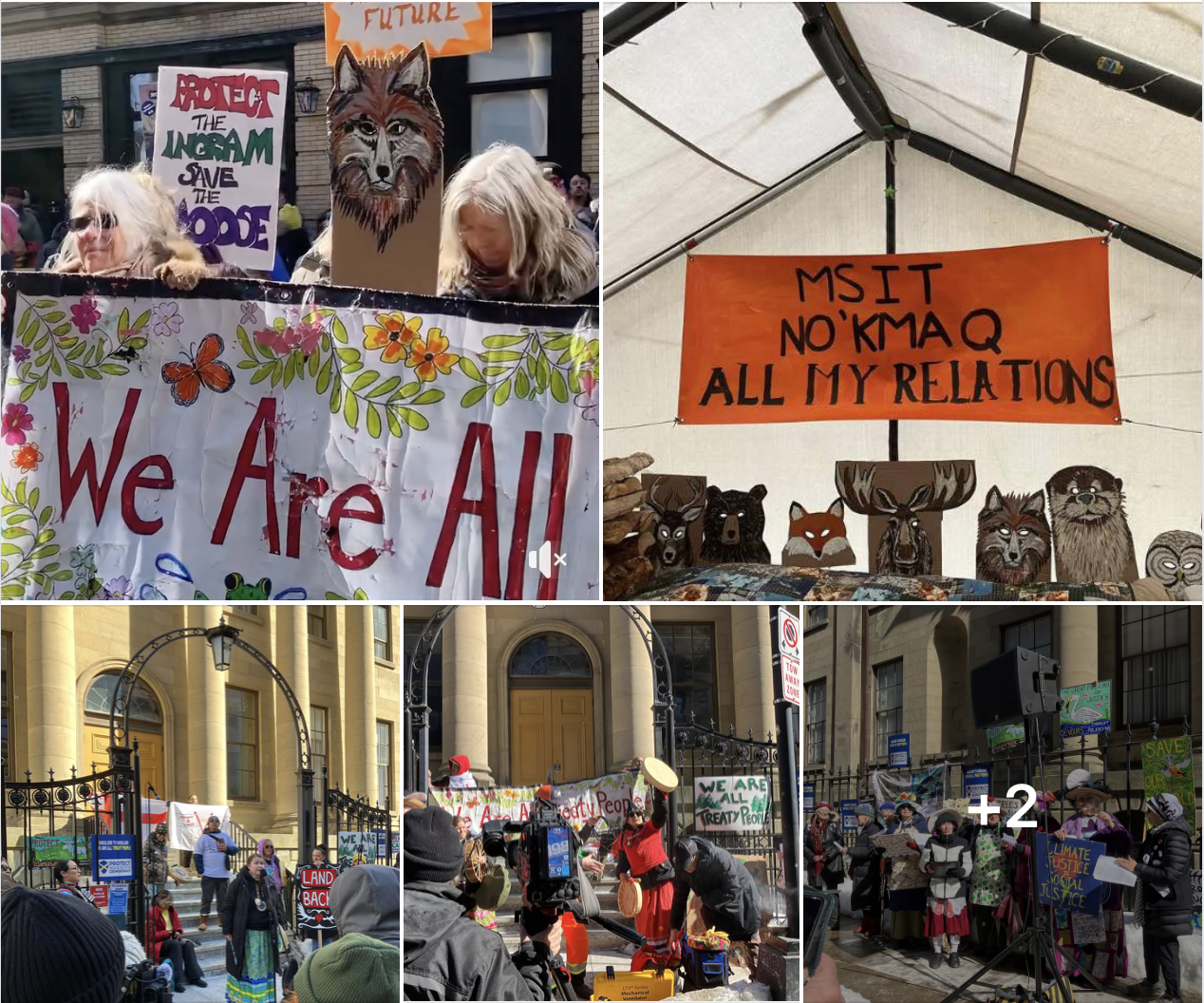 Camp NOW — Day 94
Nina Newington, Mar 4, 2026
Yes, the animals went to town.
Shoulder to Shoulder.
Great day.
And on Mar 6, Nina comments:
Lovely to look at all the faces and flags and signs and oh I do love the animal masks Deb Kuzyk made for Camp NOW.
And the solitary skimpy little tree now counting towards the 15% protected area goal.
Shoulder to shoulder we can stand up for nature, speak for those who can’t speak, get in the way of what damages the earth.
 Screenshot What a powerful day it was at Province House yesterday. All kinds of people travelled from all over this part of Mi’kma’ki, including Mi’kmaq land and water defenders, to bring together our voices to speak up for Treaty Rights, environment and democracy. We shouted at the pillars of the Legislature Building, and made our voices heard while Tim Houston’s government attempted a productive work day. We listened to several moving speakers share their emotion-filled words of wisdom, we prayed together, we sang together, and we danced together. We heard from critics and NDP members, who offered their support and thanked us for our presence. We want a government that respects Treaty Rights and upholds their own treaty responsibilities. We want a government that believes in and respects democracy – one with a leader who will not flee to another province when they have the opportunity to listen to the people they represent. 📣 We made our voices and our demands loud and clear – we won’t give up, we won’t back down. 📣 |
Camp Now Day 90
by Nina Newington, Feb 28, 2026
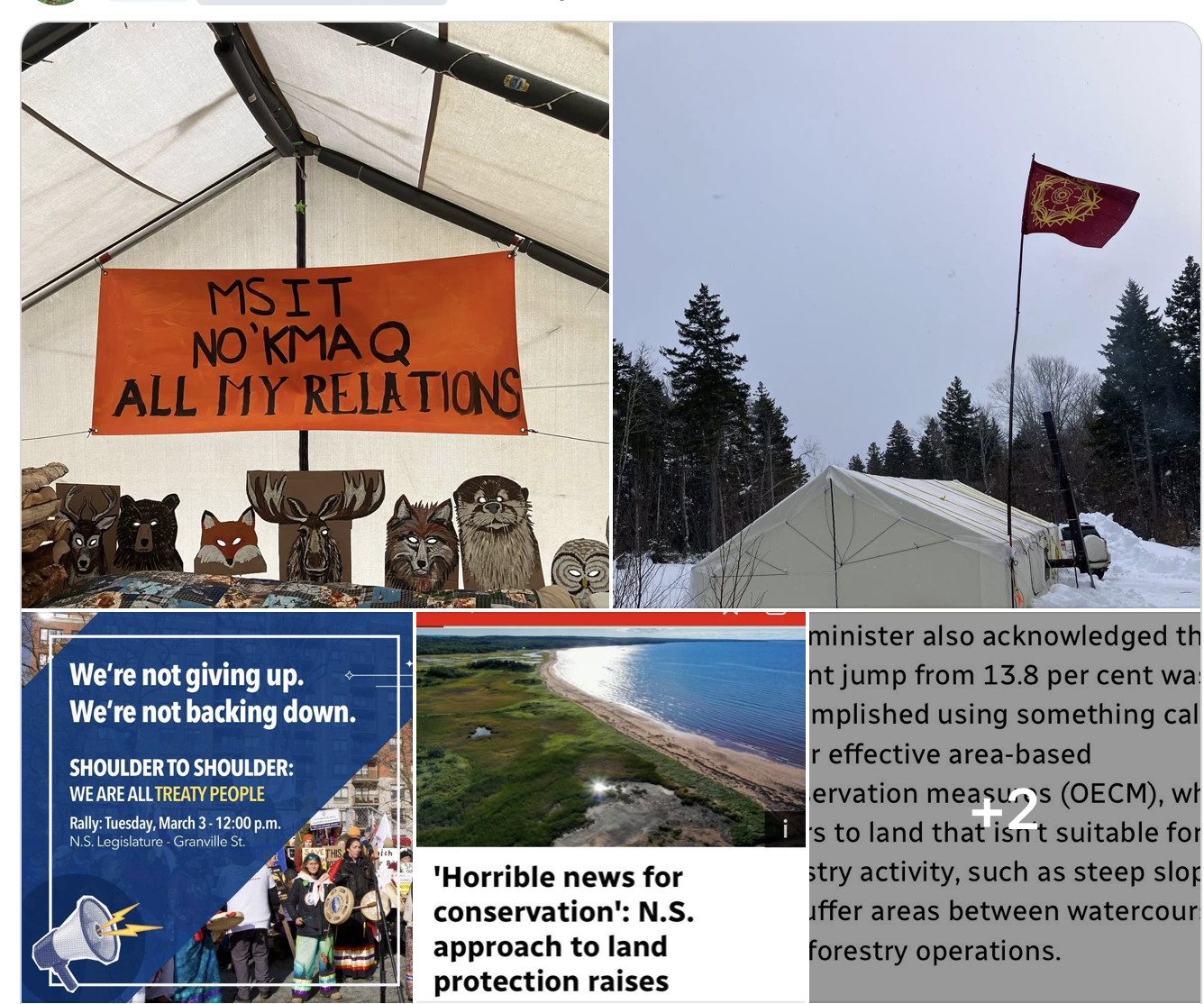 There’s a lot going on out in the human world. The animals at camp are deciding whether to take a trip into the city.
They watch a video Spider sent. It was Fly that took the footage, but Spider packaged it.
A bald, middle-aged white man is speaking. Three other middle-aged white men are listening. They have more hair.
‘Maybe it wasn’t such a good idea to make it a legal commitment, but it sounded good.’ The Minister sits up straighter, takes a deep breath and declaims:
‘In 2021, our government committed to protecting 20 per cent of Nova Scotia’s land and water by 2030. Achieving this goal is so important that we legislated it in the Environmental Goals and Climate Change Reduction Act.’
He looks around at the other men.
‘We are now pleased to present the new Collaborative Protected Areas Strategy for Nova Scotia, which sets the direction to achieve this conservation goal.’
‘The federal government gave us $28.5 million to help us meet our conservation goal.’
The three men stare at him.
‘Okay, that was back in 2023. The thing is, to get the money we had to agree to protect 15% by 2026. I mean, we’ve made progress. We started at just 13.45%. By the beginning of this month, we were at 13.77%. That’s…’
He stares up at the ceiling, directly at Fly’s eyes. He is sweating slightly.
‘Point three two percent,’ says Forestry, ‘you’ve taken from logging.’
‘And mining,’ says Mining.
‘Now the Special Interests are running around, whining and wringing their hands and telling people we’re going to have to give back that money, and we’ve got this big deficit which isn’t our fault, but it’s not going to look good if we have to give back millions.’ The Minister stops and looks at the three men. ‘What should we do?’
Mining and Forestry look at each other then at the Communications Director.
‘We already gave you a to do list,’ says the Director. ‘You’re only halfway through it.’
The Minister squares his shoulders. ‘We’ve got to protect something. So it looks like we’re going to hit 15%. Then maybe we can forget the whole stupid idea.’
‘Oh for God’s sake,’ says Forestry, ‘we’ve been telling you for years. Protect the places we can’t cut. Do I have to spell it out for you? Steep slopes. Places too wet for our machinery. Those 20m buffers along streams. Declare those areas protected.’
The Minister looks at the Director.
‘OECMs,’ says the Director.
‘What?’
‘Other Effective Conservation Measures. They’re in that Collaborative Protected Areas Strategy booklet the communications department put out before we got rid of them.’
‘The one the Special Interests keep telling people to read because it describes the kinds of areas that should be protected?’
‘Yeah, yeah, but you know what? Biodiversity has six syllables. Count them. Bi-o-di-ver-si-ty. Who reads that shit?’
The Minister gets to the thumb on his other hand and nods. ‘So we count all the areas where you can’t cut. How far does that get us?’
’14.55%,’ says the Director.
‘That’s not even…’ The Minister looks up at the ceiling. ‘15%’
‘No, but it’s close.’
‘We only have till March 31st.’ Sweat is running down his forehead.
‘Nah. End of the year,’ says the Director.
‘And the federal government will accept them? I mean they will count, right, towards the total?’
Forestry and Mining nod.
The Director says, ‘Sure, and if they don’t, well, then the Feds are fucking us over, stealing our money.’
The Minister nods. ‘14.55%,’ he says. ‘It sounds like 15% already.’ He pulls a handkerchief from his pocket, wipes his forehead.
The camera fades to white.
‘It’s a wrap,’ says Spider.
‘Well?’ says Coyote.
‘Heard there’s a bus going,’ says Bear.
‘And drumming and dancing, says Marten.
‘Our relations will be there,’ says Owl.
‘I’ll watch the camp,’ says Otter.
Camp Now Day 82
by Nina Newington
Feb 19, 2026: – ‘Shock and awe’ at DNR: Wildlife division gone, managers sacked, and restructured department geared for natural resources exploitation and extraction
Joan Baxter in the Halifax Examiner.
I was going to write a cheery post about the new warmth in the February sun; the joy of shadows on snow; the steady stream of visitors to camp, travelling from near and far to drink tea and talk and walk or ski.
But then came this in the Halifax Examiner: ‘News of massive changes to the Department of Natural Resources (DNR) staff landed in an email today, according to a source who asked for anonymity to protect his career.
The source describes the changes and sackings as “shock and awe,” and compares them to Elon Musk’s dramatic and vicious slashing of the United States’ public service by the Department of Government Efficiency (DOGE) last year.
The entire wildlife division in DNR is gone, replaced by something called “integrated resources planning,” which will be inside a new “Land Strategy and Planning Branch.” (…)
Sources also tell the Examiner that managers who were focussed on actual forest health – managers of biodiversity, of ecosystems and habitats, and the head of the wildlife division – were sacked.”
A member of what was the wildlife division spoke to CBC today:
“This is completely devastating to all of the work that the wildlife division was doing. We will not be able to function as an entity moving forward,” the source said.
The layoffs amount to the loss of “a massive amount of information” that will take years to recover and “will be completely devastating to conservation in Nova Scotia,” they said.
“There is no one left to protect wildlife in Nova Scotia.”
The managers in the Wildlife Division led small teams with specific missions:
-Understand and protect the biodiversity of Nova Scotia.
-Understand and protect the unique ecosystems and habitats in Nova Scotia,
-Maintain the health of game and non-game populations of wildlife in Nova Scotia.
They had their own office in Kentville where they were meant to do science-based work, independent of industry and of the other divisions of DNR. They had their own division head. He has been fired too. The heads of the other two DNR divisions — Forestry and Geoscience & Mines — remain.
As my Day 79 post made clear, the upper reaches of DNR frequently undermined, twisted or corrupted the work of the Wildlife Division. They ignored, for example, a wildlife biologist’s report that she had been unable to place cameras so they had a good view of a possible endangered Chimney swift nest tree. Instead, they used the fact that the cameras had not captured any images of the birds as proof that the tree was not a nest tree. Nothing to see here.
The biologist did her job. She told the truth. She may never have seen what senior staff at DNR made of that truth.
It is important not to attack the people who are doing their best to do an important job – such as protecting biodiversity – within an unsupportive institution. The citizen scientists have reported hundreds of species at risk identifications. Until recently we always got a response from Dr. Donna Hurlburt, Ph.D., the Manager of Biodiversity within the Wildlife Division, thanking us for our work and acknowledging receipt of the information. This information was shared promptly with the Forestry Division and the required buffers were removed from the relevant harvest plans. The harvest plans were duly amended. Freedom of Information requests allowed us to track this process. (A recent change to this process is making it harder to track, but that’s for another day.)
Donna Hurlburt was fired yesterday. She posted about this last night on Facebook.
But the post I want to quote here is from February 9th:
‘Been thinking a lot about my experiences as a Mi’kmaw woman employed in government – natural resources management, at that. Good thing I came from strong resilient stock and my connections to the land and waters run deep. My moral compass sure is taking a beating as it tries to stay on its path. Doing my best to speak for those who cannot speak for themselves, but it sure is a slog.’
I have deep respect and admiration for the woman who took on this work. In so many dimensions it must have been hard. Now more than ever we need to support each other, all those who are trying our best “to speak for those who cannot speak for themselves.”
The forces of greed and ignorance are powerful and desperately short-sighted. We need everyone, whether you are camping by a logging road or still working in a government department, in academia or a non-profit or a corporation, or sitting at home, wondering what to do. Shoulder to shoulder, Mi’kmaq and settlers, we can resist the destruction of the Earth and work for a world where we take care of each other, human and other than human. We are all in the same boat. Those of us who know it must show it.
Msit No’kmaq
First step. Call your MLA and object. Numbers of calls count. No need for a long message.
Second step. Save the date: March 2nd at noon outside the legislature in Kjipuktuk/Halifax. Shoulder to Shoulder: We Are All Treaty People returns.
Camp NOW – Day 79
Nina Newington, Feb 18, 2026
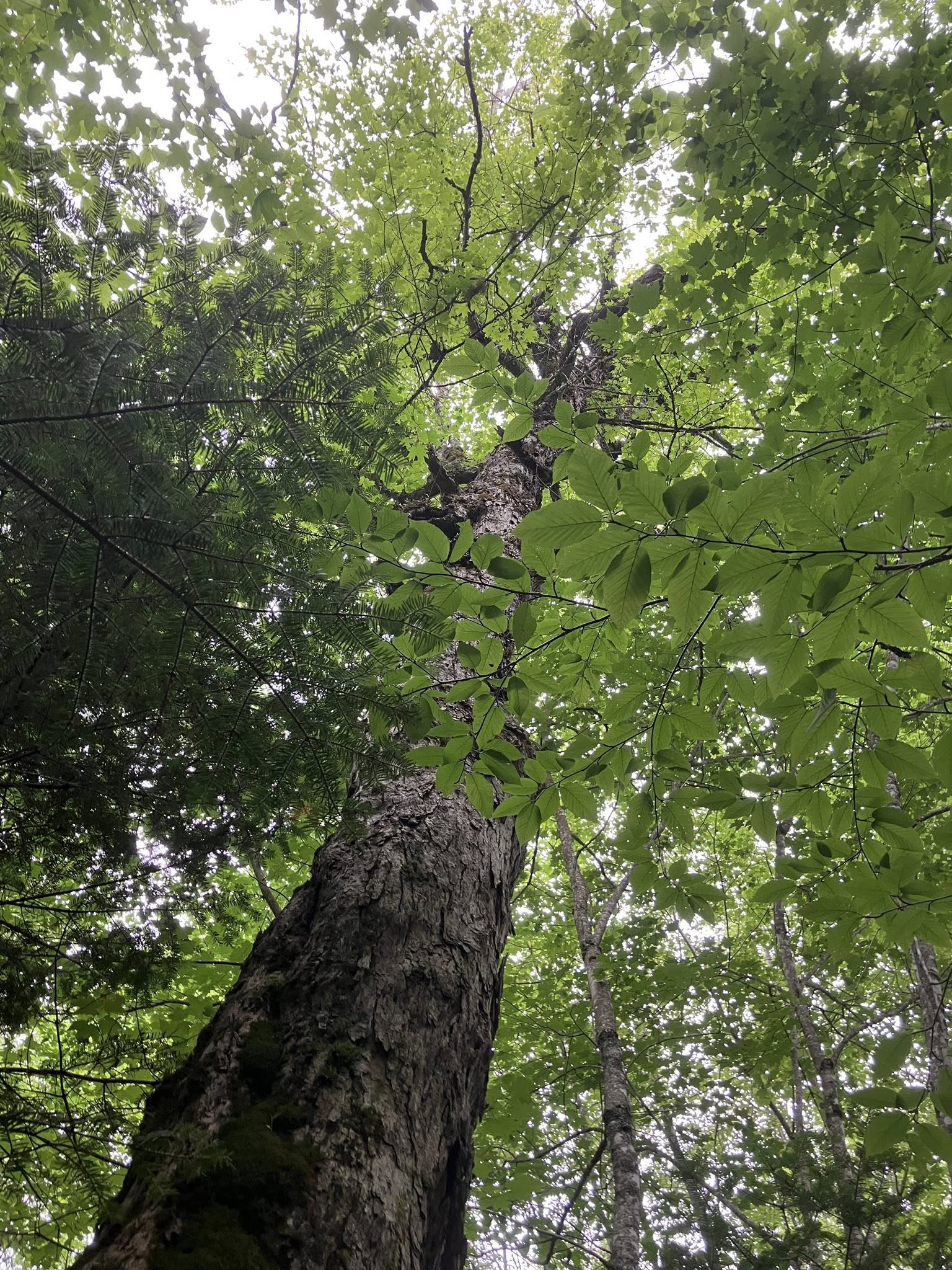
A massive yellow birch on the Corbett Pninsula beginning to thin out at the crown. This tree is probably already hollow.
Near the end of the Day 72 post I wrote, “It is only because of an extraordinary combination of dumb luck, industry error, plus passion and diligence on the part of ordinary people that most of the old and old growth forest on the Corbett peninsula is still standing.” I keep thinking about the heart-felt hard work of Bev Wigney, Scott Leslie and so many others in that crucial period in 2018 and 2019.
Seven years on, it is clear that the 6th Mass Extinction is upon us. It matters more than ever to protect reservoirs of biodiversity wherever we can. Nobody knows which areas will survive the consequences of climate breakdown. In the face of terrible uncertainty, we can only do what we can. But doing what we can is essential.
Looking back through documents received as part of a Freedom of Information request that I filed regarding the Corbett peninsula and DNR’s activities there, I came across several beautiful letters making the case for not logging this area.
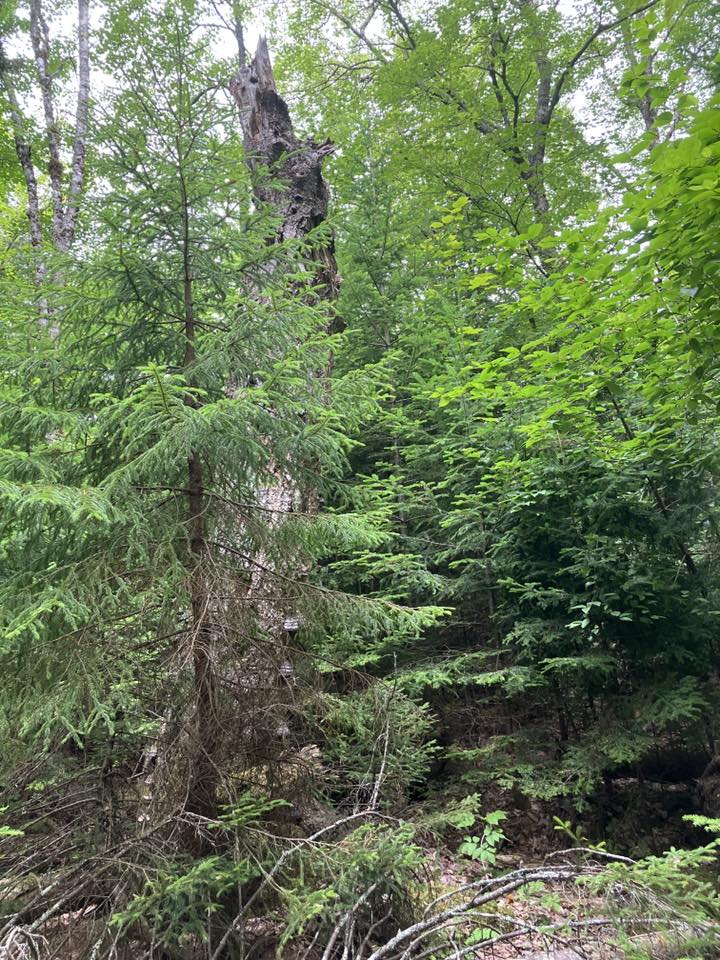
This is not The Tree, just one of the large yellow birch snags to be found on the Corbett peninsula — part of what makes this areas so valuable as habitat for all kinds of wildlife.
The one shown in the screenshot, dated June 12, 2019 and addressed to then Premier and Annapolis County MLA, Stephen McNeil, opens: “I’ve just received several photos – of which this is one – of what is, in all probability, the actual nest site for the Species-At-Risk Chimney Swifts that we have been seeing almost continuously at Corbett-Dalhousie Lake for over a week.”
Read the whole letter. It pulls together a lot of information to support the identification of an actual Chimney Swift nest site. And it makes the point that protecting endangered species is a legal obligation for the government. It is not up to industry or government to decide on some ‘balance’ between industry’s interests and the interests of wildlife.
The letter was passed on to DNR. What did they do with it? Well, check out the screenshot of the email chain. The earliest email is at the bottom. DNR’s Integrated Resource Management biologist at the time, Sarah Spencer, decided to go and set up a couple of cameras at the possible nest site. This she did on July 2nd, braving those dangerous nature lovers who might still be roaming the forest. The result?
I visited the site yesterday. I set up a couple of cameras but there really was no good spot to get a view of the crown of the tree.
And what did her DNR bosses do with this information?
A couple of weeks later they came up with an Advice/Recommendation to the Minister document stating, among other things:
Department staff conducted a site investigation for a potential chimney swift roost site using trail cameras near the cavity tree that was identified as a possible site the Chimney swifts were utilizing. No Chimney swifts were captured by the cameras.
They then recommended that the hold that had been put on the harvest be lifted so that logging could proceed in the fall.
Fortunately that didn’t happen, but not for lack of trying by DNR.
This exact same statement has been used ever since by DNR in advice and briefing notes to the Minister regarding the Corbett peninsula. It surfaced yet again in the September 6, 2024 Decision Request asking the Minister, once again, to lift the hold on the Corbett peninsula harvest plans. This time the Minister agreed.
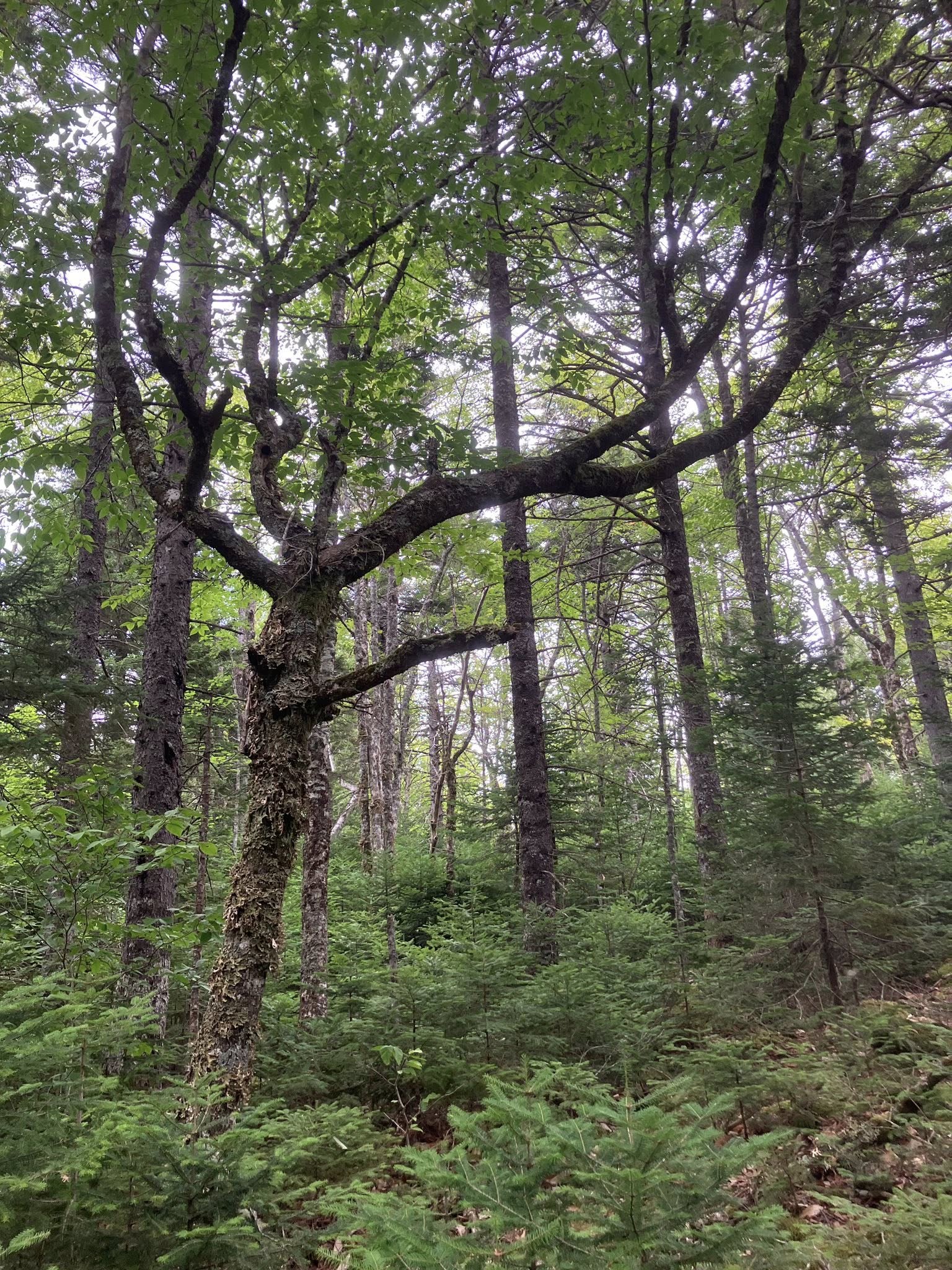
Just for the beauty of The Old Forest
Ministers rely on accurate information from staff in their department. But in the case of DNR, they don’t get it. In their communications to the Minister of the day, DNR staff repeat statements that were either unfounded or misleading to begin with (viz the Chimney swifts) or have since been disproved.
We see this with the portrayal of the proposed Goldsmith Lake Wilderness Area — including the Corbett peninsula — as ‘managed forest throughout’, meaning forest that has been clearcut and sprayed and thinned to turn it into a softwood monoculture that cannot support much biodiversity. Forest, by implication, that is not worth protecting.
Even now, when DNR itself has recognized 31 stands of old growth forest in the area, they are still feeding the Minister the same line. By definition old growth forest is not managed forest. But that doesn’t seem to matter.
 Nor does the identification of 137 species at risk occurrences in the area, three-quarters of them old forest indicators.Inconvenient evidence can be ignored and inconclusive results twisted to imply whatever DNR wants to imply.
DNR claims repeatedly that they prioritize biodiversity on 90% of Crown land. This is what prioritizing biodiversity looks like for DNR:
I visited the site yesterday. I set up a couple of cameras but there really was no good spot to get a view of the crown of the tree.
Becomes:
Department staff conducted a site investigation for a potential chimney swift roost site using trail cameras near the cavity tree that was identified as a possible site the Chimney swifts were utilizing. No Chimney swifts were captured by the cameras.
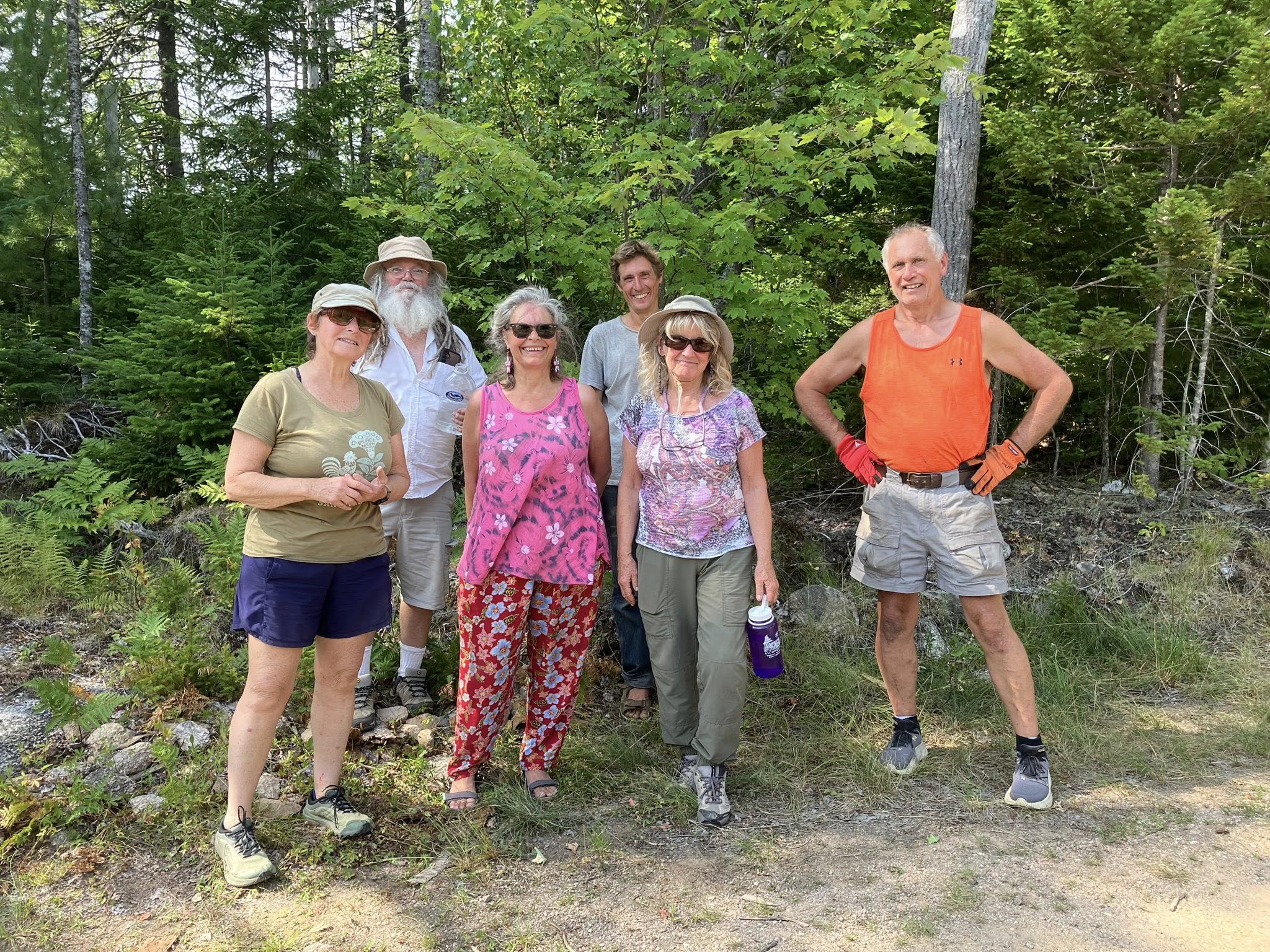
There are people who care.
Under these circumstances it is up citizens to speak for the voiceless — for the four-legged, the swimmers and flyers and crawlers, as our Mi’kmaw friends put it — for all the astonishing variety of life that is now under threat. As are we two-legged.
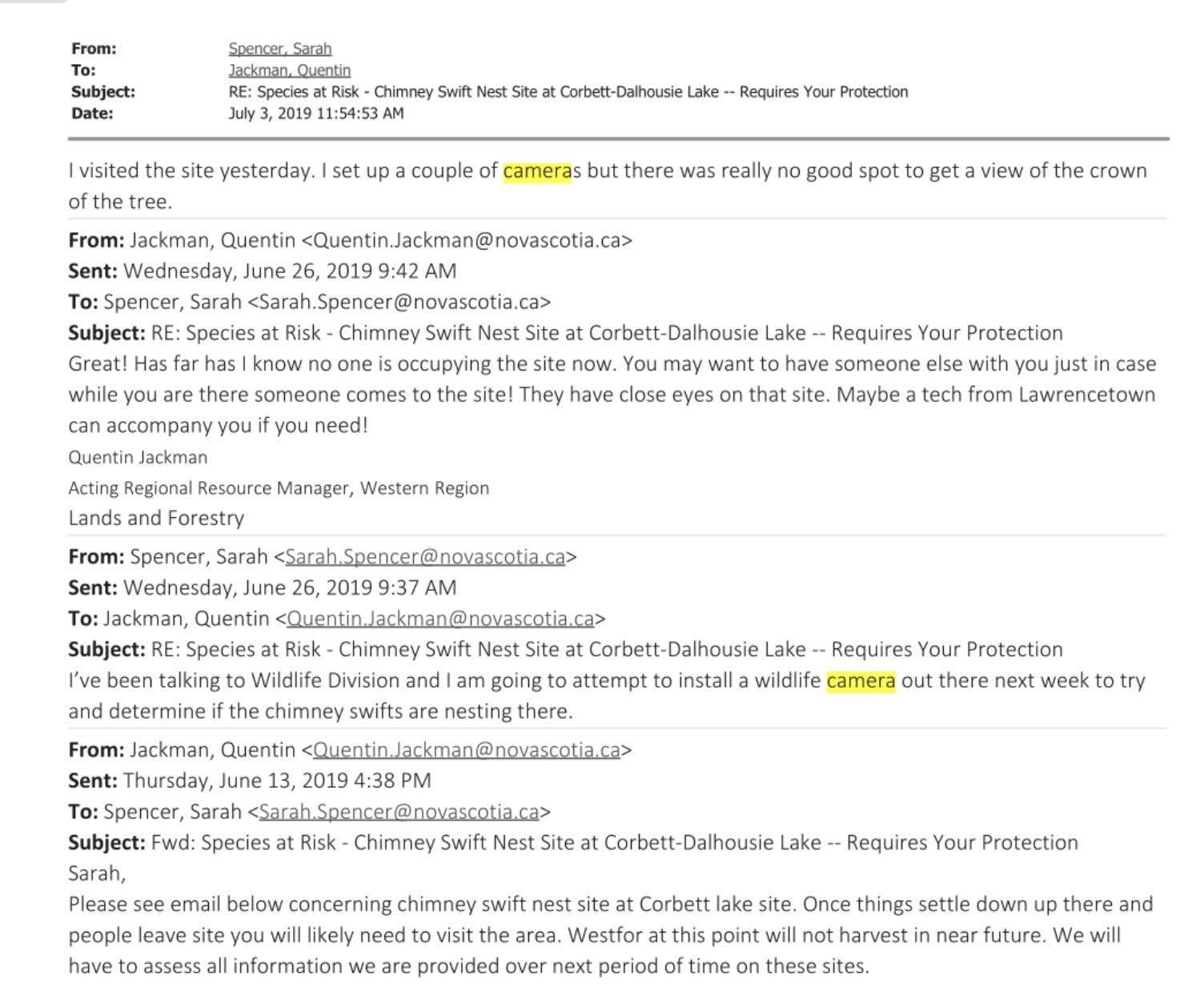
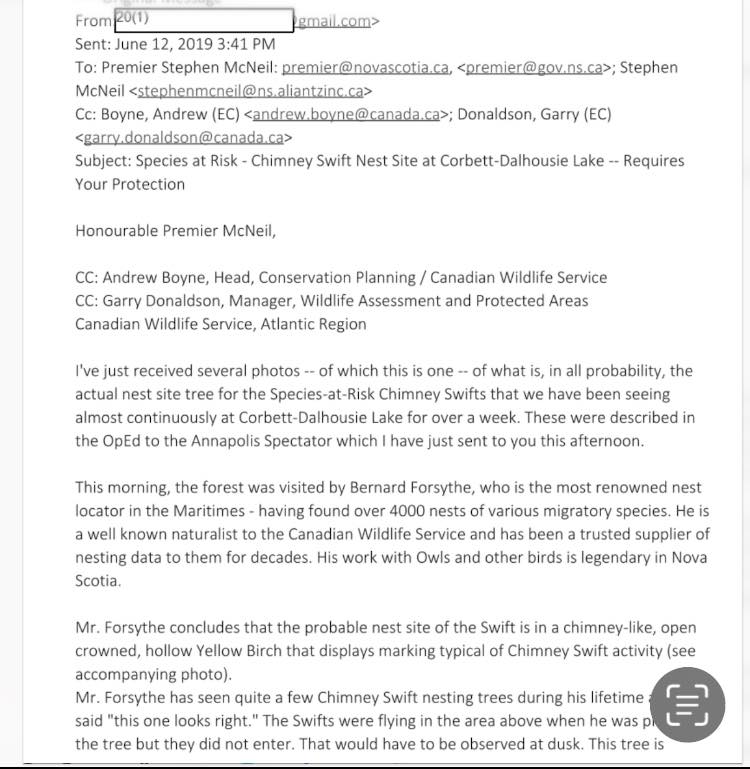
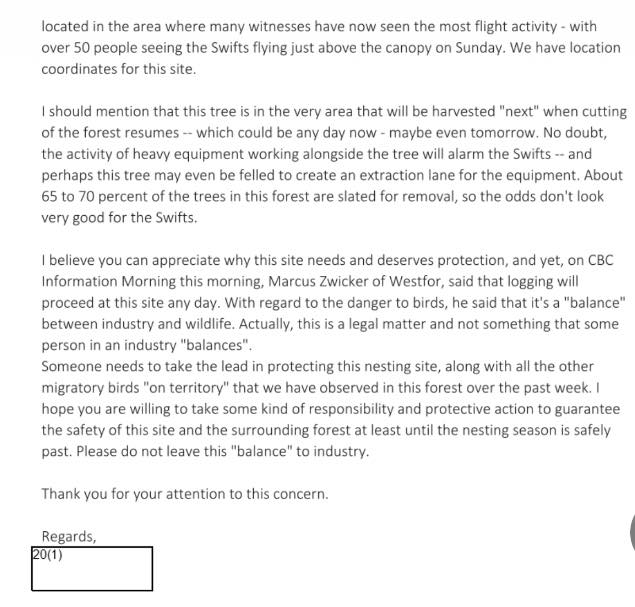
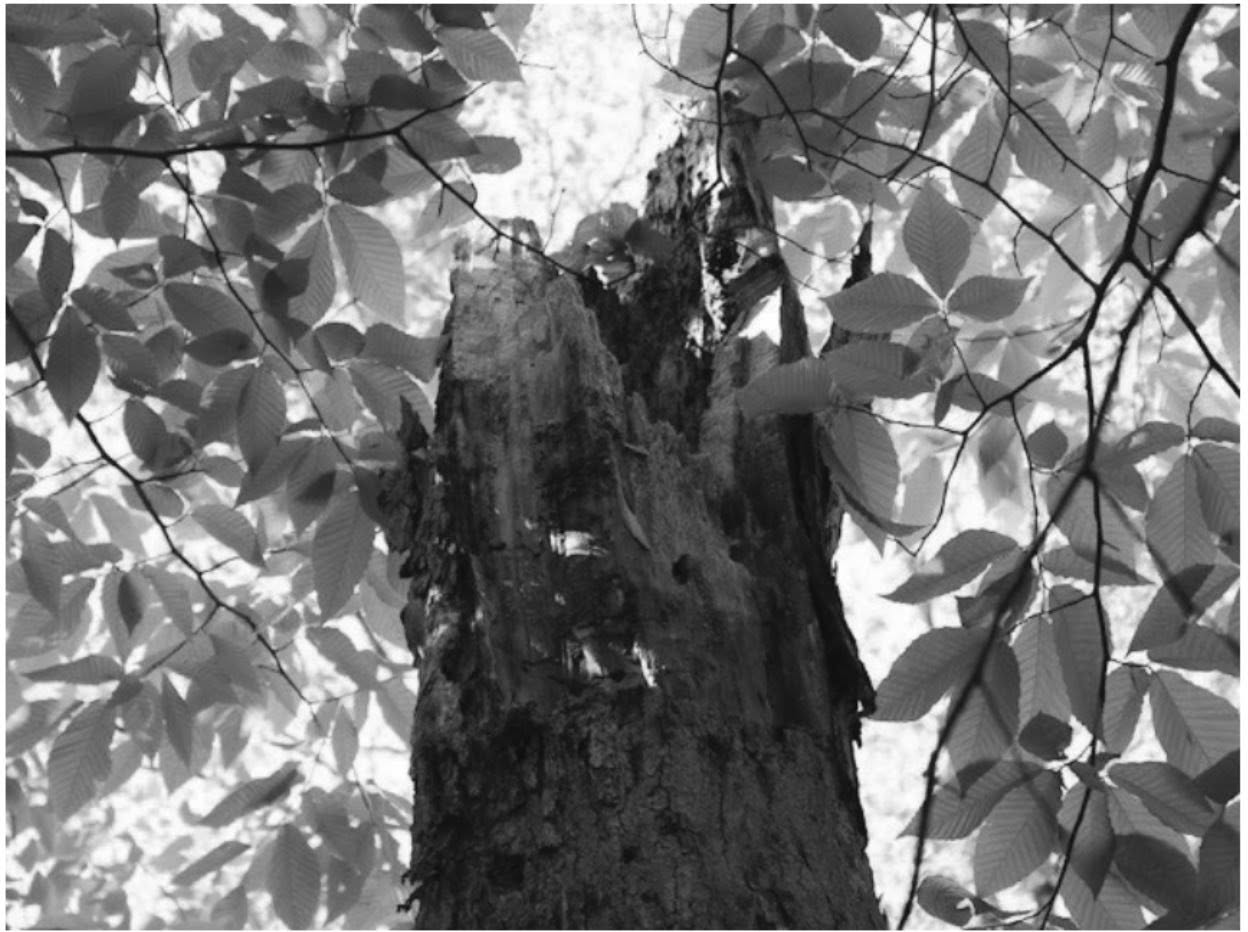
The photo that accompanied the letter, a probable Chimney swift nest site in one of the cutblocks on the Corbett peninsula.
NN Comments The author of this letter (above) does make one slight error. Chimney swifts return en masse to their roost at dusk. But if this yellow birch was a nest site, as no less an authority than Bernard Forsythe thought likely, then the parents — a single pair — would be slipping in and out during the day to feed their young. It is notoriously difficult to spot the adults doing this. The survival of their young depends on them being inconspicuous, so they are
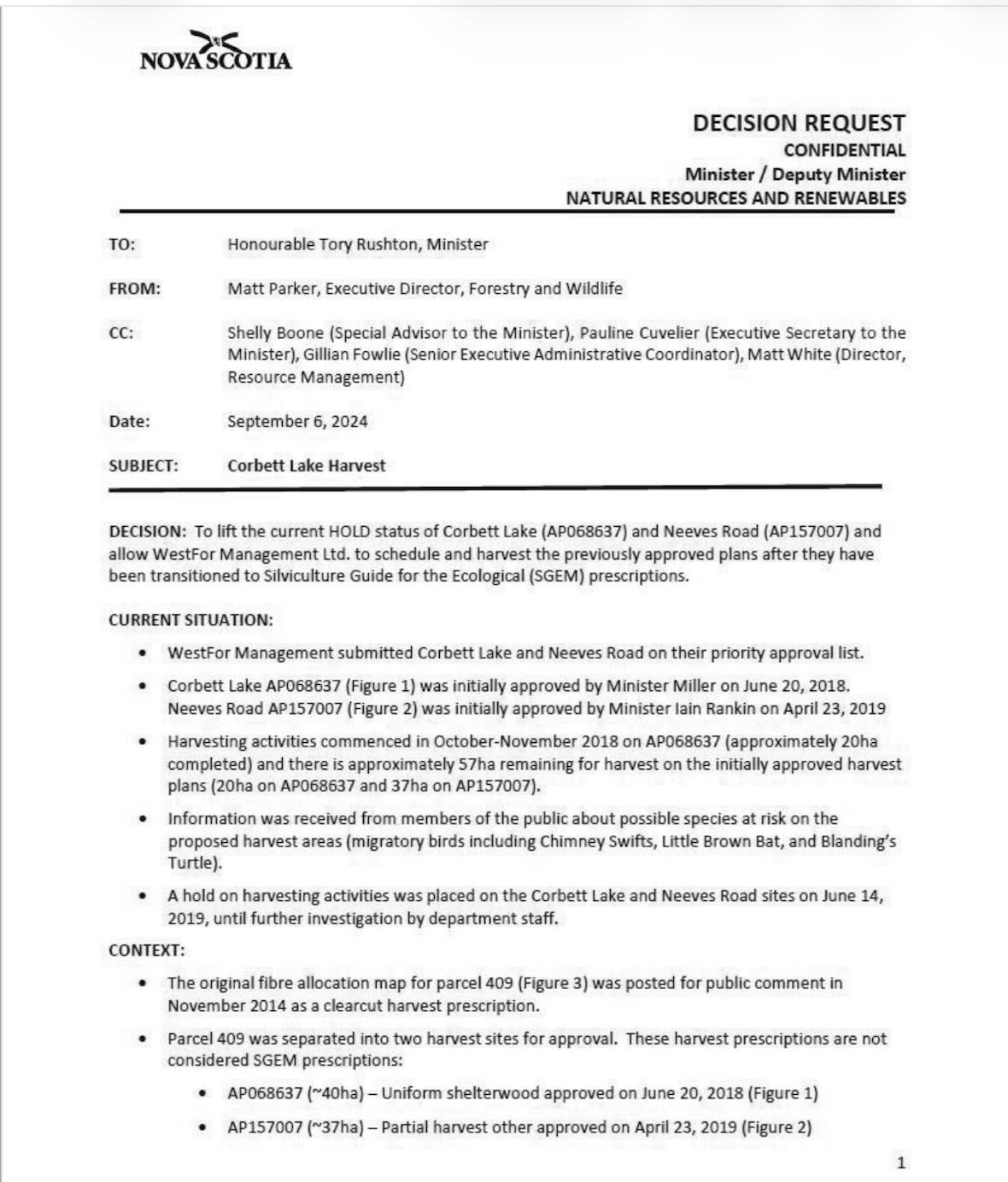
 NN Comments on the above:
Yup, there they are saying that forest stands ‘have been identified as not being old growth by Department staff’. And yet 6 months later three stands on the peninsula had been identified as old growth.
As to the Migratory birds bullet point, it’s a mess. Staff were supposed to be investigating a nest site but they apparently decided to call it a roost site even though their cameras didn’t catch any images of Chimney swifts (possibly because they didn’t actually have a view of the place where the swifts would be going in and out.)
And the point about the photo of the Magnolia warbler in her nest was that she was a nesting bird protected under the Migratory Bird Convention Act. This applied whether or not she was a species at risk
Take a breath. The world is still beautiful.
Camp NOW — Day 72
Nina Newington
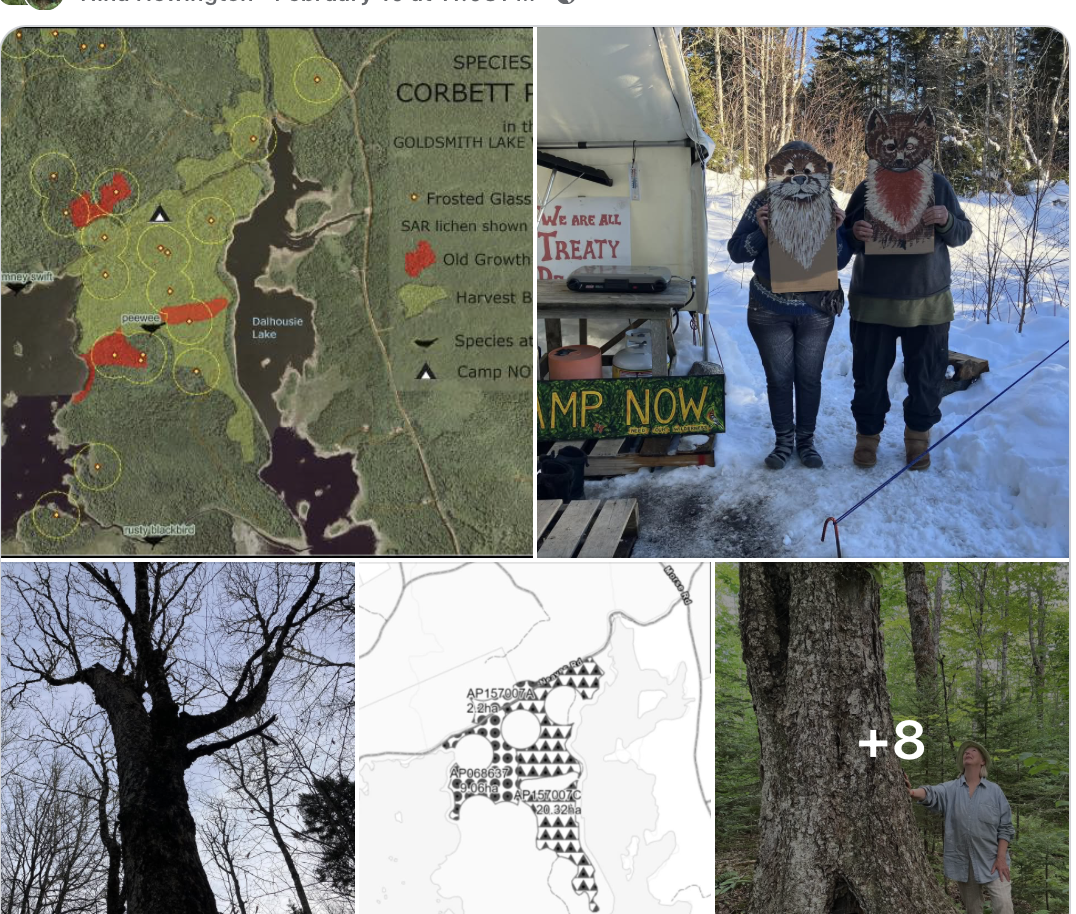 Why not protect the Corbett Peninsula? It’s beautiful, it’s accessible, it’s full of old growth and old forest on its way to being old growth. It is home to the endangered Marten, to Rusty Blackbird and Eastern Wood Peewee, to Canada Jay and species at risk Lichens.
It’s some of the best of what we have left.
After camping here for five months this spring and summer, and two more this winter, I know it is much visited by local people – snowmobilers and cross country skiers in the winter; in the rest of the year, runners and hikers and hunters and people out walking their dogs or going for a ride in their side-by-sides.
It is rare – you could even say miraculous — to find so much old forest still standing on an easily accessible peninsula on crown land, 15 minutes outside Bridgetown. It could so easily have been cut. Just look at the last twelve year
The mill that had the contract to cut it back in 2014 didn’t get around to it.
In 2016, WestFor was created and given the license to manage crown land in Western Nova Scotia. If WestFor had had their way, most of the eastern half of the peninsula would’ve been clear cut in 2019.
But, to its credit, DNR, then Lands and Forestry, with Iain Rankin as Minister, refused to approve their clearcut plan. I know this from Freedom of Information requests (FOIPOPs) because the General Manager of WestFor at the time threw a hissy fit. It seemed to him none of his plans to clearcut were being approved by DNR. Less extreme plans were approved though. These plans weren’t made public.
In 2018 WestFor cut about 20 ha, half of one of these newly approved plans. But then they made a mistake and posted the new plan on the Harvest Plan Map Viewer for public comment – as you would with a new plan. Whoops.
The plan was pulled from public view before the comment period was up. But not before local people spotted it and began to organize to protect the rest of the area.
When WestFor put up signs in June 2019 saying logging was about to begin, 50 people gathered to protest. Some of us set up camp later that day, pretty much where Camp NOW is located.
It was nesting season. Naturalists combed the woods for nesting migratory birds. Media came to see what was happening. The General Manager of WestFor put his foot in his mouth on live radio, announcing that WestFor could change its schedule for snowmobilers but not for birds, even though that meant harvesting equipment would kill birds on their nests.
Five days after we set up camp, the harvest plan was put on hold.
After a while, people heaved a sigh of relief. There were no logging plans for the peninsula on the Harvest Plans Map Viewer. Perhaps sanity had prevailed. Word was that harvesting in the area was on hold.
It was, for five years. But then, in September 2024, at WestFor’s insistence, the hold was lifted.
We found this out by accident. A FOIPOP that asked for information about species at risk in the whole Goldsmith Lake Wilderness Area showed a harvest plan had been amended as a result of a species at risk lichen find. The harvest plan was for the Corbett peninsula, a harvest plan we thought had gone away.
The FOIPOP showed two harvest plans for the peninsula, one for the east side with a sliver to the north, one for the west. They covered 54 ha. The plans showed no old growth forest stands and only the one species at risk lichen. WestFor made it a priority for DNR to approve them. DNR obliged. In January 2025 they were about to send the signed documents to WestFor when someone in DNR wrote on the approval, ‘Missing information.’
The next time the harvest plans resurfaced they showed a stand of old growth. Then two more stands. Back in 2019, DNR made a big song and dance about how there was NO old growth on the peninsula, in spite of what all those naturalists were claiming. But now there were three stands.
In the meantime, citizen scientists were out searching for species at risk lichens and finding them. By March 2025 the cutblock area had been reduced from 54 ha to 32 ha. It looked like Swiss cheese.
FOIPOPs show that DNR expected WestFor to come in and cut Corbett at the end of May 2025. We set up Lichen Camp on this spot in April, before we saw that FOIPOP. I don’t know what stopped WestFor from following through on their plan. Perhaps it occurred to them that it would be nesting season again, just as it was in 2019 when they planned to cut here.
Over the summer we identified more species at risk on the peninsula, both birds and lichens. Then the woods were closed because of the fire risk and we took down camp. In November we got word that the cutblock on the eastern half of the peninsula had just been flagged. The harvest plan had presumably been amended and approved again. We found another species at risk lichen and reported it. This cutblock must be down to 14 ha by now, half the size it was.
The next FOIPOP should tell. It’s been delayed by 30 days. Should be here soon.
Believe it or not, I could add another chapter to this tale, one concerning the endangered Marten, but let’s leave that for another day.
The big point is that it is only because of an extraordinary combination of dumb luck, industry error, and passion and diligence on the part of ordinary people that most of the old and old growth forest on the Corbett peninsula is still standing. DNR has sometimes helped but mostly harmed. It’s no wonder we have so little old growth left.
It’s particularly miraculous because the old forest on the Corbett peninsula is easy to get to. Most surviving old growth is in hard-to-reach places. Hard for industry to reach and therefore hard for the public to reach. But you don’t need a vehicle that can handle logging roads to visit the Corbett peninsula. It’s 15 minutes out of Bridgetown.
The Corbett peninsula is a unique and valuable part of the proposed Goldsmith Lake Wilderness Area. Please keep asking for this whole area to be protected. And ask for a freeze on harvesting in the meantime.
Ask MLA David Bowlby. Mladavidbowlby@gmail.com
Ask the Premier. Premier@novascotia.ca
Bcc soof@saveouroldforests.ca so we can keep track
Camp NOW — Day 66
Nina Newington, Feb 4, 2026
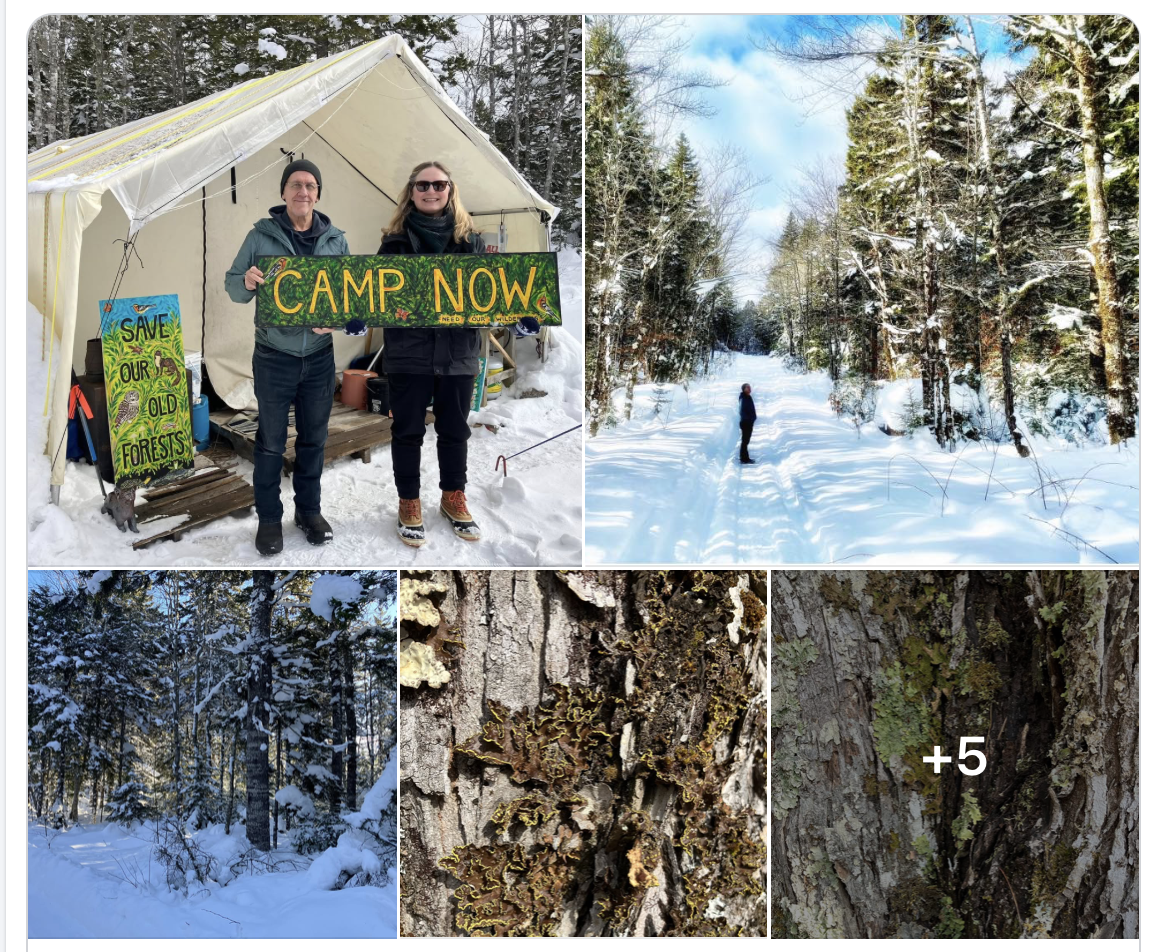 Two Save Our Old Forests members came out to camp yesterday afternoon, one to take snow photos in the sunshine, one to look for mushrooms. No, not on the ground — I asked — on tree trunks.
Last weekend, people taking a tracking workshop ate lunch and warmed up in the tent. Not too far from camp, they found not only otter track and slides, but also anal gland excretions. Unlike otter scat, these contain no fish scales but they smell plenty fishy. I love this kind of information. I have since I was a young child.
For many of us, the non-human part of the natural world is a source of fascination and wonder. Some go deeper, studying specific areas, lichens and fungi, for example. Some, like our mushroom hunter, are professional scientists, others are unpaid and unattached to any institution, but no less dedicated to precise observation.
The mechanistic origins of western science, in which humans are separate from the rest of nature and the observer is detached from the observed, lead to the notion that scientist shouldn’t care, shouldn’t feel for the subjects of their study.
As it turns out, however, the observer affects the observed. Modern physics has demonstrated this. There is no point outside of nature where we humans can stand, God-like, observing. We can be aware of our impacts, as we can be aware of our feelings towards the subject, but separation is an illusion.
Still objectivity is prioritized. Empathy — feeling with the subject — is viewed as unscientific. As for love, well that is the terrain of ‘tree huggers.’
Generally, citizen scientists don’t hug lichens, but if we could, many of us would. We make friends with certain species. When I recognize a yellow specklebelly lichen, I say, ‘Hello Yellow Specklebelly.’ I feel a little glow.
This might* be why DNR puts quotation marks around “citizen scientists” when they brief MLAs and ministers about our work, but it is precisely because I love and respect lichens in their wonderful particularity that I would not falsify any data I collected about them. They’re not mine to use as I wish. This respect is shared by all the citizen scientists I have encountered.
Other people, hearing of the hours we put in on cold winter days — or buggy summer ones — peering into cracks in maple trees in areas slated for harvest, looking for a species at risk, shake their heads. Some people ask, only half-joking, ‘Why don’t you just transplant one?’
The answer is no, not just no we can’t, but no, we won’t. We won’t, out of respect for the lichen and respect for the shared enterprise of science.
In purely practical terms, I know for myself I couldn’t speak strongly, clearly on behalf of the species that need this area to be protected if I knew we were falsifying data.
Does DNR abide by the same standards? Does the pressure of industry interests — mining, forestry —and politicians’ priorities lead them to falsify or ignore data?
*Is that the real reason they put quotation marks around “citizen scientists”? To discredit data that DNR staff in the Wildlife Division have recognised as being 98% accurate?
More on this in future posts.
More too about Etuaptmumk, Two-Eyed Seeing, the bringing together of Indigenous and Western scientific knowledge systems. Dr Elder Albert Marshall proposed and developed this idea. He’s given some great talks on this. Links when I have better signal.
Camp NOW — Day 64
Nina Newington, Feb 2, 2026
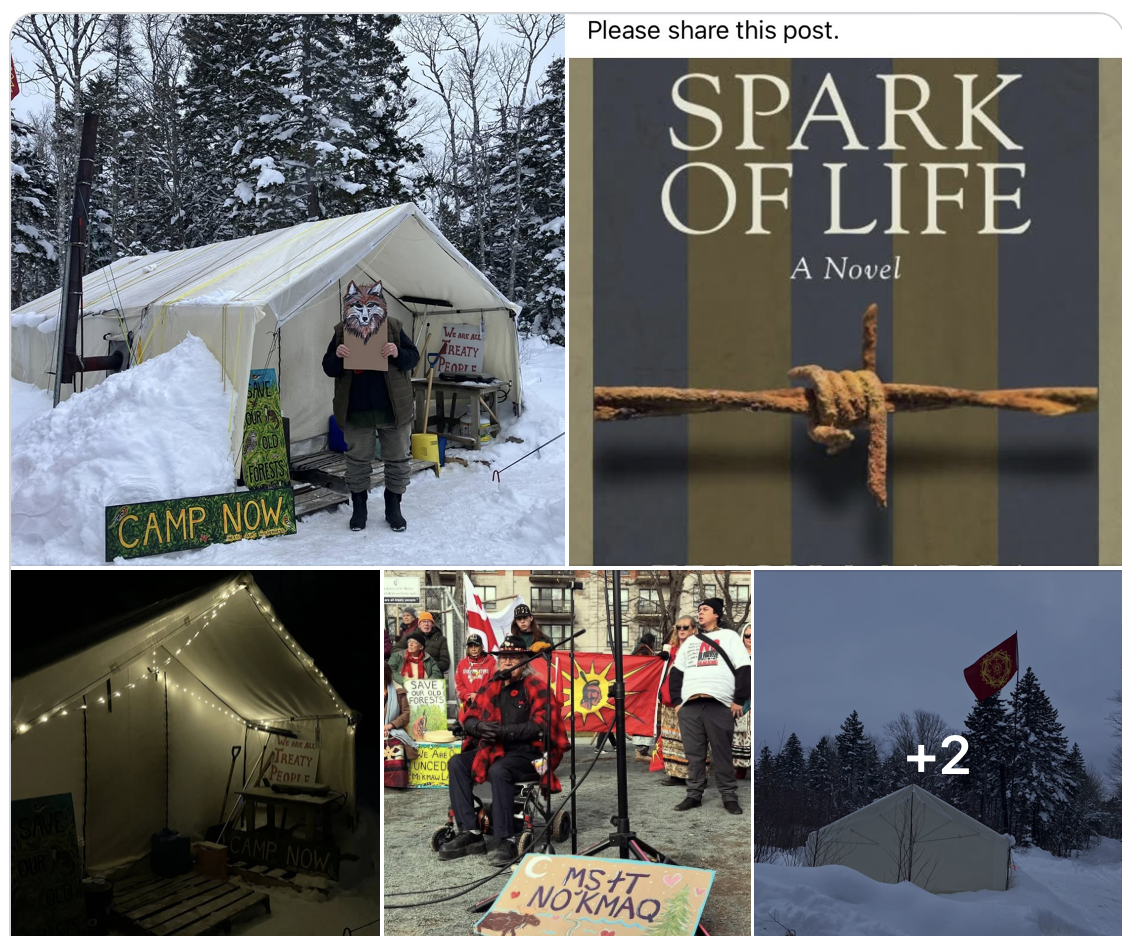 Thoughts from the storm. Last night, sitting by the wood stove in the tent, canvas flapping, wind blundering through the treetops, I kept coming back to Larry Powell‘s brilliant post, ‘When Ordinary People Refuse to Obey – Reflections on Resistance and Remarque’s Spark of Life.’
I think in particular about his description of conscience, “that stubborn internal refusal – the decision not to become what the system demands”. The system in the novel is a Nazi concentration camp. Larry roams further afield, to the current resistance of Minnesotans, their refusal to become part of the system being created by Donald Trump and co.
Resistance is not easy. Alex Pretti was murdered trying to help another resistor.
The characters in Remarque’s novel live with constant fear. “What sustains them is not certainty of victory, but certainty of purpose. The knowledge that surrendering conscience would cost more than obedience is worth.”
At far less risk to my personal safety, it is still the same force — conscience — that has led me to camp on this logging road in February. A stubborn internal refusal to believe that my human society has the right to drive other species to extinction. The right to wreck the extraordinary home we share with millions of other forms of life. I believe the same force drives the many others who make this camp possible.
Conscience — “the decision not to become what the system demands” —is profoundly personal and, at the same time, it involves a feeling of responsibility beyond oneself. What the system demands in Nova Scotia is passivity, selfishness, indifference. Despair is helpful.
Refusal takes many different forms, but all of them involve responsibility. In the words of Mi’kmaw Elder Doctor Albert D Marshall, “our inherent responsibility is to be the eye, the ear, and the voice for those that cannot defend themselves.”
For many, this responsibility is felt primarily for other humans. That is all good. For myself, I am with Albert Marshall when he says, “our number one responsibility is to ensure our natural world is loved, appreciated and protected.”
The responsibility is not only to defend. It’s also to envision the world we want to go towards. Again in Albert Marshall‘s words, “Let’s come together and create an alternative that will allow nature to flourish.” This alternative is a place where we care for nature and for each other because we understand that we are a part of nature. Never separate. Never alone.
So that’s why I’m camped on a logging road in February. I’m glad to be doing it. I cannot accept that people have the right to chop down the forest that the endangered Marten depends on; to mess with the streams that the salmon need; to destroy the shelter of the forest that the lichen need, that the moose need. This government may pass laws intended to intimidate people working to protect our forests, imposing outlandish penalties for ill-defined infractions, but conscience refuses to be intimidated.
* * *
Quotes from Dr Elder Albert Marshall come from this powerful video about Hunters Mountain…
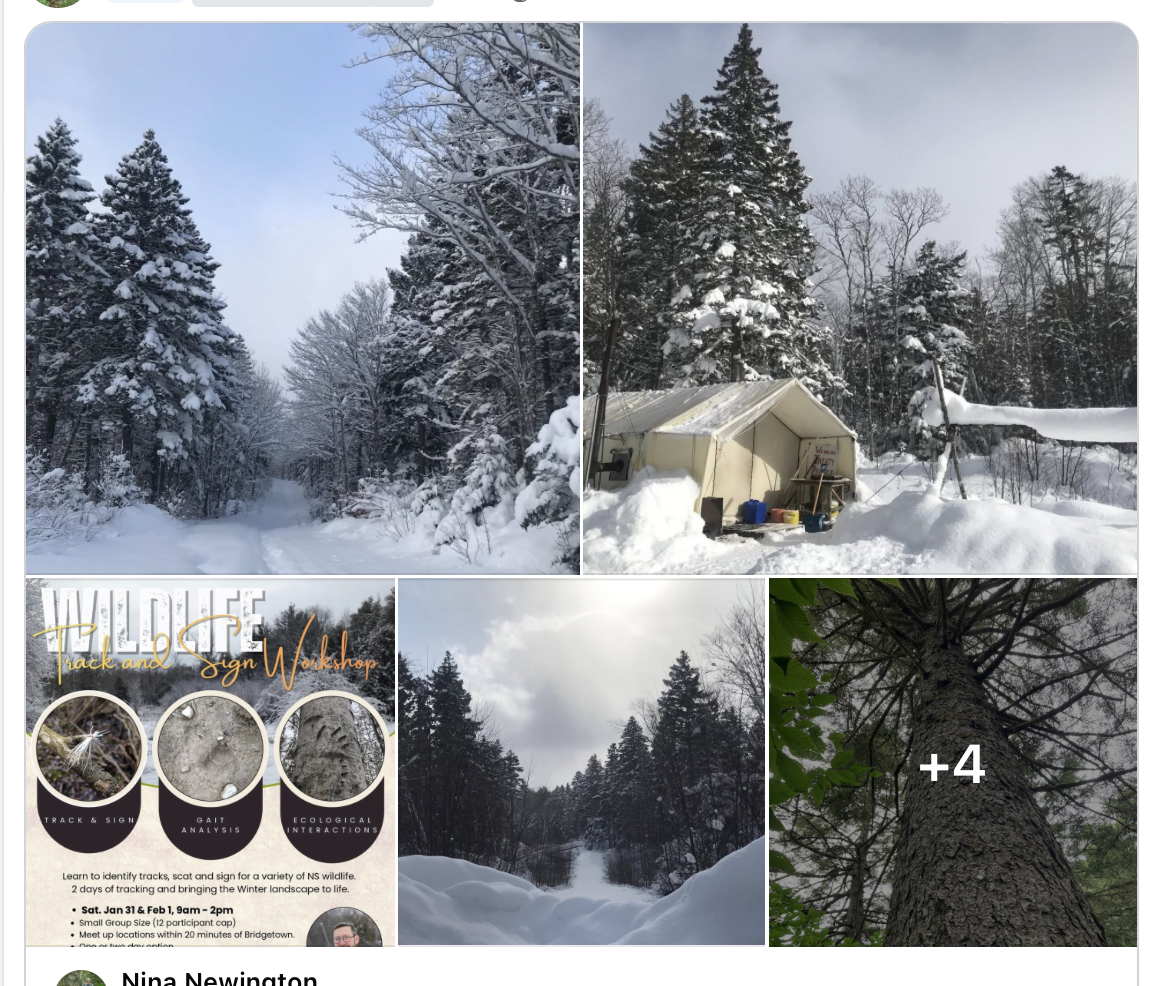 Camp NOW — Day 59
Nina Newington, Jan 28, 2026
Snow and then some more snow last night. Windy cold conditions for days and now weeks. We have a tent, stove, down sleeping bags to keep warm. Wildlife from endangered moose to marten need the shelter of mature to old evergreens in this kind of winter. They need stands like the red spruce stands in the cutblock WestFor flagged shortly before we set up Camp NOW.
This cutblock does not appear on the Harvest Plan Map Viewer many people have learned about recently. The HPMV is supposed to allow the public to see all the harvest plans on Crown land, but mysteriously this plan and the other one approved for the Corbett peninsula are missing. We only know about them from Freedom of Information requests, oh and that flagging that showed up in November.
More on the curious history of these zombie harvest plans another day. Suffice to say that, thanks to public actions to protect them over the past 7 years, the old and mature red spruce north and east of camp are still standing, providing shelter from this winter’s storms. Old red spuce are a rarity, as anyone who spends time in Nova Scotia’s forests knows. Although they are capable of living well past 250 years, it’s unusual to find an old red spruce that doesn’t have some kind of flaw that made it undesirable to the mills. The only way to rebuild the stock of old growth red spruce dominated stands is to leave a few of the mature stands alone. It’s not a huge ask of a government that is supposedly committed to protecting 20% of our lands and waters.
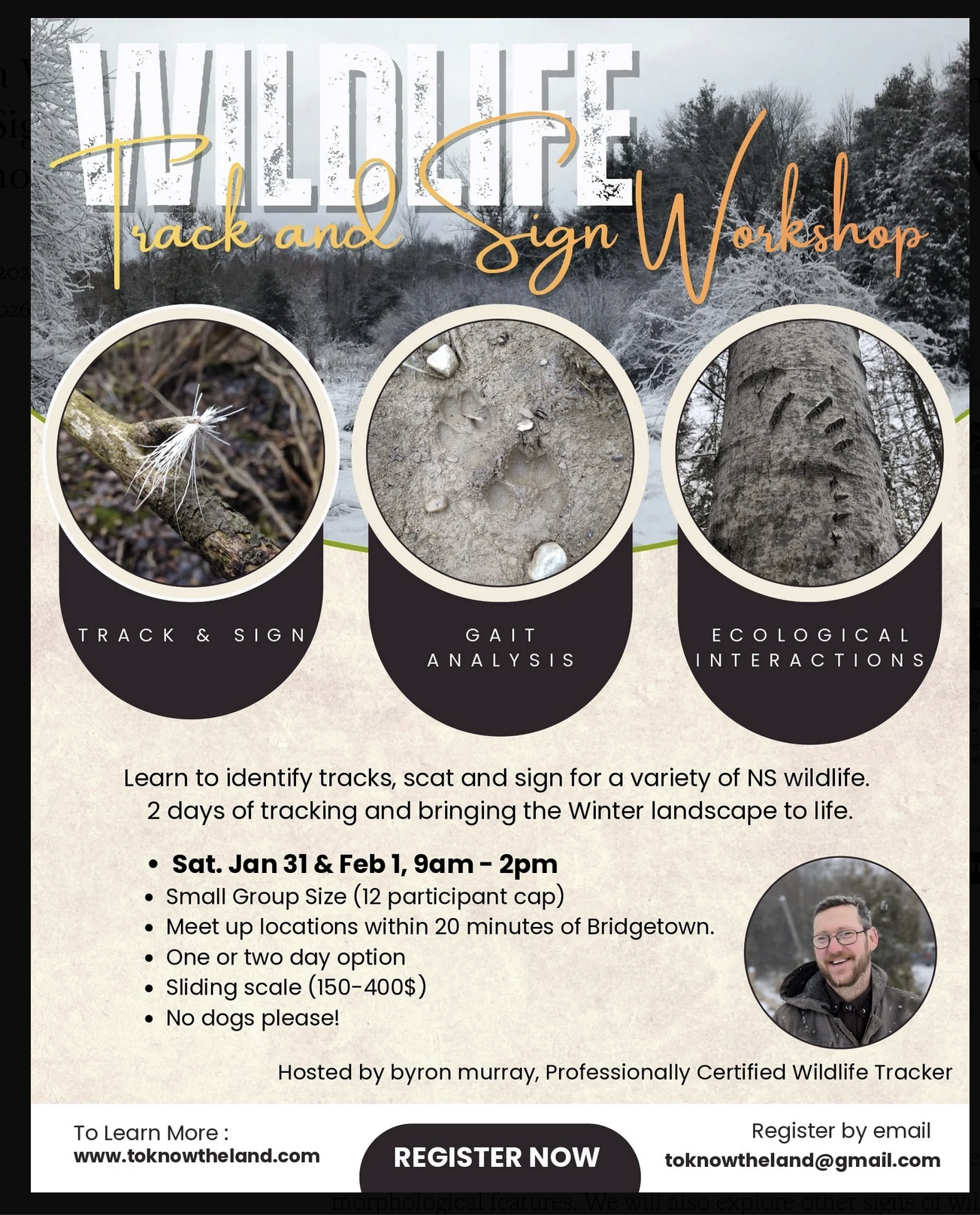
About the workshop. Click on image for larger version &/or go to website.
On a happier note, participants in a tracking workshop this coming weekend will get to visit and warm up in the tent at Camp NOW. There’s a sliding scale for the workshop and still I think a couple of spots. Check it out:
https://www.toknowtheland.com/events/nova-scotia-wildlife-track-and-sign-two-day-workshop
Camp NOW — Day 51
Nina Newington Jan 20, 2026
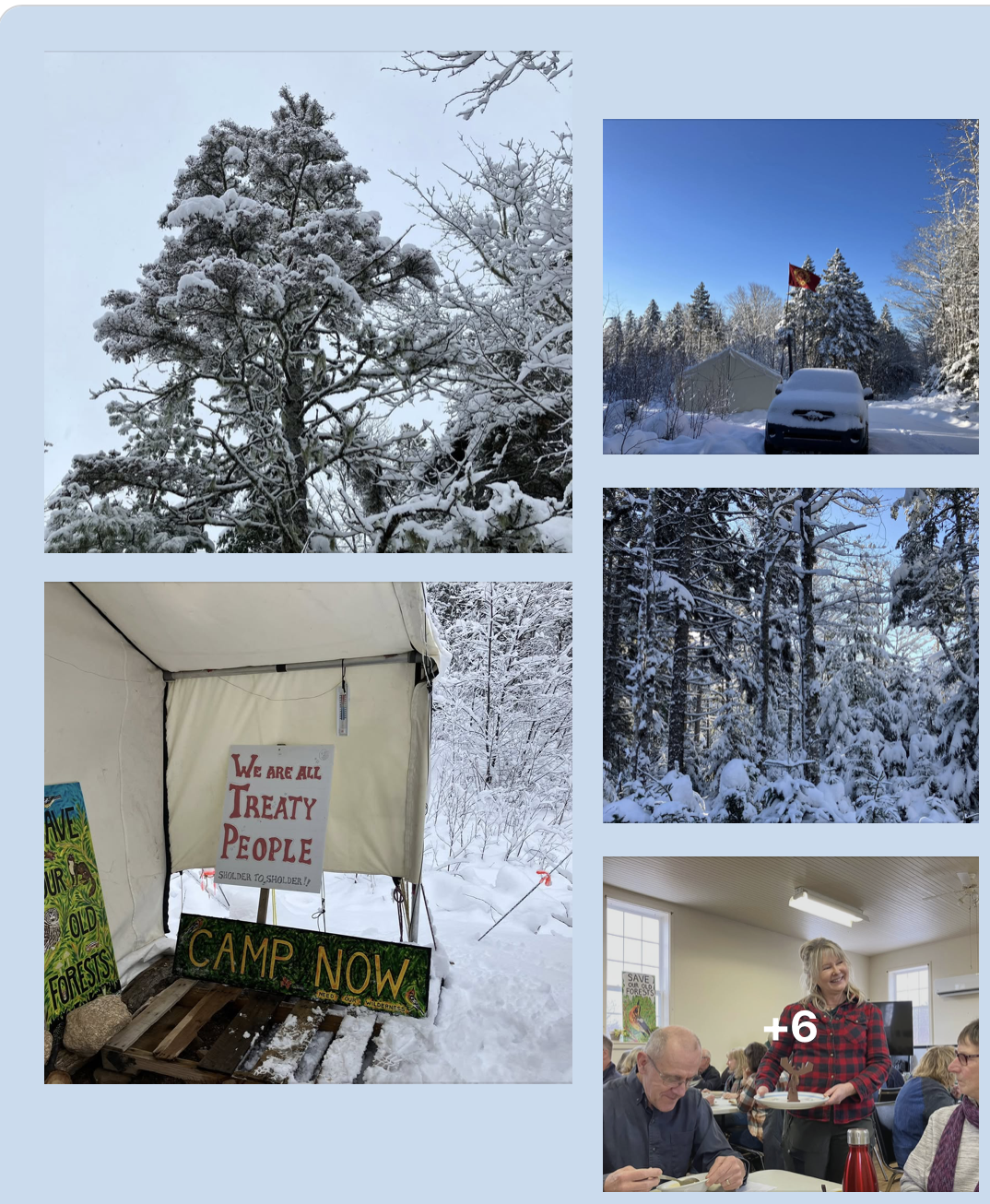 New snow, deep quiet, only the tap tapping of a woodpecker. Time to regroup. Feel. Think. Be with the trees.
Searching for Species at Risk where DNR would like to create a biodiversity sacrifice zone was the fun part of last week. Then came trying to explain in comments on the province’s Harvest Plan Map Viewer exactly how badly DNR has failed to follow the guidelines it laid out a mere two years ago for selecting these so called High Production Forestry sites. The guidelines that said sites important to endangered wildlife would be dropped from consideration. Ditto sites important for biodiversity. A weary anger builds as you sit for long hours and stay up too late, commenting on site after site, because it might make a difference.
It might.
It probably won’t but the thing is,
if no-one comments, that fact is highlighted. See, no one objected.
How do I know this? Through Freedom of Information requests. These are the only way you can find out what actually happened with that harvest plan you spent your evening commenting on. That’s right. The result of the review process for a harvest plan on our public land is not made public.
It grinds you down, just as it is intended to, the secretive way DNR manages public lands.
Which makes it doubly important to gather with other people who care too. The first SOOF Soup Sunday landed at just the right time, the day after the comments deadline. The Centrelea Hall was full, the soups and bread excellent. New faces mingled with familiar ones. People laughed and listened and thought. The news is not good at any scale. But here we are, doing what we can. And doing it in good company.
“Stubbleicious Snag! This is a term I like to use to describe a snag (standing, dead tree) with lots of stubble lichens!” Click on image to go to video on FB
Camp Now : “You may wonder why I’m posting these pictures of weird little pin-like organisms…”
Lisa Proulx Jan 16, 2026
You may wonder why I’m posting these pictures of weird little pin-like organisms…read on dear reader….
If you’ve been following us for awhile, you will have heard us talking (sometimes incessantly!) about Stubble or Calicioid lichens. Well, we have some very good reasons to share our excitement about these unusual and mostly overlooked cuties.
Stubble lichens can grow on a variety of substrates from tree bark, exposed inner wood of a tree (alive or dead), tree resin, and even some bracket fungi or other Lichens! Each species has its own specific requirements such as light, humidity, substrate pH,
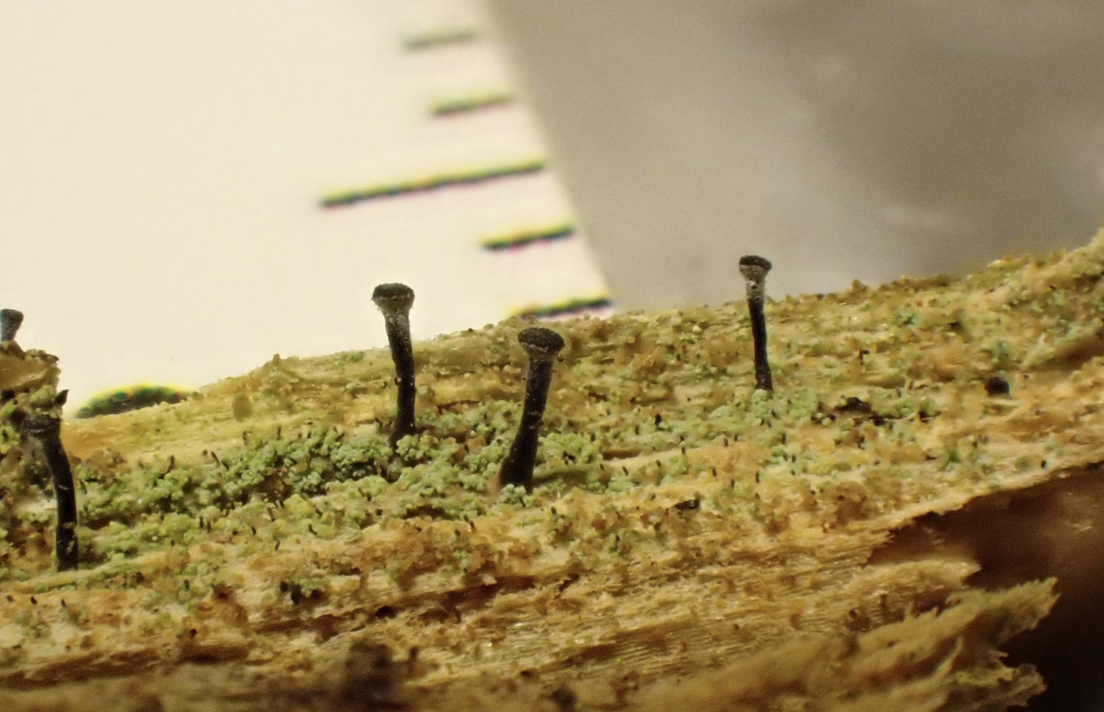
Yes those are millimetres! Note thee whitish collars around the cups.
texture and moisture capacity. We have spent countless hours surveying for the protected Frosted Glass Whiskers stubble lichen which is an indicator of old and old growth forest due to the long time required for the conditions it needs to develop.
Overall, the number of species of Stubble Lichens tells a story about the general age of a forest, or its ecological continuity….how long its been allowed to
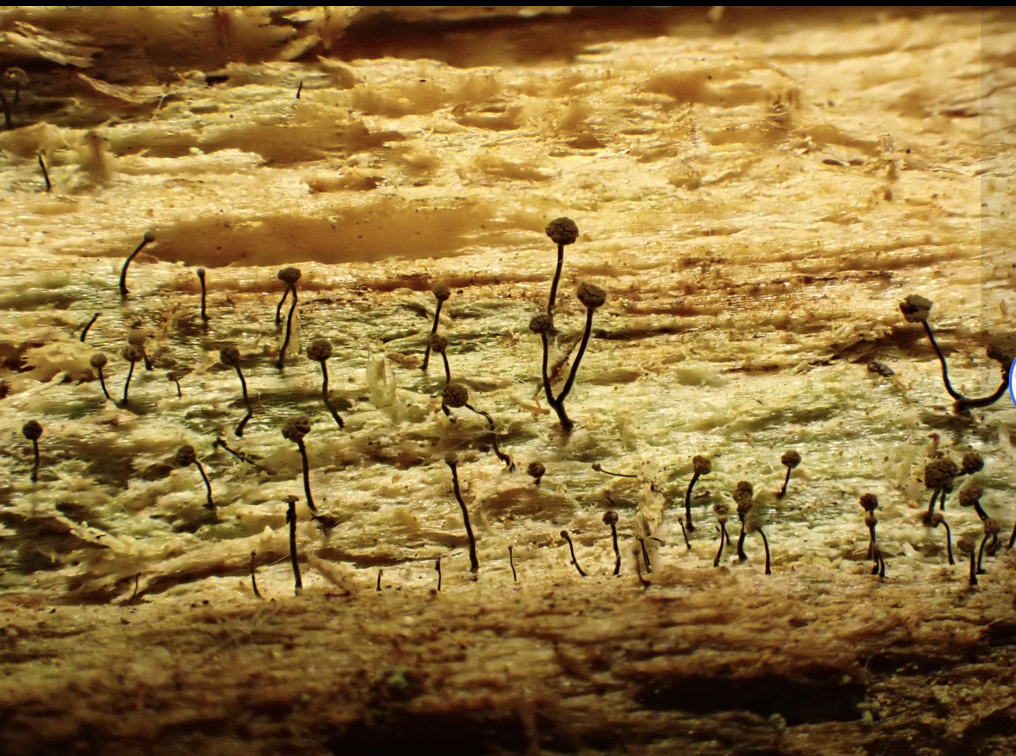
Notice a couple of these stubbles are branched which may help in identification although they all need microscope work for an accurate ID.
do what forests do…grow and recycle nutrients creating habitat for a wide range of birds, animals, insects, fungi over time. The more Stubble Lichens in a forest stand the greater conservation value it has. In other words the forest can support a wide variety of biodiversity.
This big probably White Pine snag is an important part of that process and will continue to contribute to the forest ecology for years.
But what happens if DNR allows Westfor and its contractors to use this area for High Production Forestry? The area will be clear cut and sprayed over and over again.
Please make your voices heard by calling or emailing MLA David Bowlby and the ministers of DNR and ECC. Also put your comments on DNR’s Harvest Plan Map Viewer…links in recent posts.
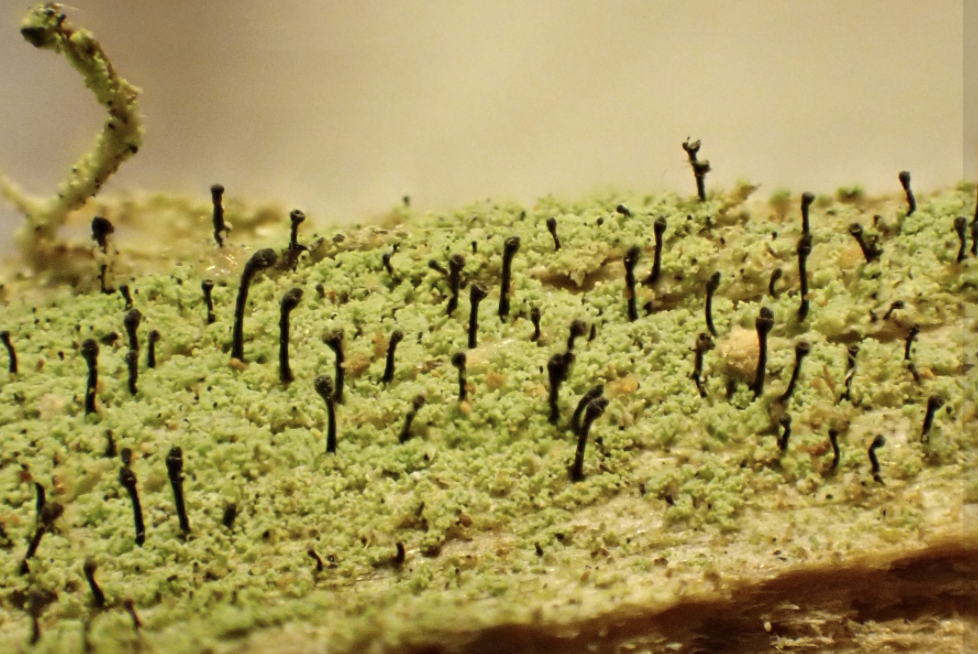 Sometimes the thallus, or main body, of the Stubble Lichen is visible as you can see in the greenish, granular substance. The stalks hold the spore bearing fruiting bodies. Often it is embedded within the wood where you can’t see it. |
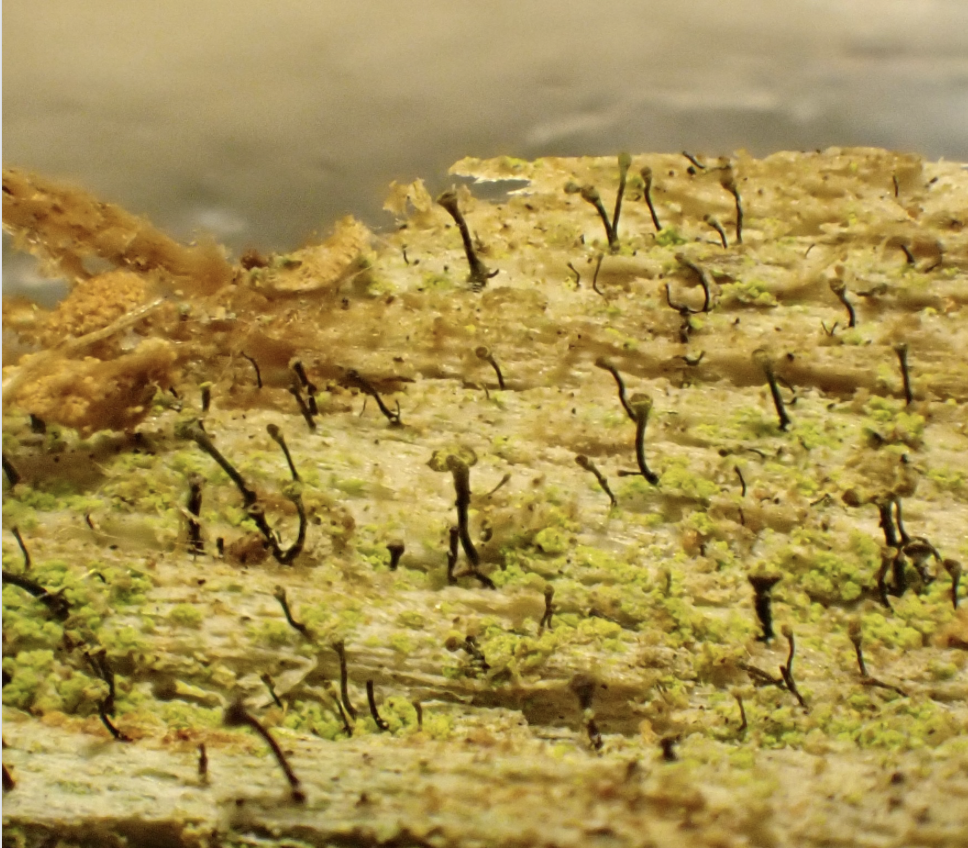 You may be thinking…they all look the same to me! It’s true they are tiny and look a lot alike but with a hand lens, time and practice we can learn to spot subtle differences but it still takes a trained lichenologist to look at spores and the algal partner living within for a definite ID. |
Camp NOW – Day 43
Nina Newington, Jan 12, 2026
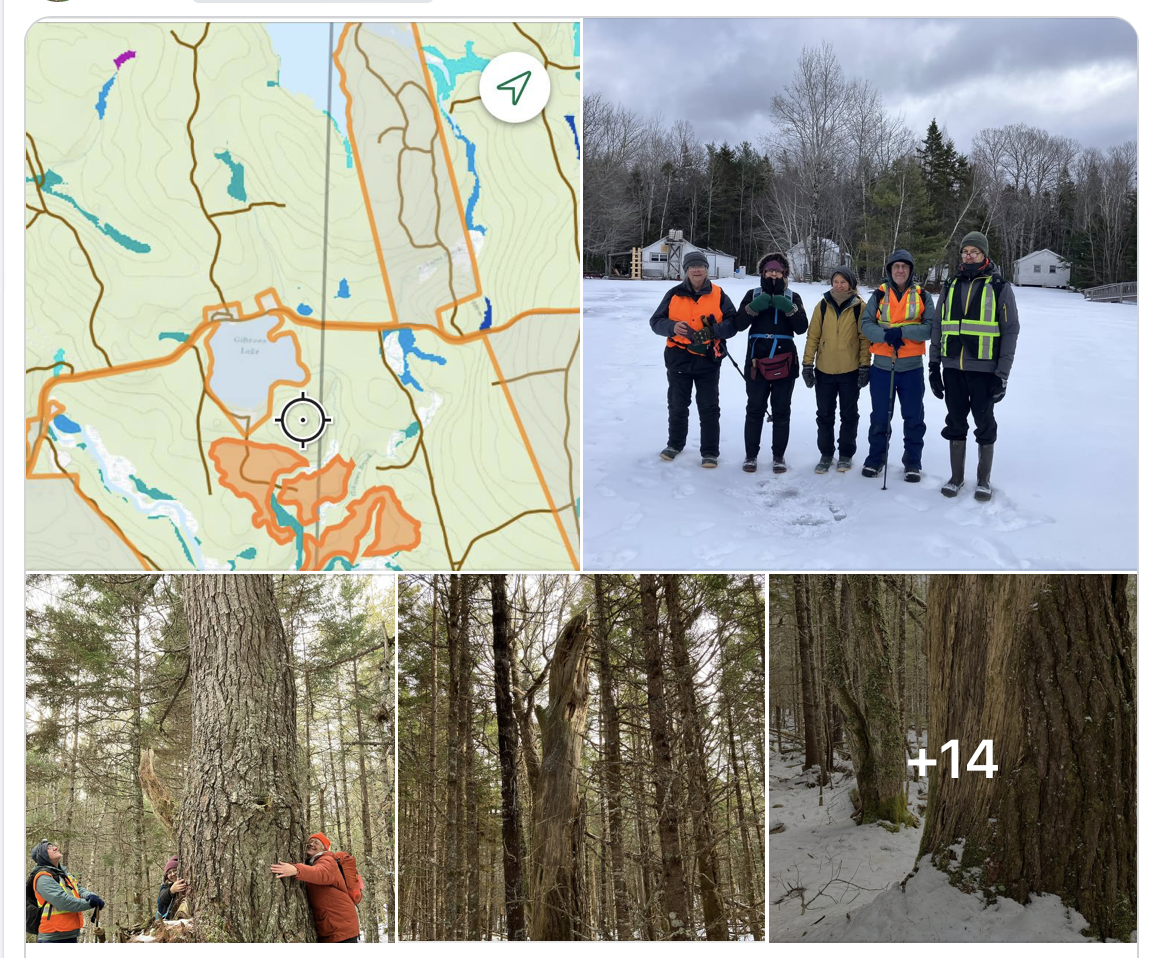 Today citizen scientists went to check out AP26D1005, the 31 ha DNR is proposing to clear cut and spray within the proposed Goldsmith Lake Wilderness Area.
It was a chilly and very windy day. At 6AM the walls of the tent were flapping, and the wind was roaring in the treetops. Staying in bag seemed a better option, but we wanted to get in and look at the site before the January 17 deadline for comments on the Harvest Plan Map Viewer.
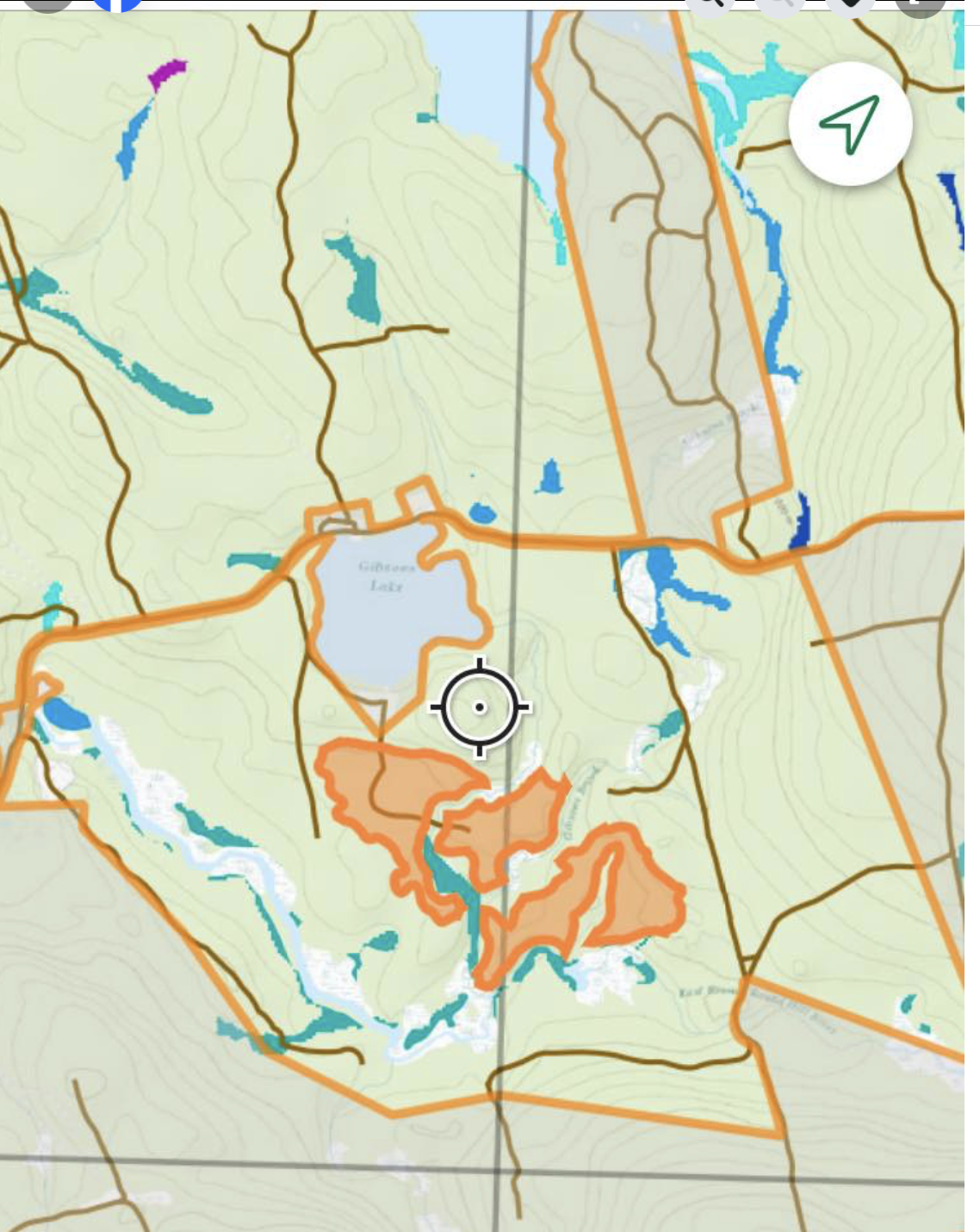
Orange shading is the proposed clearcut. AP26D1005. Orange line is the proposed boundary of the Goldsmith Lake Wilderness Area
What we found was so good, we’re going to have to go back again. The forest surrounding Gibson’s Brook where it passes through the proposed clear cut is rich with species at risk lichens — seven occurrences identified today. It is also home to an extraordinary array of calicioid (stubble) lichens. More on these in another post.
What we also discovered, near the second stream to flow through the proposed clearcut, were enormous white pines. White pine is an old growth forest species capable of living north of 250 years. 116 cm DBH was the biggest I measured among the living pines. Then there were the many mighty snags with hollow crowns. The biggest of these was 121cm DBH.
It’s hard to overstate how important and how rare
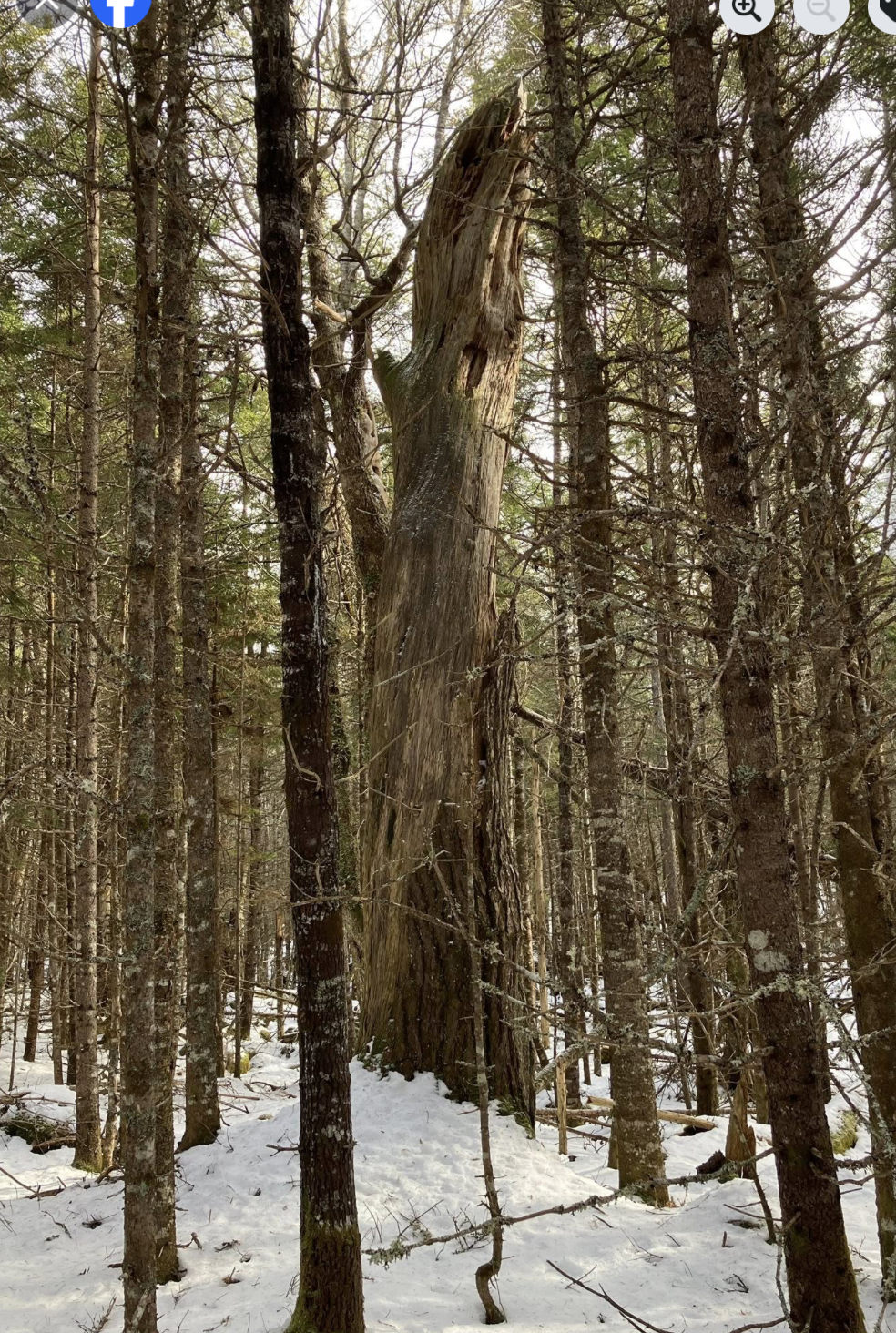
White pine snag. 121 cm dbh…”looked like inviting habitat for maybe Chimney Swifts of bats looking for a roost!”
these very large snags are. Big snags with hollow crowns are essential for endangered chimney swifts and bats to roost. Many other species make their homes in snags. Looking up, my eyes kept finding more and more cavities. No housing shortage for wildlife here.
And then there was the forest floor, laced with massive fallen trunks and boughs. The province’s Old-Growth Forest Policy includes the presence of ample ‘coarse woody debris’ as a key element of old-growth but I never saw coarse wood debris like this.
Some of the trunks had fallen across the brook and were clearly much used by wildlife as bridges. This is exactly the habitat the endangered Pine marten needs.
We’ll submit the species at risk
identifications to DNR, as we always do. We’ll put this site specific information in our comments on the HPMV.
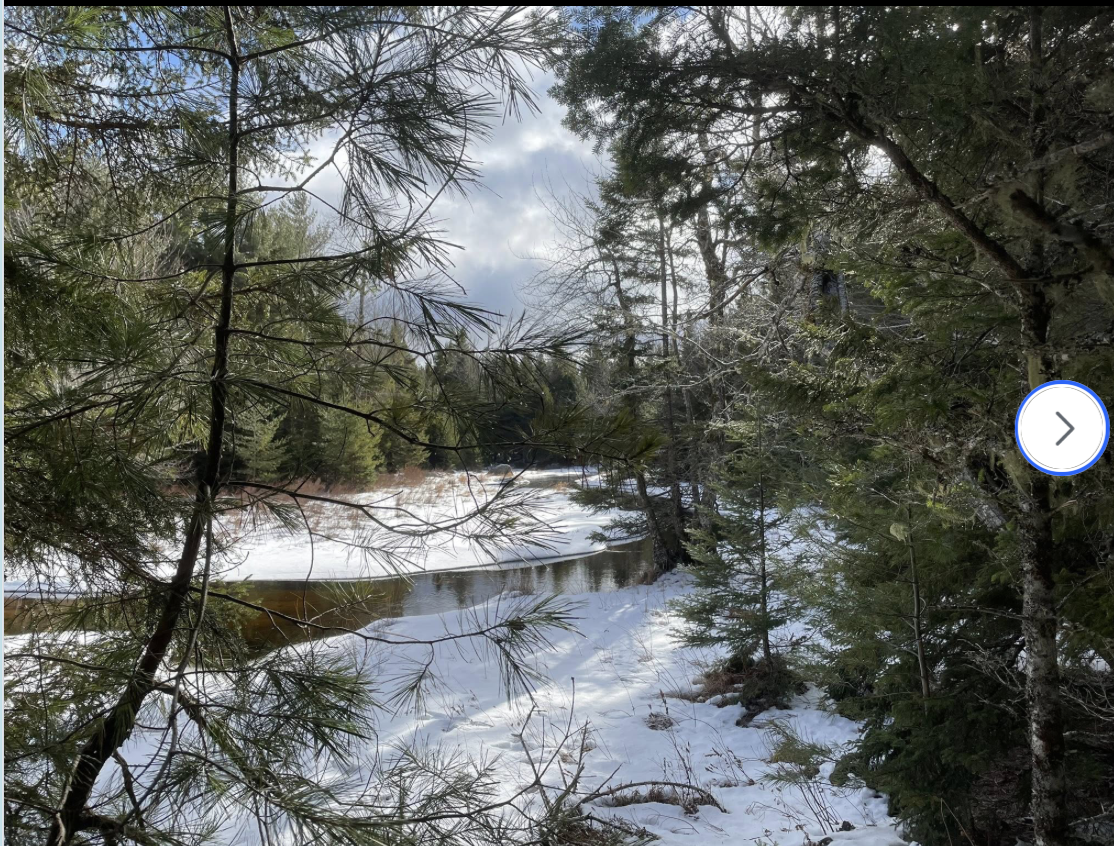
Gibson’s Brook flowing south from Goldsmith Lake towards the East Branch of the Round Hill River
The High Production Forestry Phase Two document DNR published is very clear: there can be no HPF in high biodiversity areas. The information we gathered today should be enough to make DNR drop the plan to make this an HPF site. Will it?
You can help. If you haven’t already, please submit your own comments on the HPMV by January 17th, for this harvest plan, AP26D1005. My Day 39 post has lots more information. While you’re at it, weigh in on the outrageous plan to clearcut and spray 79 ha next to the Mickey Hill Provncial Park, AP26D1003.
Camp Now — Day 37
Nina Newington Jan 6, 2026
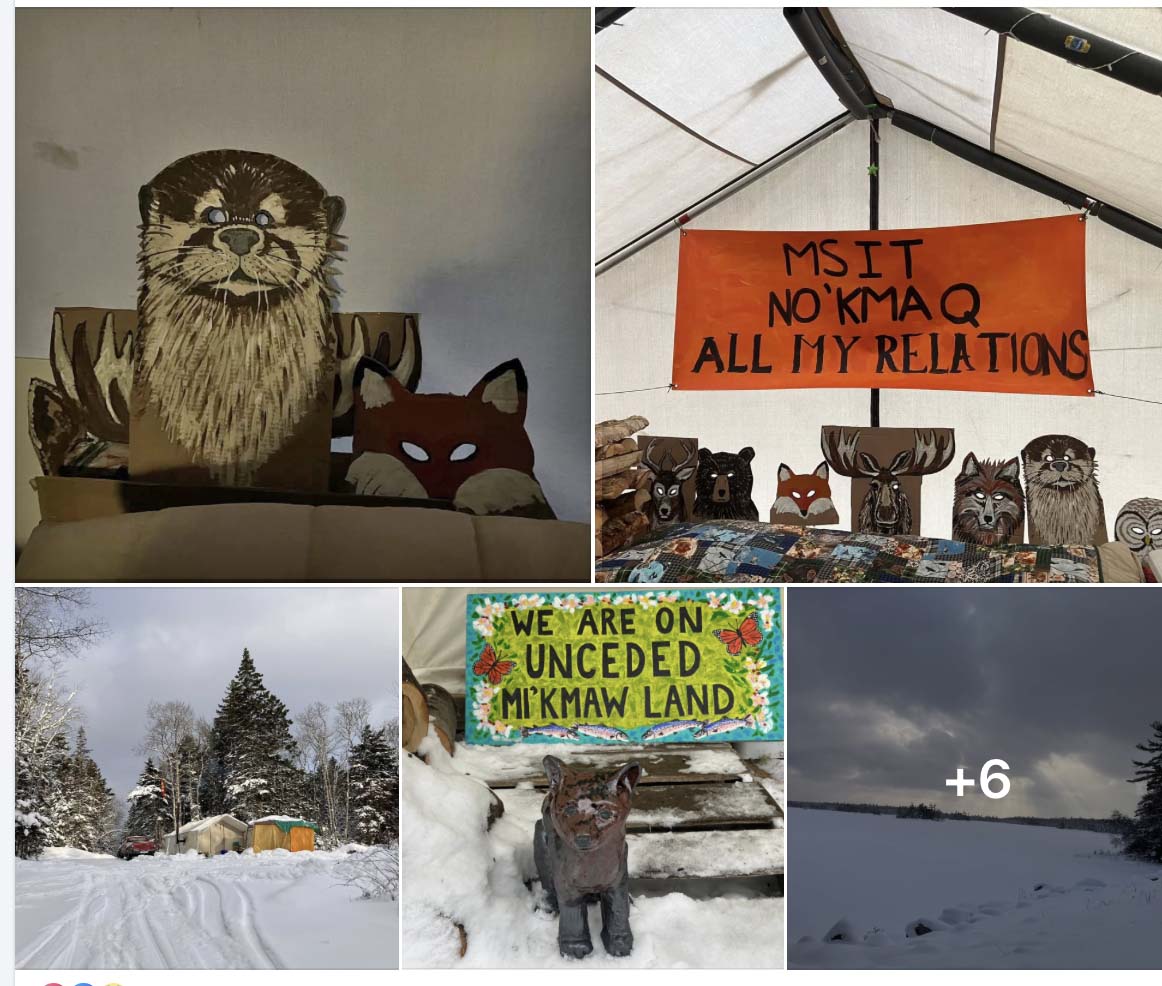 There’s a new face at camp, a lovely otter mask, in honour of all the otter tracks we’ve seen since setting up camp.
When I first saw this mask I cried. It’s something about the whiskers. I’m so grateful to Deb Kuzyk for the faces that fill the tent. They’re not cute but they are touching. And dignified. Possessed of their own particular spirit. Visitors pause when they choose which to hold. And yes, everyone does smile behind the cardboard, even though the photographer can’t see.
Msit no’kmaq. These are our relations. What does that mean?
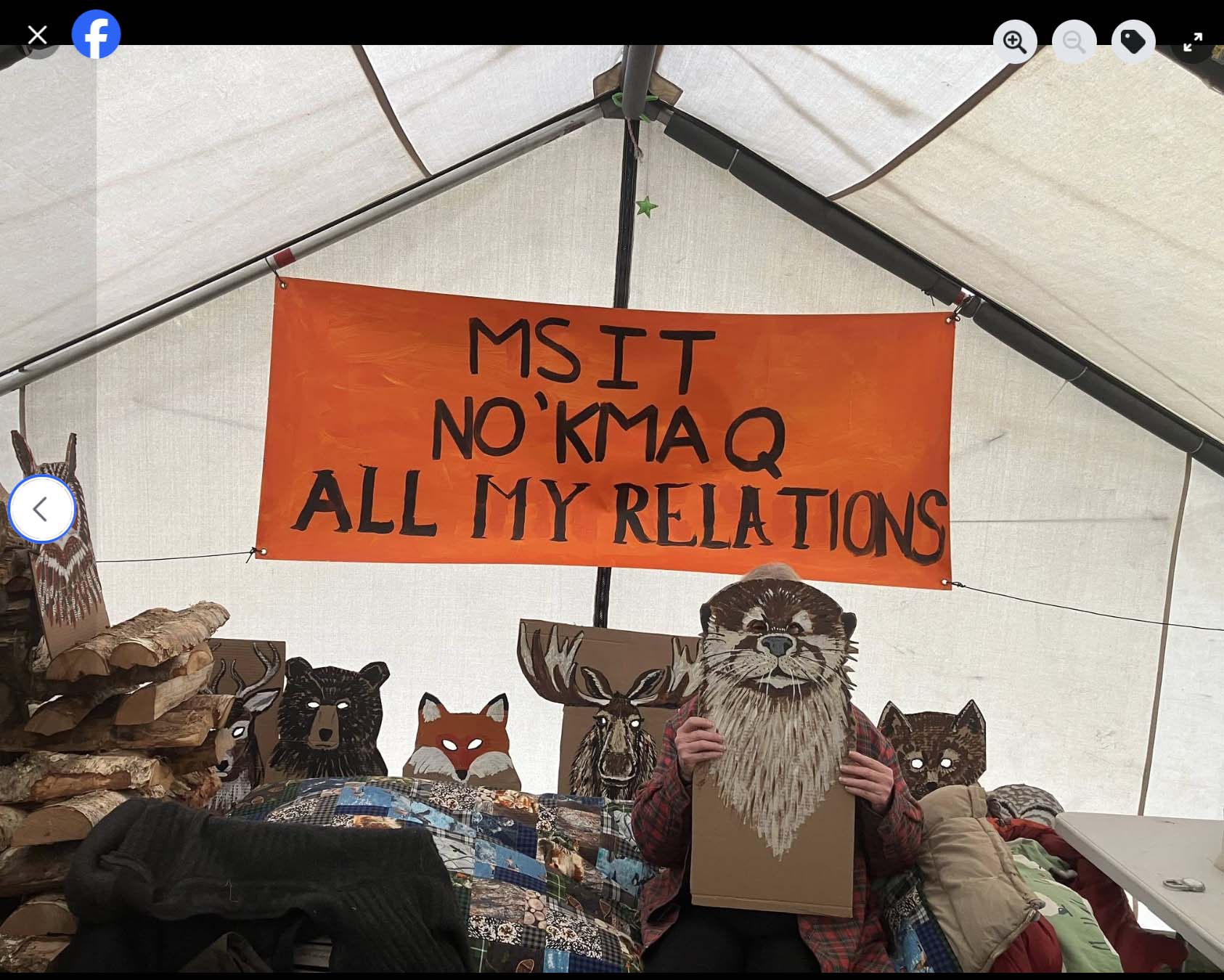
“Company”
Camp is a good place to think and feel. The silence is profound (except when it’s windy). In the night I hear coyotes. Twice lately a great horned owl. Evening grosbeaks and chickadees. Some mornings there are tracks in fresh snow.
Yesterday there was a mysterious channel in the snow, a slide perhaps. No paw prints. Otters again? Far from the place where I’ve seen otter tracks before. But close to another body of water.
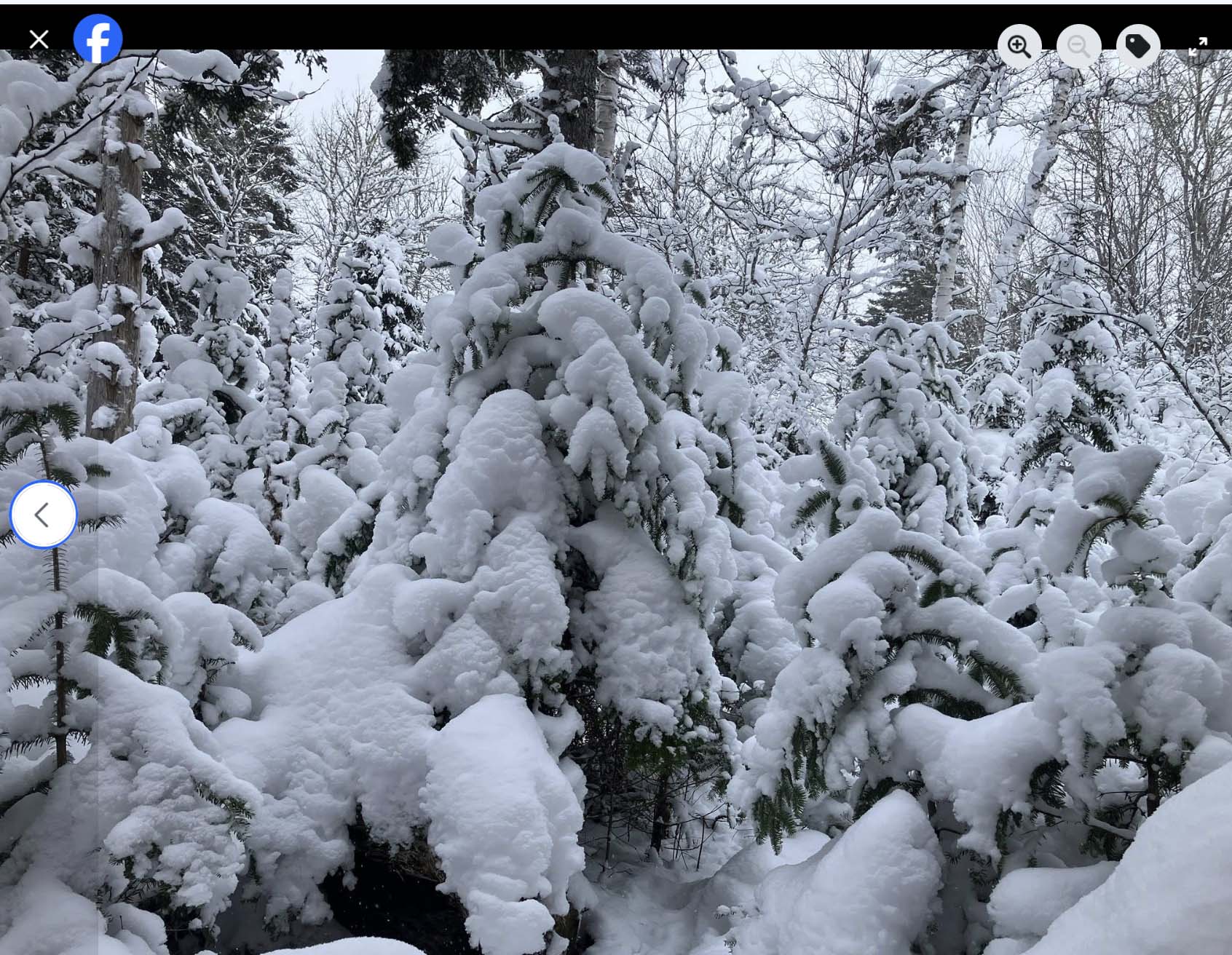
You take personally what happens to your relations. Whether they have what they need to thrive. You don’t control their lives, their experiences, their fates but you care. You aren’t separate.
You aren’t alone.
Camp NOW – Day 32 (Jan 1, 2026)
Nina Newington
 Happy New Year!
It’s been a month since we set up Camp NOW. Need Our Wilderness. Seems like a good moment to sum up why we’re camping beside a logging road in the snow.
Camp NOW is protesting this government’s failure to protect the proposed Goldsmith Lake Wilderness in particular, and in general to make any progress towards meeting its own legislated commitment to protect 20% of Nova Scotia’s lands and waters by 2030.
The camp is on Crown land. It is not blocking any logging road. We don’t know if the new Protecting Nova Scotians Act (sic) will be used against the camp. We refuse to be intimidated by a vague law with ridiculous penalties. We have a constitutional right to protest.
In addition to our right to protest, we take seriously our responsibility under the Treaties of Peace and Friendship to care for these unceded lands and waters, and to respect and uphold the rights of the L’nu, the original guardians of this land. We are proud and grateful to fly the flag of the 7 Traditional Districts of Mi’kma’ki.
We wish to be a voice for the voiceless, for the bear and the marten, the lichen and the toad, moss and snake and trout and loon, and to live in the wisdom of Msit No’kmaq – all my relations. We are not separate, us humans. We have a place in nature, and responsibilities. We need to act on those responsibilities. Now.
The immediate impetus for setting up camp was discovering fresh flagging around one of the two cut blocks on the Corbett peninsula, in the eastern part of the proposed Goldsmith Lake Wilderness Area. The flagging indicates that WestFor is getting ready to log this parcel.
This is not the first time citizens have stepped up to protect the peninsula between Corbett and Dalhousie Lakes. Following public protests in 2018-2019, including an encampment on this same spot, a hold was put on any logging here. In September 2024, bowing to pressure from WestFor, DNR quietly lifted that hold. Since then, 15 species at risk occurrences and 3 stands of old growth forest have been confirmed on the peninsula. As a result, the area available for logging has shrunk by more than half.
The amended harvest plans look like Swiss cheese. It’s nice that the new flagging excludes the buffer zones for species at risk lichens and a stand of old growth forest, but it is long past time for DNR to recognize that an area with this high a conservation value should not be logged at all.
If the government were serious about meeting its 20% commitment, it would put a freeze on logging and other industrial activities in the Goldsmith Lake Wilderness Area so that the area can be formally reviewed for protection. But that’s not what’s happening.
Instead, DNR recently put forward a plan to clearcut another part of the Goldsmith Lake Wilderness Area. The same thing is happening in all the other citizen-proposed Wilderness Areas. Far from meeting its legal commitments, this government is undermining them.
Meanwhile, the reasons we need to protect substantial areas of this and every province grow ever more compelling.
This summer, the Long Lake fire burned right up to the boundaries of the proposed Goldsmith Lake Wilderness Area. Human activities played a big part in this fire. The managed softwood plantations that have replaced so much of our native Wabanaki forest set the stage for the fire, a fire that burned out of control as a result of a terrible drought. The drought was made far more likely by human-caused climate change.
Climate change and nature loss threaten our whole existence and the lives of all our relations on this planet. It is time to say no to business as usual, to say we want to care for the land and for each other. We don’t want to extract and extract and extract to line the pockets of the rich and never mind the cost. We are all already paying the cost and that cost will only grow.
It’s time to change course. How do we do that? *Keep using all the available channels to insist that our governments respect their legal commitments to protect nature. And don’t give up.
*Get in the way of what damages the Earth. *Stand shoulder to shoulder with the traditional guardians of this land. *Paint and write and dance and dream.
*Grow food and share it.
Each of us must do what we can. But we don’t have to do it alone. Here’s hoping we come together in 2026, settlers and Mi’kmaq, rural and urban, young and old, to look after the Earth and each other in the spirit of the Treaties of Peace and Friendship.
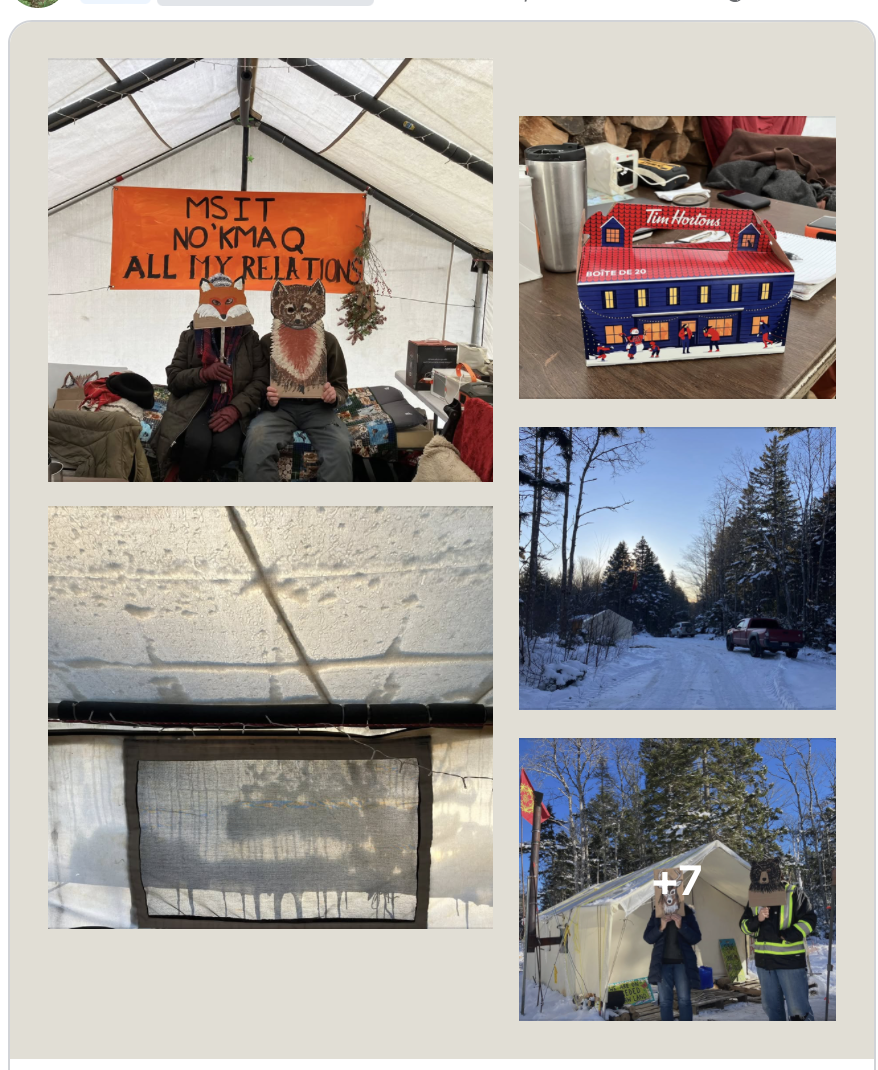
Camp NOW — Day 29
Nina Newington, Dec 29, 2025
So many visitors to camp in the days before this latest storm, many replenishing the stock of treats. Simple pleasures abound. Putting a face to a facebook name. Real, wide ranging conversation between 3 generations. Sunshine and ice make art on the tent. Otter makes tracks again.
Camp NOW — Day 23
Nina Newington, Dec 23, 2025
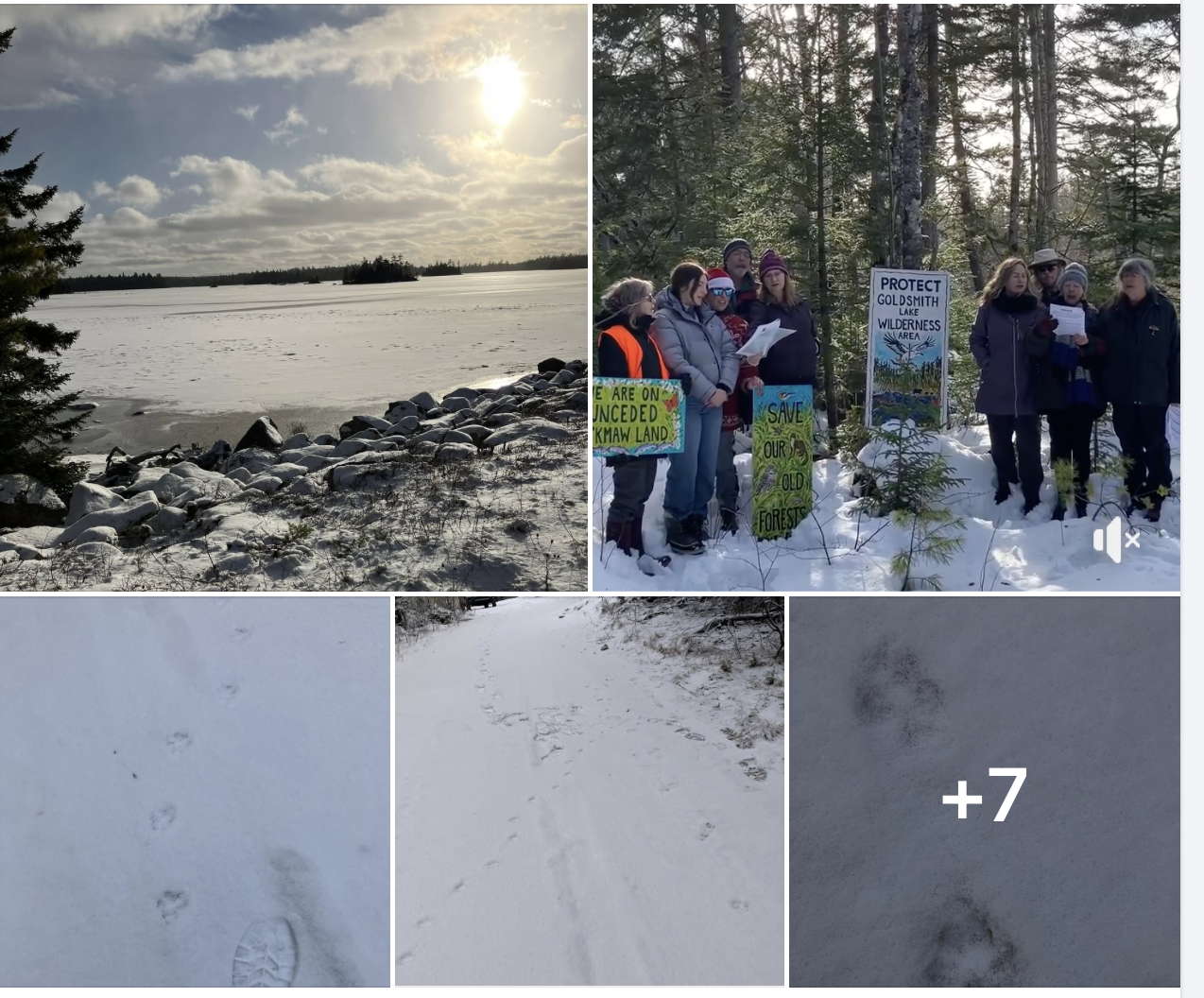 Snow tells stories about what our no’kmaq — our relations — are up to. Last night, for example, or perhaps in the early hours of this morning — long enough ago for some snow to have sifted into his or her tracks — a coyote came trotting up the logging road from the north. Twenty metres from camp they slowed then made a tight little circle and went back the way they came. After a few metres they headed west into the forest.
A hundred and fifty metres south of the camp, coyote tracks reappear on the road. They come out of the forest on the west side of the road. Same size tracks, same length of stride, same vintage. Probably the same coyote, going on about their business, having skirted the camp, heading south on the road past Corbett Lake.
Other fresher tracks cross the coyote’s: snowshoe hare, squirrel, mice, a grouse.
When I was younger I took tracking courses from a guy called Paul Rezendes and wandered the woods where I lived, hungry to read the forest. I was never that good at tracking, but eager to learn. I found out early that paying close attention to the natural world is a reliable source of joy. It is also heartbreaking. If you’ve paid attention, it is impossible to miss how empty the woods are, compared to how they were even 40 years ago. And by all accounts, those woods were empty compared to the way they had been 40 years before that.
Recent studies have established the links between forest degradation – the loss of old natural forest — in the Maritimes and declines in bird populations. It’s not only birds that need settlers to mend our ways. Colonization devastated the wildlife of Mi’kma’ki as surely and as systematically as it devastated the human society indigenous to this place. But the web of life in these lands and waters is powerful and resilient.
However diminished the forests may be, it matters more than ever to protect the best of what is left.
And it matters to learn. Paying close attention deepens love. It is love of the land and the water that makes us willing to stand up for this place and for all our relations.
By a happy coincidence there is a two day tracking workshop coming up at the end of January, with one of the days using Camp NOW as a base. Spaces are limited.
https://www.toknowtheland.com/events/nova-scotia-wildlife-track-and-sign-two-day-workshop
Camp NOW — Day 21
Nina Newington, Dec 21, 2025
 Camp came through the storm just fine.
And today we crossed the threshold into winter. Every year I am grateful that the days are already getting longer by the time winter bares its teeth. Imagine if the days kept getting shorter until February!
The Winter Solstice is a holy day to me, a day to ground in the cycle of the year in northern climes. To connect with ancestors who knew without question that we are part of the natural world. Living in a tent helps.
Not without artificial lighting, it must be said. The length of the nights is measured in the battery power required to charge camp’s ‘solar’ lanterns.
But today, today is the day the nights start growing shorter.
It is also the day a terrifing array of delectable treats arrived at camp from Arch & Po bakery in Annapolis Royal. I’ll do my best to diffuse the treat bomb but it’s a good thing we have plenty of visitors coming over the holidays.
Looking at all these goodies is reminding me of the first time Arch & Po sent Christmas treats. That was to the Last Hope Camp, set up on December 2nd, 2021 to protest the planned logging of a forest by Beals Brook, about 15 km east of here. They sent us tree cookies with green icing. That tangible, edible support really mattered. It still does.
Thank you, Arch & Po, and all the other local businesses that support SOOF’s work. Special shout out to the Bees Knees while I am at it for donating yummy bread to so many SOOF Soup Sundays.
There’s something about these cold short days that makes one treasure human warmth and kindness even more than usual. Camping out in winter ratchets that up a notch. It also makes me very aware of all the people without shelter, without the funds to stay warm, without dry clothes, without enough to eat.
Lots of people are asking about donating to Camp NOW. We are doing fine for now so if you can, make a donation to people who need a little help to stay warm and dry and fed this season.
Camp NOW — Day 19
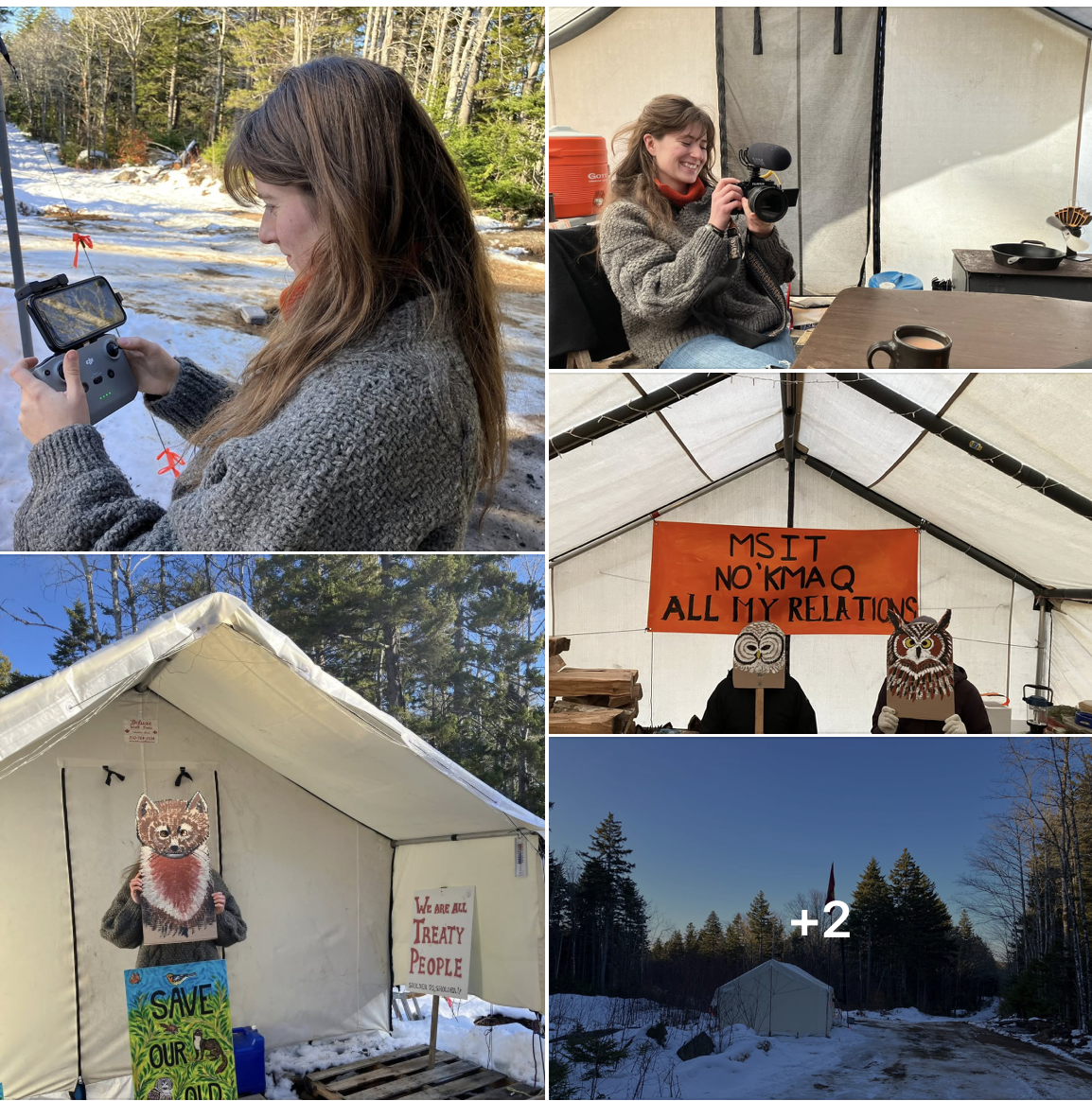 Nina Newington Dec 19, 2025
The Goldsmith Lake area is one of only a few places on the mainland where Marten have been documented in multiple locations.
Yesterday, in the calm before the storm, documentary maker Emily Russell stopped by camp again to get some drone footage and to talk a bit more in the wake of the arson at Hunter’s Mountain.
She got to try out the new Marten mask too. The Pine or American Marten is recognized as endangered in Cape Breton. DNR has been studying Marten populations on the mainland. The Wildlife division is in the process of recognizing the Marten as endangered in the whole of Nova Scotia. The Goldsmith Lake area is one of only a few places on the mainland where Marten have been documented in multiple locations.
DNR recognizes that the Corbett peninsula — where camp is located — is Marten habitat. And yet their plans allow logging to go ahead here.
Camp NOW is here to speak for the Marten. They need this forest to be protected. Wildlife need protected wilderness areas. So do people.
Camp NOW is here to protest this government’s ongoing failure to meet its own legal commitment to protect 20% of our land land and water.
Thank you to all our visitors, from film-makers to carol singers to cookie-bearers and firewood-bringers and camp-tie-downers, to people stopping by to say hello and get a little owl-y. ‘Tis the season to care for all our relations.
Msit No’kmaq
Day 17 Biodiversity in the GLWA
By Keith Egger, dec 17, 2025
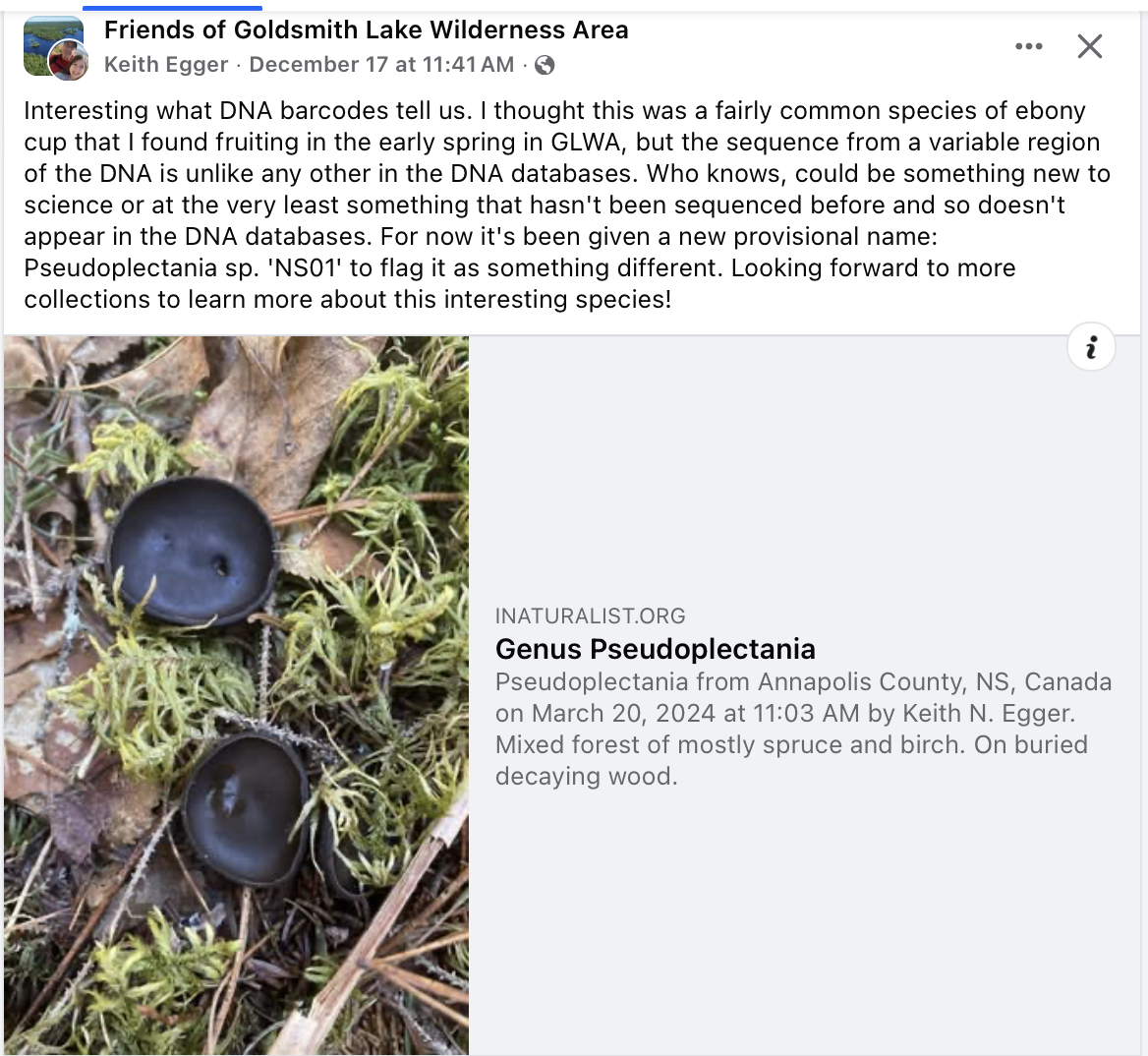
Camp NOW — Day 12
Nina Newington Dec 12, 2025
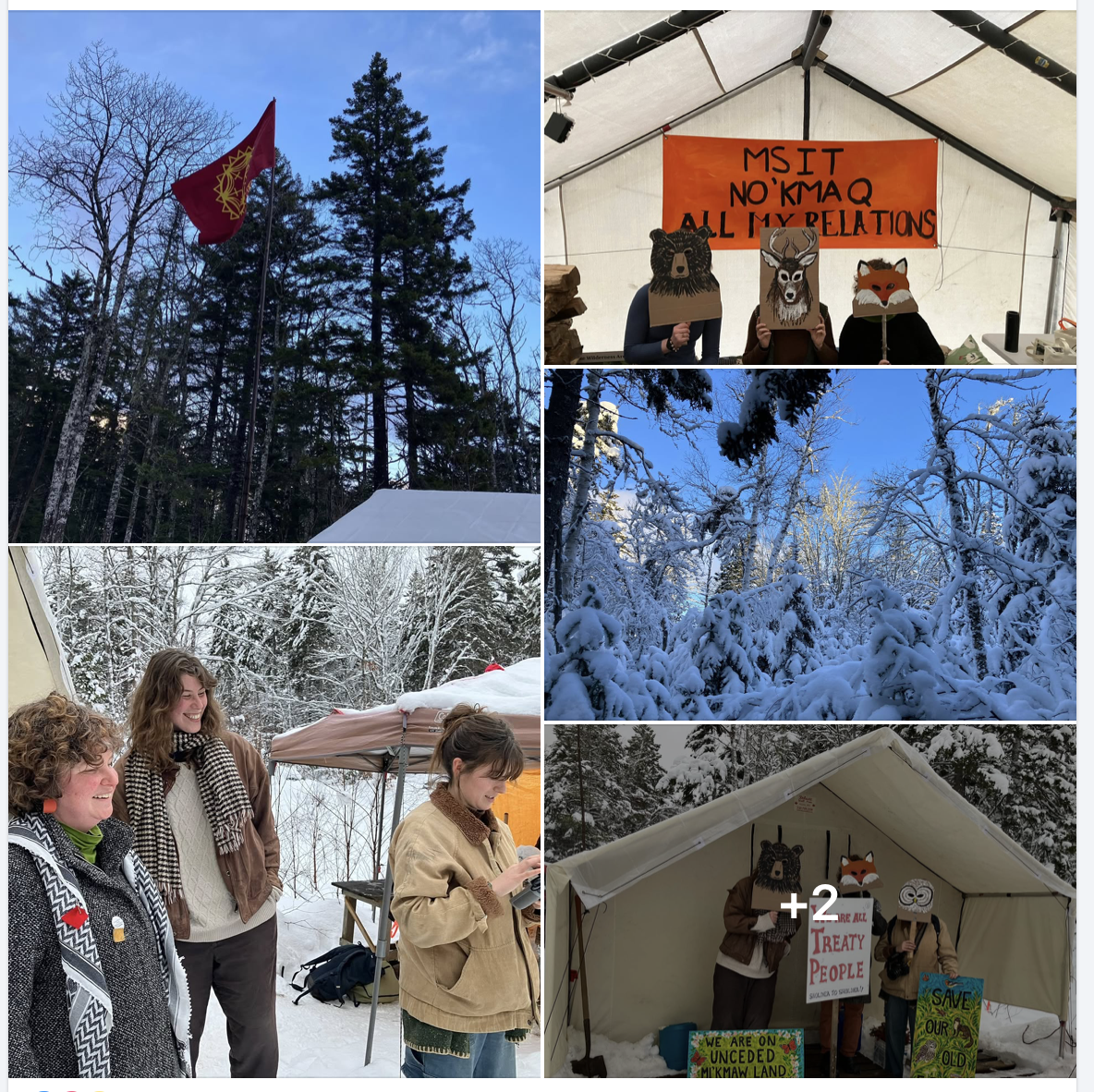 No visitors yesterday — the road in was horrible — but beautiful brief sunny breaks.
Wednesday brought Erin and Emily, making a documentary about Hunters Mountain, and Sadie Beaton, fellow organizer for last month’s Shoulder to Shoulder: We Are All Treaty People rally.
Sadie has been showing up for her responsibilities as a settler under the Treaties of Peace and Friendship for many years now. She has built relationships of trust by being there for the work. It was a privilege to sit and listen and talk in the tent while Emily recorded and filmed and Erin asked questions.
Tim Houston’s aggressive disrespect for Mi’kmaw rights, the rights of nature, our democratic rights as Nova Scotians, is prompting many more of us to stand up, to stand together, to say ‘No, this is not the direction we want to go in. We want to live in peace and friendship with each other and with all our non-human relatives on this beautiful unceded land.’
It is good to have time at camp to think and feel about my own responsibilities as a settler here. I am deeply grateful for the opportunity to work peacefully and persistently to protect forests and lakes and wetlands that are home to such a variety of life. To speak for those who cannot speak for themselves: the animals, the trees, the fungi, the lichens.
Msit No’kmaq.
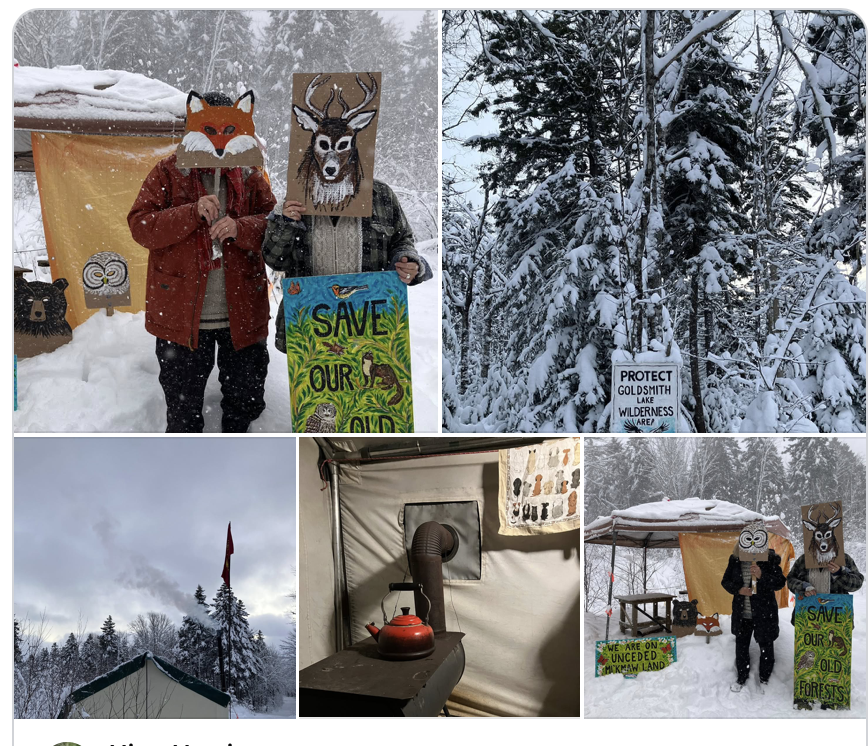 Camp NOW – Day 8
Nina Newington Dec 8, 2025
Check out The Todd Veinotte Show on 95.7 News radio tomorrow at 10:30am. Live interview from Camp NOW!
In the meantime, visitors and beautiful fluffy snow and dry firewood. Life is good.
Speak for the animals. They too need protected areas.
 Nina Newington
Camp NOW – Day 6
Fun to have visitors to camp, bringing news of otters — four of them crossing the road on the way in!
I keep thinking about all the wildlife displaced by the Long Lake fire. The fire came right up to the southeast corner of the proposed Goldsmith Lake Wilderness Area. The fire burned 85 square kilometers. The proposed Wilderness Area covers 40 square km. Wildlife need refuge more than ever. Why can’t the government just protect this area?
Donna Crossland spoke so well about this in yesterday’s CBC interview. Protecting the area helps people as well as animals, especially the people who are now living in a blackened landscape. The green shade of an old forest is soothing, healing.
To listen to the interview or read a rough transcript, check out https://nsforestmatters.ca/in-the-news-top/in-the-news-climate-change/rough-transcript-of-what-do-forest-protections-look-like-now
Dec 4, 2025
Nina Newington
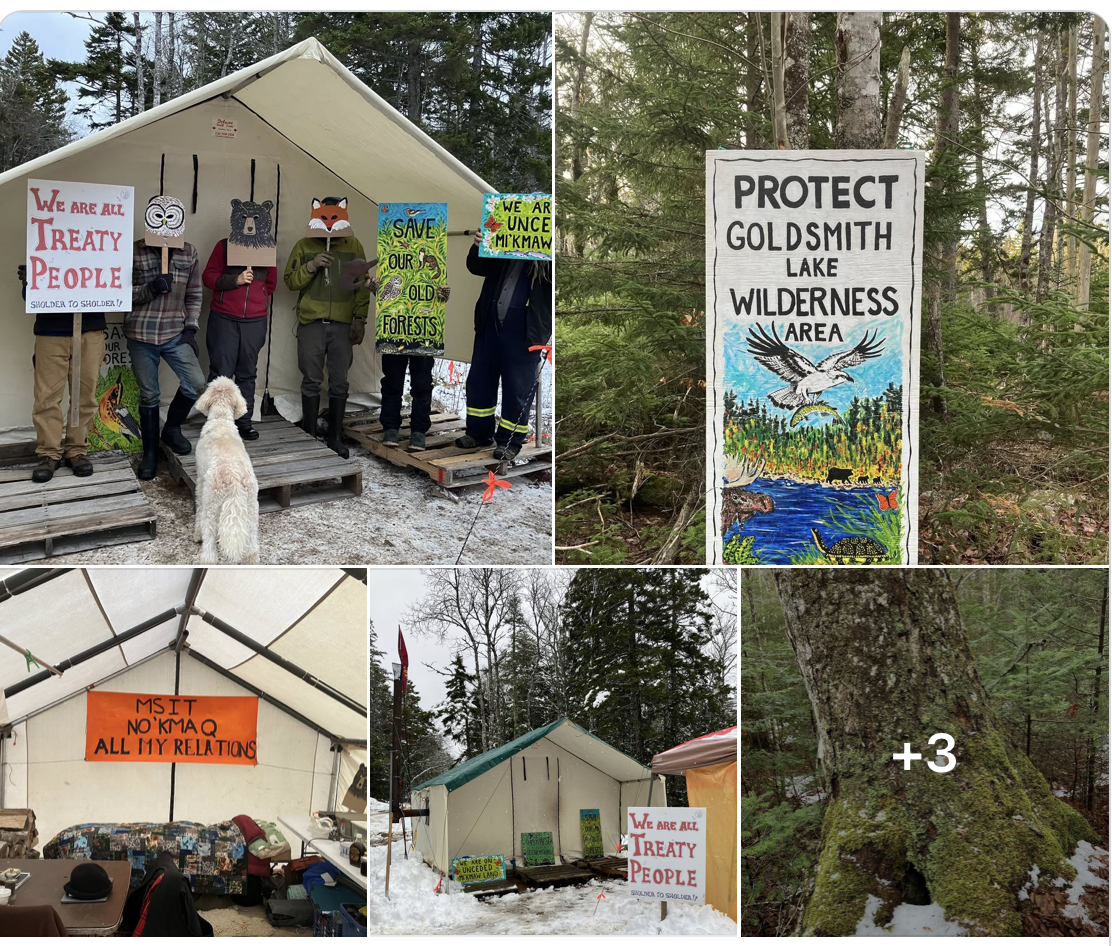 Camp N.O.W. – Need Our Wilderness – is up and running on the Corbett Peninsula in Annapolis County, the same part of the proposed Goldsmith Lake Wilderness Area where Lichen Camp was set up in April.
But Camp NOW is different. We are here to protest this government’s failure to protect the Goldsmith Lake Wilderness Area or any other new Wilderness Areas on public lands. Progress towards protecting 20% of Nova Scotia’s lands and waters by 2030 has been miniscule, less than half a percent since the 20% commitment was included in the Environmental Goals and Climate Change Reduction Act in 2021. Instead, DNR is approving logging in citizen-proposed Wilderness Areas including Goldsmith Lake, Beals Brook, Ingram River and Chain Lakes.

“Camp NOW occupies the exact same spot as this year’s Lichen Camp”. Photo from the Lichen Camp,
A couple of weeks ago, citizen scientists discovered new flagging around the largest cutblock on the Corbett peninsula. With recognized Pine Marten habitat, three stands of old growth forest, and 12 confirmed species at risk occurrences, the peninsula’s high conservation value is well-established. It more than meets all the government’s own criteria for areas to protect. But DNR is allowing logging to go ahead anyway. Enough is enough.
MORE ON THIS STORY tomorrow at 6:40 am on CBC Radio’s Information Morning