We all need to work together. In the end, the well-being of our communities and the natural world depend on trust and good will, as do markets.
Post/Page on Nova Scotia Forest Matters
By David Patriquin
Dec 12, 2025; some editing Dec 13, 2025
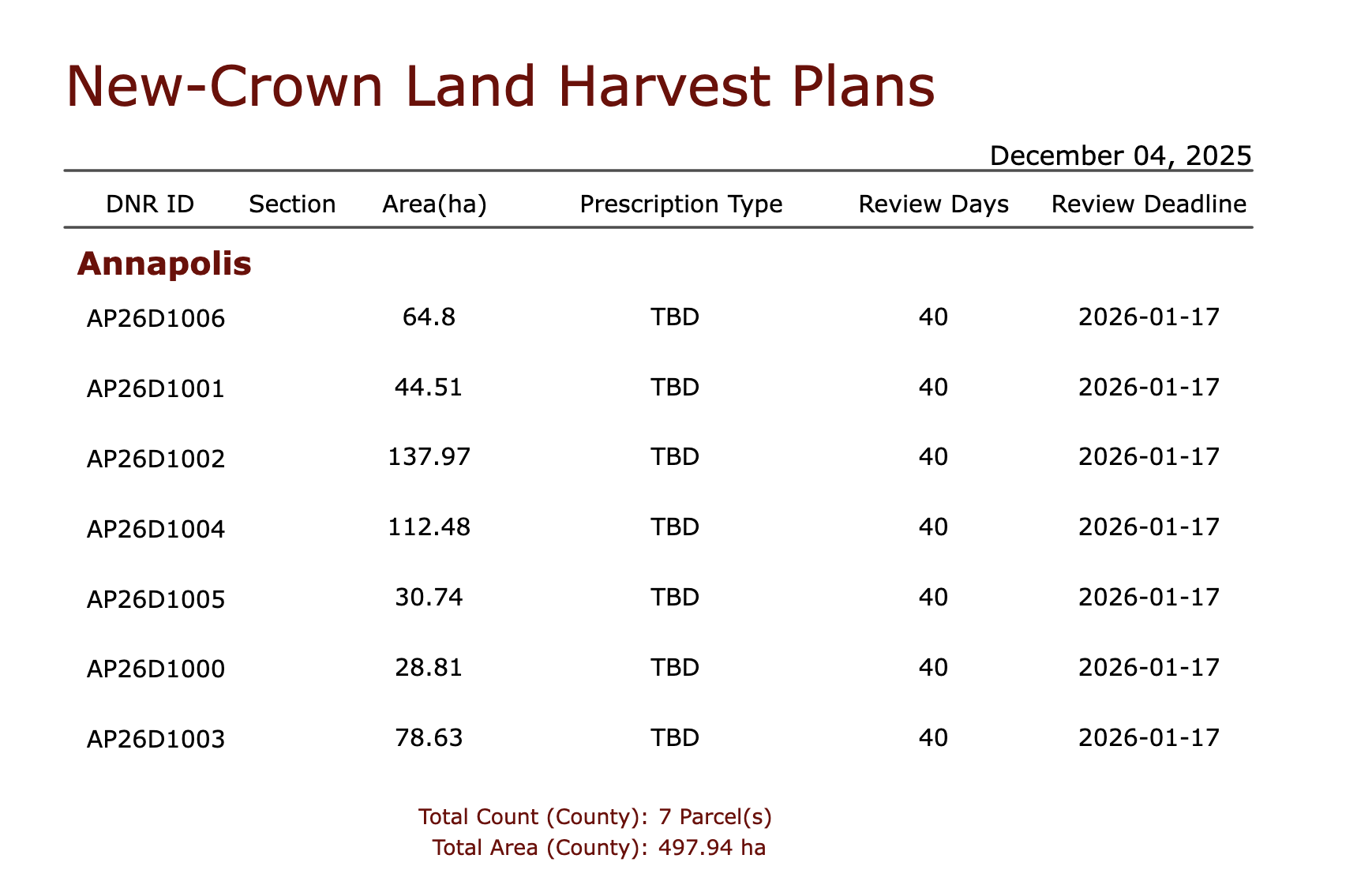
Top part of the announcement, stats for Annapolis Co.
CONTENTS
The WestFor 12-month Plans
On Dec 8, 2025, Nova Scotia Forestry Maps provided subscribers of Harvest Operation Maps an announcement/opportunity-for-comment on proposed harvests of 76 parcels/5642 ha of Crown Lands.
*These notices are not posted or archived on the NS Gov website. so you have be a subscriber to view them. More recent ones are available on NSFM.
Of that total, 5461 ha/56 parcels – distributed in Annapolis, Digby, Halifax, Hants, Kings and Lunenburg counties – are “licensees’ development plans [in which they] outline their proposed harvest operations for the coming 12 months”; the plans are “open for comment for 40 days.* Under Prescription Type, “TBD” is given for all of these parcels.
*The other 181 ha/14 parcels are “Harvest proposals that are not included in a development plan [and] are posted for comment for 20 days.”
On Nov 6, 2025, Forestry Maps had announced in its message to subscribers that such 12-month would be forthcoming “starting this fall”:
We are making changes to how harvest proposals are reviewed and approved. Starting this fall, licensees will submit development plans that outline their proposed harvest operations for the coming 12 months. The majority of their proposed work on Crown land will be captured in these plans. Sometimes they may have individual proposals outside of these plans. The development plans will be posted on the Harvest Plans Map Viewer for comment for 40 days. If your comment provides information about the proposed harvest plan that is specific to the site, you may be contacted for further detail.
Harvest proposals that are not included in a development plan will be posted for comment for 20 days. These changes streamline the planning process while still keeping an avenue open for people to provide local knowledge about the sites being proposed for harvest. It’s one way that we’re supporting our forestry industry to sustainably manage forests on Crown land, create jobs for Nova Scotians and bring more than $2 billion a year into our provincial economy.We thank you for your interest.
As the lands cited on Dec 8, 2025 are all Crown lands managed for the Crown by WestFor, I am referring to these “plans” as the “WestFor 12-month Plans“.
This is the second big drop of longer term (1 year) or long term (5 year) forestry plans made subsequent to the NS Gov. declaring on 17 Jan 2023 that it had completed the implementation of The Triad model.
The PHP 5-yr Pilot Project
The first big drop (“Part I”) was on Aug 1, 2024 when subscribers were given 40 days to comment on 4216 ha/103 parcels proposed for harvest over the ensuing 5-year period on Crown lands in Inverness and Victoria Counties in Cape Breton; these are lands managed and harvested by Port Hawkesbury Paper under a FULA (Forest Utilization License Agreement). This set of parcels was described as part of “a pilot project on “Outcomes-based forestry” by Port Hawkesbury Paper in partnership with the Department of Natural Resources and Renewables…taking place in the Cape Breton Highlands (ecodistrict 210) starting in 2024. It will run for 5 years.” I refer to it as the PHP 5-yr Pilot Project

Subscribers were informed that “Pre-Treatment Assessments (PTAs) are not available through Harvest Plans Map Viewer for the pilot project. The licensee will still be required to evaluate forest conditions and document the basis for treatment decisions.” View NSFM post Aug 5, 2024 for more details.
Requested public input is limited to site-specific info
In relation to the current announcement (WestFor 12-month plans), subscribers are told that Forestry Maps wants to hear from the public only in regard local, site-specific information (italics inserted):
The purpose of the Harvest Plans Map Viewer is for the public to share local information that the department may not already know about sites where harvest operations are proposed. It shows proposed plans for the matrix and high production forest zones of our model for forestry… If you share specific information about the site of a proposed harvest, you may be contacted for further detail.
Similar language was used in relation to the Cape Breton Pilot project and they added that “If you have general comments and/or questions about outcomes-based forestry or ecological forestry please direct them to ecologicalforestry@novascotia.ca or visit https://novascotia.ca/ecological-forestry/ for further information.”
On the Forestry EA, OBFM and public input to strategic-level planning
As well as consulting the public for site specific information, it is clear that Lahey intended for the full set of stakeholders in our Crown lands to have an ongoing say at the landscape or “strategic” level of decision-making. Thus I noted in relation to the PHP 5-yr Pilot Project that there was no mention of the Forest Environmental Assessment which was an integral component of the Lahey Recommendations and would provide for more extensive consultation and transparency; it would also introduce landscape-level planning for biodiversity conservation as a component of a “20-Year Forest Stewardship Planning Guide“.*
* See Biodiversity Landscape Planning for Nova Scotia is being developed as part of the L&F Environmental Assessment Project, post on nsforestnotes.ca June 16, 2020, also links cited under Section 7 of Addendum: On the EA
Lahey cited the benefits of the EA in his Conclusion # 78: (bolding inserted)
| # 78. A legislated forestry management process conducted as a Class II environmental assessment – or in a comparable process under an independent third party (or panel) – has the potential to accomplish a range of objectives: a. It will bring transparency to the management of Crown land for forestry production and provide the public with a meaningful opportunity to contribute to Crown land management at a strategic level of decision making. b. It will help to ensure that forestry is conducted on Crown lands in ways that are compatible with the full range of values applicable to the management of public lands, with the activities of other users of Crown lands, and with activities taking place on neighbouring lands. c. It will help to embed the principles and values of ecosystem‐based forestry (or of ecological forestry) into the plans that will then inform operational planning and harvesting decisions. d. It will bring a significant measure of institutional independence from DNR to the planning of forestry on Crown land. e. It will create opportunities for stronger and continuing relationships between operators and their stakeholders and mechanisms for ongoing dialogue with those stakeholders through the process of a plan’s ongoing implementation. f. It will facilitate and enable customized application of the principles of ecosystem‐based forestry to account for relevant regional differences. g. If done properly, with openness and transparency and based on strong science, it will reduce the pressure for intense scrutiny by DNR or the public of individualized harvesting decisions. |
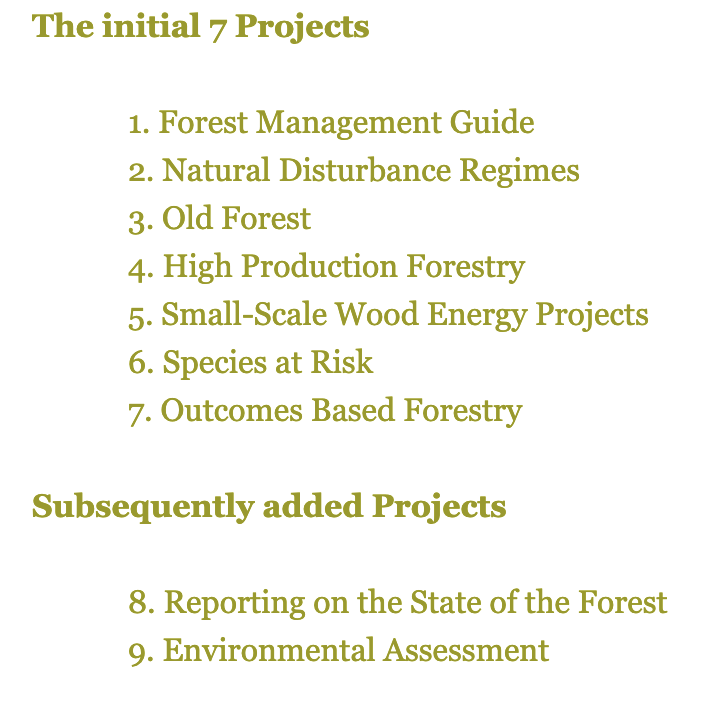
From Post on NSFNotes Sep 8, 2020
They are all still on current list, even though some have been completed.
In regard to item (d), the independence from DNR and the reduced pressure for intense scrutiny by DNR (item g) – and also reduced pressure on DNR staff – would be provided by implementation of Outcomes-Based Forestry Management, another of the suite of 9 projects set up to implement the Lahey Recommendations (see list at right).
As cited above, the The PHP 5-yr Pilot Project was described as a ” OBFM (Outcomes Based Forest Management) pilot project” and there there was no mention of an E.A.
It’s not clear how the WestFor 12-month Plans relate to Lahey’s recommendations and the ensuing nine project areas. Clearly what we are presented with are Harvesting Plans for the next 12 months, they are not broader, strategic plans that present info. on sustainable harvest levels, stand age distributions, considerations related to wildlife connectivity etc; there is no evidence of any Landscape-level Planning for Biodiversity Conservation in these “plans”. It’s at least implicit that such planning is involved in OBFM as being applied in the the PHP 5-yr Pilot Project although without the EA and the associated “20-Year Forest Stewardship Planning Guide”, it doesn’t seem to be spelled out anywhere.
So what are the the WestFor 12-month Plans? Evidently they do not involve OBFM – or do they, or are they some kind of hybrid?
Regardless, like the PHP 5-yr Pilot Project, there is no EA and no alternative mechanism for the public input related to strategic level planning. I just learned that PTAs had not been conducted for the WestFor lands when the announcement was made*; (as noted above, PTAs are likewise not available for the PHP 5-yr Pilot Project). So really, what is it that WestFor/NSGov. want feedback on? That perhaps the harvesting might interfere with access to a favourite fishing spot?
*See subpage Re: PTAs for the WestFor 12-month plans(?) for details.
Adding some further haziness into how the Lahey Recommendations are implemented, the agreement with WestFor is not a FULA as cited in the EA documents, although that was apparently the initial intention*, and it is clear in the context of the Lahey Report that WestFor lands would also be subject to an EA.
*See THE PATH WE SHARE A Natural Resources Strategy for Nova Scotia 2011-2020 Five-year Progress Report APPENDIX 3, page 23. “The consortium was incorporated in 2015 as WestFor, which will jointly hold one western Crown harvesting licence. A Forest Utilization License Agreement (FULA) negotiation began with WestFor in July 2015 and is expected to be completed by December 2016.”
Cherry-picking from the Lahey Recommendations
In short, it appears that the NS Gov./DNR, it’s claim to have completed its triad model of ecological forestry notwithstanding, is cherry-picking from the Lahey Recommendations, choosing to implement Outcomes based Forestry Management that enables industry to operate more independently, but not implementing the EA which provides for more transparency and input by a wide range of stakeholders, and for at least some degree of Landscape-Level Planning for Biodiversity Conservation.
It’s probably not a stretch to suggest that one outcome of such cherry-picking has been the “Hunters Mountain Protest” and the related, ongoing concerns about lack of consultation expressed by First Nations peoples.
But even in relation to site-specific comments, it’s difficult to believe that NS Gov/DNR is serious about public input, such as the citizen science rare lichen surveys and other efforts being made by citizens to contribute constructively towards towards the goal of 20% protection by 2030; rather the compressed review processes are seen by many as a deliberate strategy to minimize such input.
On the other hand, Forest NS folks consider that “we’ve done a very good job of implementing two-thirds of the Lahey report”, but complain that “The part that has not been implemented to its fullest extent and really just tip of the iceberg so far is the high production forestry… which allows us to remove higher volumes in a smaller area and reduce those costs of harvesting.”
They also complain about the cost of harvesting Crown lands compared to private land which they blame on “all of the pre-assessments and post-assessments and quality checks and controls…all the rules in place to operate on government or Crown owned property as opposed to private wood lots.*
*Comments made in How do we deal with the Softwood Lumber Tariff? a recent Forestry Uncut podcast produced by Forest NS.
So I have to wonder, are these perspectives driving the compressed comment periods/lack of more public consultation and the apparent priority being given to developing the High Production Forestry over meeting Protected Area commitments?
The Triad as a compromise (or not)
The inclusion of an EA was a factor that prompted ecologically oriented folks skeptical about the Triad to support the Lahey recommendations overall.
It’s not that they (we) liked the EA process particularly, and many had bad vibes about HPF…there was debate about it all following the release of the Lahey Report in Aug of 2018, but by the latter part of September 2018, there was overall endorsement by ecologically oriented folks of the recommendations at large.
The Triad was accepted as a compromise. Both sides (Big Forestry/conservation oriented folks – with the more ecologically oriented forestry organizations straddling both) would get less than they wanted for the sake of both sides getting a good portion of what they wanted, and for the sake of peace on the forestry front in NS.
In fact, the developers of the Triad concept, Robert Seymour and Malcolm Hunter, both of whom were on Advisory Group for the Independent Review, maintain that in the end it is not a compromise, it will benefit conservation AND increase wood supply; “it is a win-win deal…Triad has something for everybody”.*
*See NS Triad and the subpage Triad Lit on this website.
Perhaps, just perhaps, if both sides were sincere and with Lahey’s guidance, it would work. For a period, forestry organizations big and small, government personnel, and the rest of us (including NGOs) sat at the same table and worked out details of how to “implement Lahey”. That went well overall in regard to the Forest Management Guide project, and to some extent for the Old Forest Project but in most other areas, the rest of us have been largely excluded, especially under the current government. The State of the Forest Report which should include an updated assessment of the wood supply are surely way overdue.*
*- Comments Lahey 2021: “…too much further delay in producing an improved and expanded State of the Forest report would be concerning for these reasons:
• It will inhibit our ability in the near future to measure and evaluate change – or the lack of it – in the condition of forests as a result of implementation of other FPR recommendations.
• As discussed below…expanding state of the forest reporting in the ways recommended in the FPR will be crucial to the effectiveness of future evaluations and the role evaluation can play in guiding implementation of the FPR and improving transparency and accountability.
• An improved State of the Forest report and forest reporting process offers a clear and regular mechanism for the Department to be more regularly and predictably transparent and accountable to the public and for demonstrating the progress made in implementation of the FPR and in transitioning to ecological forestry, particularly on Crown lands.
– The currently cited Sustainable Harvest Level for Nova Scotia, 5.7 million cubic meters/annum, dates from NS Government sources in 2016. It surely does not represent what’s available today, what could be sustained well into the future…Read More
As commented recently by Nina Newington, “Lahey’s triad model is a tradeoff…The bargain is not being kept.”
It’s not a story we can keep to ourselves. There is a lot of interest globally in Triad Forestry Management, but it’s not a proven process; how it unfolds in NS is being/will be observed and documented both within NS and by academic and other researchers outside of NS.*
*”Within NS”: see 5-year study to look at how move to ecological methods affects N.S. forests, economy CBC News Oct 28, 2023. “Other researchers outside of NS”: See On Reversing Forest Degradation in Nova Scotia, Section 8. Conclusion: can Nova Scotia be a model for the practice of Triad Forestry? (page on nsforestnotes.ca
Making the Triad work for all of us
Can we change course and make the Triad work for all of us, including the natural world? I hope so.
There are many very positive activities on the forest and forestry front in NS to build on; some examples:
-the Mass Timber initiative is a highlight on the Big Forestry side of things and in principle is well matched to Triad forestry*’
– on the conservation side, the active involvement of citizens in documenting biodiversity and advancing Citizen proposed Protected Areas is surely what is called for in the NS Gov.’s Collaborative Protected Areas Strategy’
-As always in Nova Scotia, there are the very many smaller scale woodlot operators such as those recognized by Woodland Owner of the Year awards who manage their woodlots for a multitude of benefits for nature and communities as well as for wood.
*See Could Nova Scotia-produced Mass Timber reduce our housing shortage AND save our Old Forests? Post on versicolor.ca/nstriad, Jan 7, 2024. Also view Mass Timber, page on this website.
We all need to work together. In the end, the well-being of our communities and the natural world depend on trust and good will, as do markets.
Some related posts, links
– Principles of ecological forestry. By R.S. Seymour & M.L. Hunter, 1999. Pages 22-61 in Maintaining biodiversity in forest ecosystems, Hunter, M.L. Jr. (ed.). Cambridge University Press, Cambridge, UK. 698 p. PDF of the full paper available here.
– Ecological forestry – Government of Nova Scotia, Canada
Page on NS Gov website. Lists various documents related to the Review of Forest Practices in Nova Scotia 2017 to 2018 (aka the “Lahey Report”) and the subsequent and ongoing implementation of the Triad.
– Outcomes-based forestry
Background document Posted on NSGov Ecological Forestry Page, (no date, no authors cited)
– TRIAD: A New Vision for Forest Management in Nova Scotia
Posted on NSGov Ecological Forestry Page, Oct 7, 2019
– Understanding the Triad model
Mark Pulsifer on NSWoods.ca, Mar 7, 2020
– Why we need a Precautionary Biodiversity Landscape Plan for Nova Scotia
Post on nsforestnotes.ca Mar 16, 2020,
– Two years after Lahey Report, L&F Minister Rankin again confirms that L&F’s priority for our Crown lands is logging
Post on nsforestnotes.ca Aug 20, 2020
– Five Big Victories of Big Forestry versus the ‘Biodiversity Lobby’ in Nova Scotia, one pending
Post on nsforestnotes.ca Mar 25, 2021
– Prof. Lahey’s Independent Evaluation of the Implementation of the 2018 Forest Practices Report for Nova Scotia released
Post on nsforestnotes.ca Nov 30, 2021.
– Perspectives: Thirty years of triad forestry, a critical clarification of theory and recommendations for implementation and testing
Austin Himes et al., Scientific Paper in Forest Ecology and Management Apr 15, 2022 “…We describe guidelines for implementing the triad that may assist policy makers and forest managers in putting theory into practice and provide a real-world example of triad adoption from Nova Scotia, Canada.”
– Province Making Progress on Implementing New Forest Practices Guide
NS Gov. News Release, 29 April 2022
– Nova Scotia Government: ‘Triad forestry model is complete’ but Landscape-level Biodiversity plan and EA component are still lacking
Post on versicolor.ca/nstriad Jan 18, 2023.
– Why was the Port Hawkesbury Paper FULA not preceded by an EA or equivalent process?
Post on versicolor.ca/nstriad Feb 11, 2023
–Nina Newington on Citizen Science and the hold on harvesting at Goldsmith Lake
Post on versicolor.ca/nstriad Mar 10, 2023
– Some Ecological Landscape Analysis & Other Updates from Nova Scotia Natural Resources & Renewables
Post on versicolor.ca/nstriad Apr 24, 2023
– 5-year study to look at how move to ecological methods affects N.S. forests, economy CBC News Oct 28, 2023
– Will the PCs deliver on their promise to implement Triad Forestry in Nova Scotia by year end?
Post on versicolor.ca/nstriad Dec 10, 2023
– Could Nova Scotia-produced Mass Timber reduce our housing shortage AND save our Old Forests?
Post on versicolor.ca/nstriad, Jan 7, 2024
– Addendum: On the EA
Page on this wedbsite.
– Nova Scotia Crown Forest Management Process (arcGIS Story Map)
WestFor Management Inc.| Western Region Stakeholder Interaction Committee “How Crown land licensees, DNRR, Public Stakeholders and First Nations cooperate during the Provincial forest management process”