This page is a subpage of nsforestmatters.ca/
Ecol. Forestry & Conservation
SUBPAGES
Ticks/Lyme
Drafting
– 4 common invasive species in Nova Scotia forests
Page on NSCC/Centre of Forest Innovation website. Listed are
– Emerald Ash Borer
– Beech Leaf-Mining Weevil
– Glossy Buckthorn
– Hemlock Woolly Adelgid
– Forest Insects and Diseases
NSDNR webpage with links to info. for each listed species. Some are exotic/invasive, some not.
– The Japanese beetle eats 300 plant species, including blueberries — and N.L. is setting traps
Maddie Ryan | CBC News | Posted: June 11, 2026 (J. Beetle is not currently listed as amongst the significant forest pests in NS)
– Foresters adapt as insects become driving force in tree mortality
By Erika Tally for vtdigger.com July 6, 2026 “Across Northeastern forests, natural causes now account for more tree deaths than harvesting, including in Vermont, according to a recent study from the University of Vermont…This shift comes at a time when Vermont’s warming climate is already posing dangers to the health of the forest, including worsening the threat of introducing an invasive species. Now, forest health experts are determining what strategies they can use to preserve Vermont’s woods…The changing climate has created a more hospitable habitat for insects such as the emerald ash borer, which first appeared in Vermont in 2018. Higher temperatures also increase the frequency of natural disturbances, such as flooding and drought. Despite this [Emerald Ash Borer], Alexandra Kosiba, a forest ecophysiologist who leads UVM’s Extension Forestry Program, said Vermont ash trees aren’t likely to disappear. “They will still exist, but they’re gonna exist in very different ways because essentially (emerald ash borer) kills big mature trees,” she said… Officials recommend that forest managers and landowners not cut every ash tree..small cohorts of ash trees can play a large role in preserving the species, even if they can’t directly stop the damage inflicted by the emerald ash borer…Scientists are already on the lookout for another invasive insect: the Asian longhorn beetle. Introduced to the U.S. in 1996, warming climates have extended the insect’s range. The beetles, which feed on hardwoods like maples, have been found in the Northeast but not yet in Vermont.
*** Shifting balance between natural mortality and harvesting in forests of the northeastern USA
Lucas B. Harris in Canadian Journal of Forest Research 7 Apr 2026 “Natural disturbance is increasing in temperate forests worldwide as global change impacts intensify, potentially shifting the balance between forest harvesting and natural disturbance as drivers of biomass change and forest dynamics. Using national forest inventory data, we show that the balance between forest harvesting and natural mortality shifted considerably over the past two decades in the northeastern USA due to a rise in natural mortality, with harvesting accounting for 5% greater biomass loss than natural mortality in 2009 but natural mortality accounting for 39% greater biomass loss than harvesting in 2024. Occurrence of moderate–high-severity natural disturbance also increased. Our results challenge the paradigm of forest harvesting as the dominant cause of tree mortality and disturbance in the northeastern USA and support mitigation and recovery from natural disturbance as elements of forest policy and management strategies.”
ON THE HEMLOCK WOOLY ADELGID (HWA)

Observations of HWA reported on iNaturalist (accessed Nov 15, 2023)
From Wikipedia (15Nov2023), references and some links removed:
“The hemlock woolly adelgid (Adelges tsugae), or HWA, is an insect of the order Hemiptera (true bugs) native to East Asia. It feeds by sucking sap from hemlock and spruce trees (Tsuga spp.; Picea spp.).
“In its native range, HWA is not a serious pest because populations are managed by natural predators and parasitoids and by host resistance.
“In eastern North America it is a destructive pest that threatens the eastern hemlock (Tsuga canadensis) and the Carolina hemlock (Tsuga caroliniana). HWA is also found in western North America, where it has likely been present for thousands of years. In western North America, it primarily attacks western hemlock Tsuga heterophylla and has only caused minor damage due to natural predators and host resistance.
“Accidentally introduced to North America from Japan, HWA was first found in the eastern United States near Richmond, Virginia, in 1951. The pest is now found from northern Georgia to coastal Maine and southwestern Nova Scotia.[As of 2015, 90% of the geographic range of eastern hemlock in North America has been affected by HWA.”
Read More on Wikipedia
|
Hemlock Woolly Adelgid (HWA) Video Series
“…we take you into the forest to learn how to identify this invasive pest on eastern hemlocks.” Part 2: Controlling HWA (min 33 secs, posted Nov 13, 2024) “…ecologist Donna Crossland shares her expertise on managing Hemlock Woolly Adelgid (HWA) infestations, diving into the best tools and treatment methods available today” Part 3: Preparing the site (8 min 45 sec Posted nov 13, 2024) “…we show you everything you need to know about preparing your site for treatment against Hemlock Woolly Adelgid (HWA). Before treatment begins, it’s crucial to carefully measure and mark each tree to ensure precision and effectiveness.” Part 4: Basal Bark Spraying (19 min, Posted Nov 13, 2024) “…[Donna Crossland] walks you through the essentials of setting up a basal bark spraying operation to combat Hemlock Woolly Adelgid (HWA) infestations.” Part 5: Injecting your Hemlock (20 min, Posted Nov 13, 2024) “Ecologist Donna Crossland explains some of the methods for injecting trees, as well as some drilling techniques.” |

– HWA in Nova Scotia
A set of pages on www.versicolor,ca/nstriad provide some of the history of HWA in NS, discussion of related issues etc, up to June 5, 2024.
Subpages
– Eastern hemlock Notes
– About “In the Quiet & the Dark”
– Discussions in Social Media
– Comprehensive Info
– The Adelgid
– Pesticide Treatment
– Biological Control
– Silviculture
– Post HWA infestation Impacts
– “In The Quiet and The Dark”
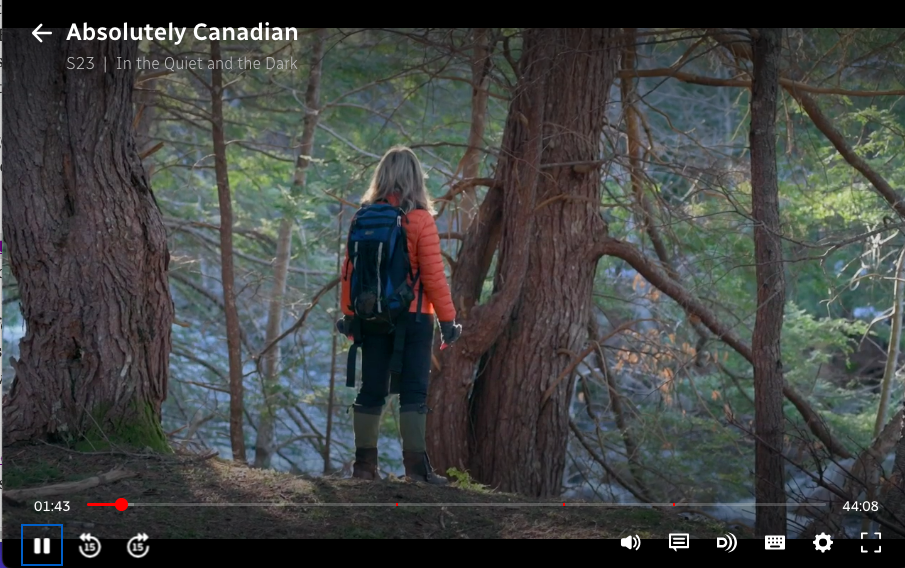 A Sea to Sea Production commissioned by CBC, 44 min. 0n CBC Gem, Featured on CBC Television Oct 7, 2023. For some background, related interviews, view Morning File (Hfx Examiner) for Sep 19, 2023: In the Quiet and the Dark: “New documentary on the people trying to save eastern hemlocks from total devastation”; also CBC Mainstreet for Oct 6, 2023 in which CBC’s Alex Mason spoke with Nance Ackerman, the film’s director.
Biocontrol and the Future of Hemlock Forests
Kirk Hillier in The Blomidon Naturalist Society’s Beyond the Tides, Winter 2026 (Dr. N. Kirk Hillier is an entomologist specializing in how insects use chemical signals to interact with their environment. He directs Acadia University’s new HWA Biocontrol Facility.) “A New Tool for a Long-Term Problem Biological control—using specialized predators to suppress HWA populations—has emerged as the most promising long-term strategy. For more than twenty years, scientists in the United States have tested and released predators from the adelgid’s native range. The results have been encouraging; although not a quick fix, these natural enemies can reduce HWA densities to levels where trees can recover and new seedlings can establish.
Acadia University is now at the forefront of bringing this approach to Atlantic Canada. A new biocontrol research and rearing facility, developed in partnership with the Canadian Forest Service and provincial collaborators, is nearing full operation on the Acadia campus. This state-of-the-art unit will house con- trolled-environment chambers, a quarantine-level research facility, and specialized equipment for rearing natural enemies of HWA. It represents the first such facility in Atlantic Canada dedicated to deploying biocontrol agents for forest conservation.”