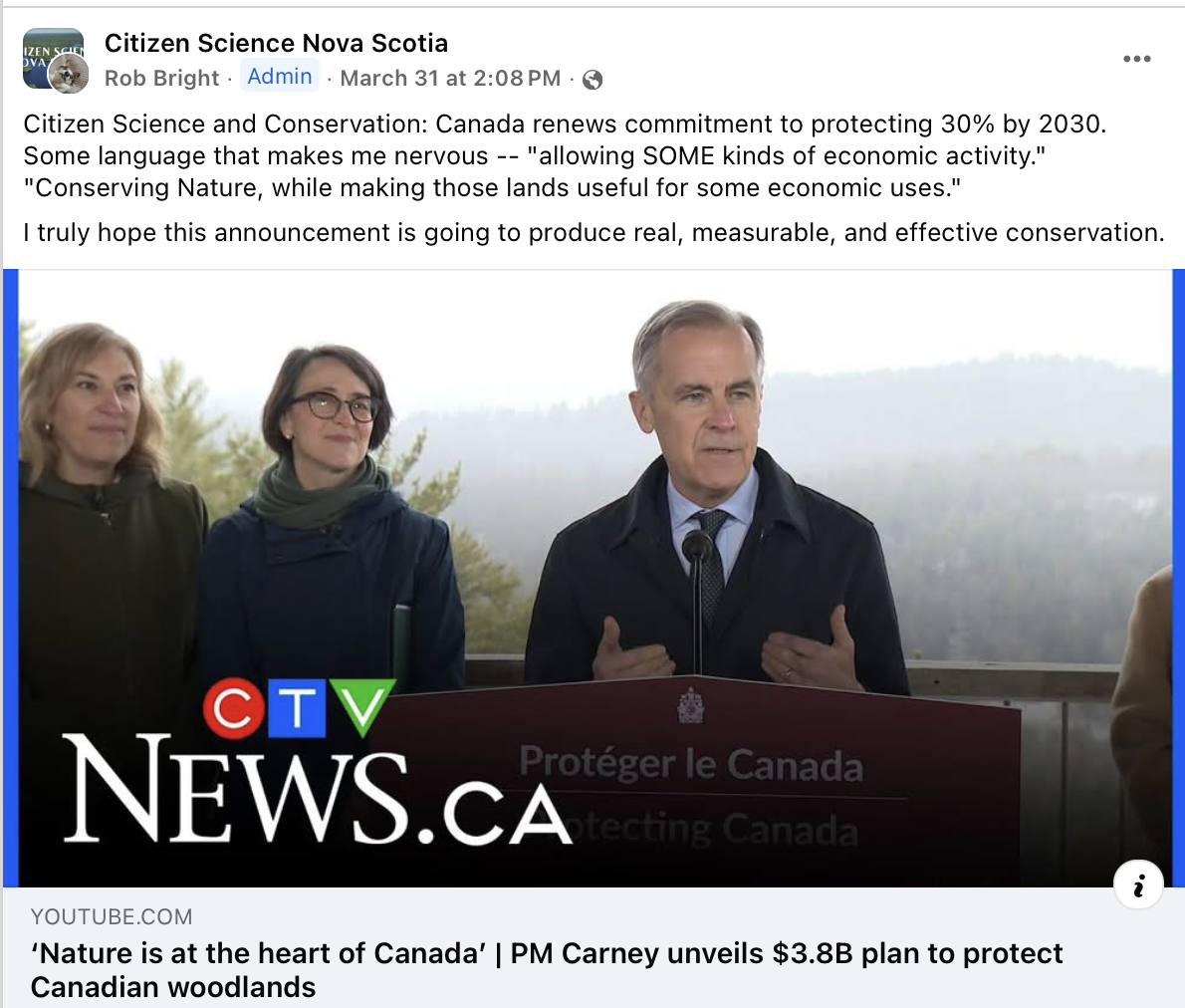
 R.B. on Citizen Science Nova Scotia (Public FB Group) Mar 31, 2026: Canada renews commitment to protecting 30% by 2030. Some language that makes me nervous — “allowing SOME kinds of economic activity.” “Conserving Nature, while making those lands useful for some economic uses.”
I truly hope this announcement is going to produce real, measurable, and effective conservation
‘Nature is at the heart of Canada’ | PM Carney unveils $3.8B plan to protect Canadian woodlands
CTV Video on YouTube March 31, 2026.
A comment by L.P.
Well, why don’t you define ‘some economic uses’ that you’re comfortable with? There are many. The trick is to be the ones who get there first. I understand why you might be a bit suspecious, but why not be the ones to actually make the plans and follow through, thus pre-empting economic uses you’re not comfortable with.
I asked AI (sue me) to come up with a list.
Here’s a list of 20 environmentally compatible economic activities for protected forest lands that minimize ecological impact while still allowing sustainable use:
— Eco-tourism – Guided nature walks, wildlife observation, and photography tours.
Birdwatching tours – Low-impact tourism focused on avian species.
— Forest education programs – Environmental education workshops for schools or visitors.
— Mushroom and edible plant harvesting – Sustainable, regulated collection of wild foods.
— Non-timber forest product collection – Medicinal plants, berries, nuts, or sap.
— Beekeeping (apiculture) – Producing honey without disturbing forest ecosystems.
— Sustainable timber harvesting – Limited, selective logging with long rotation periods.
— Agroforestry demonstration plots – Showcasing forest-friendly agriculture at small scale.
— Forest carbon credits – Participating in carbon sequestration programs.
— Reforestation projects – Planting native trees for conservation and potential carbon funding.
— Canopy walkways / eco-bridges – Low-impact structures for tourism and research.
— Wildlife research and monitoring – Funding via grants and partnerships with universities.
— Photography and art workshops – Leveraging scenic landscapes for creative industries.
— Forest therapy / wellness retreats – Nature-based health and mindfulness programs.
— Educational forest camps – Overnight stays focused on ecology and conservation.
— Eco-lodging or small cabins – Minimal-impact accommodations for eco-tourists.
— Guided hunting/fishing (catch-and-release) – Strictly controlled, if permitted by law.
— Seed collection for restoration – Selling native seeds to nurseries or restoration projects.
— Crafts from fallen wood or natural materials – Furniture, carvings, or art using deadfall only.
— Renewable energy research – Small-scale solar, micro-hydro, or biomass projects that do not clear forest.
All of these rely on minimal disturbance, careful regulation, and monitoring to ensure that forest ecosystems are not harmed.
I know SOOF is involved in lots of things mentioned here.
CS: Many details including explanations of the three pillars are provided in the new strategy to protect nature (if you haven’t already read it):
https://www.canada.ca/content/dam/eccc/documents/pdf/nature/nature-strategy/25164.06%20Nature%20Vision%20Document_EN_v10.pdf?
NN: Looks like an okay list except for sustainable timber harvesting and agroforestry plots. Those are great for outside of protected areas. In fact we should not be doing unsustainable timber harvesting anywhere at this point in the climate and biodiversity crisis.
I too worry that what is meant when politicians talk about economic activities in protected areas is not all the uncontroversial ones that are already permitted in most protected areas, it’s the kind that involve logging roads and removing timber from the forest. If we want to restore maximum biodiversity in protected forests we need to leave the trees to age and die and fall and rot. There is no other way to rebuild the base of old growth forest. I can see recognizing Indigenous traditional practices such as gathering birchbark for canoes and cutting some trees for baskets. But logging, no.
DGP: I think there us some overlap in the thinking with this: Global Forestry Companies Gather in Tokyo to Pursue Forestry Natural Capital Accounting
EIN Presswire in the Milwaukee Journal Sentinel, Apr 1, 2026: Summary from TreeFrog Foestry News: “TOKYO — Leaders from the global forestry sector met last week in Tokyo to advance the Forestry Natural Capital Project, where they collectively identified metrics to measure and report the seven chosen ecosystem services provided by sustainable managed forests. This project… prioritised the seven ecosystem services to use for this pilot: carbon, habitat and biodiversity, water quality and quantity, air quality, recreational, and sustainable timber supply. The Tokyo session concentrated on defining how these services can be consistently measured and valued across geographies and forestry management systems. The project, an initiative of the International Sustainable Forestry Coalition (ISFC)… aims to develop a consistent natural capital accounting approach for the forestry sector, enabling companies to report nature-related impacts and dependencies in a way that is credible, comparable, and relevant for investors and policymakers. …The project brings together 18 forestry organisations managing more than 23 million hectares across 38 countries.” Related: Forestry Natural Capital Project (website). It sounds good but… ‘need to watch for Greenwashing, is this being used as a vehicle to get access to Protected Areas?