By Grandmother Birch
Apr 28, 2026
Reproduced on NSFM with permission
and our thanks.
🌿
” Every fish, plant, insect, bird and animal that disappears is part of me dying. I know all their names and I touch them with my spirit. I feel it every day, as my grandmother and my father did” – Jeannette Armstrong.
 When I was a kid growing up in Southern Ontario, early in the summer I would pick wild strawberries for my Papa – my father’s father. Papa (or more likely it was Nana) would pay me a nickel for every dessert bowl I gleaned from the old farm fields. Clearly, I didn’t comprehend money or market exchange value back then. No matter!
What I did begin to comprehend, however, was something I had no words for. For it seemed to me that each and every time I picked wild strawberries I found that once I was down on the ground, crawling about, what had appeared from the perspective of standing as a sparse area changed, almost miraculously, into a patch of plentitude. First I would see one berry – pluck, into the bowl it would go. Then suddenly, just a handspan away I would spy another berry, and then another. And so it went until the dish was full. Time fell away. Picking wild strawberries was not a chore but a feeling. And what I felt was a world brimming with connectedness. Like a stitching of beads, or a colouring book of join-the-dots. Like a web!
Recently I have been learning about and growing plants for pollinators – insects and birds. This passion started with the ruby-throated hummingbird, for whom I grow blue flag iris, Canada Columbine, and Cardinal Flowers. For the love of hummingbirds I began to stop yanking out the evening primrose that grew everywhere in my vegetable garden. Following hummingbirds,I turned my attention to butterflies and moths, and small iridescent flies and bees. I’m not alone in my affections. I’m pretty sure it is true that most of us experience flowers, butterflies, and iridescent feathers as having similar qualities. They are beautiful. They seem ephemeral and fragile. They touch our hearts, so that we feel joy.
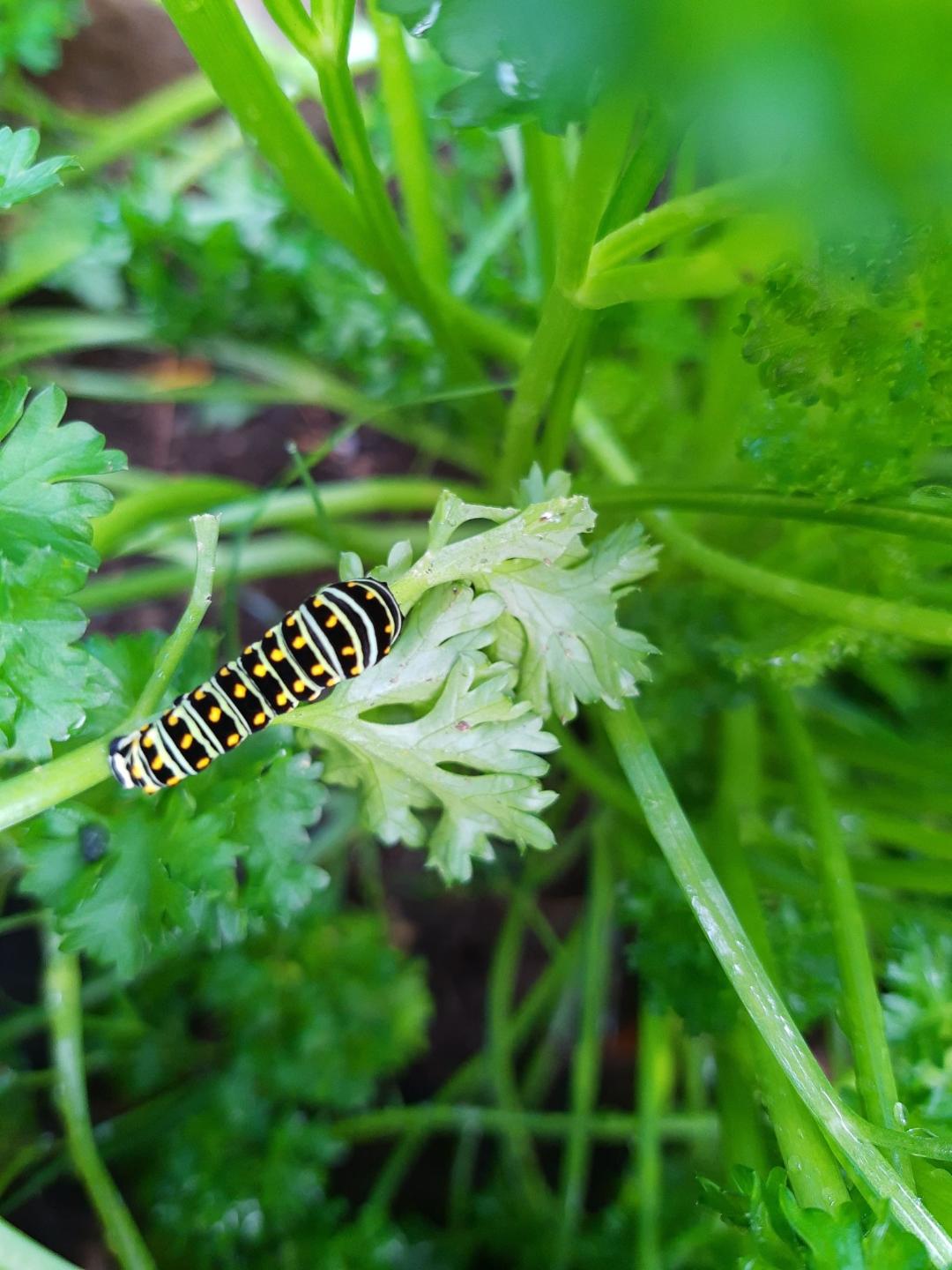
(Swallowtail eating my parsley)
Recently I read Doug Tallamy’s book on Oak Trees, where I quickly learned that butterflies (and moths) are not always so appealing. For most of their life butterflies and moths are larva and crawl around eating copious amounts of plants. Many of those plants I like to eat too, or at least enjoy seeing when they are not shot full of holes. But I am learning that seeing some leaves and flower petals shot full of holes is to see the world as it is truly meant to be. Join the dots!.
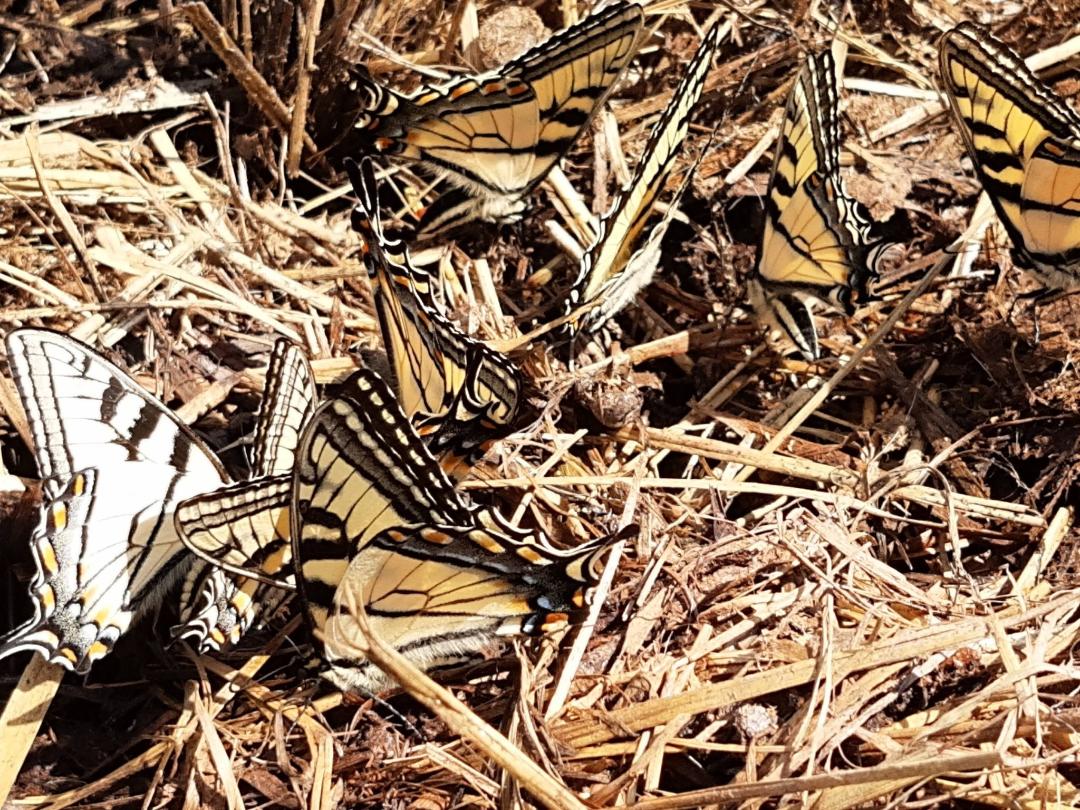
(Swallowtails ‘puddling’ in the warmth of June sunlight)
Seeing a leaf full of holes, a chewed on parsley stem, or an apple stung and scarred is the tell-tale sign that spins the world’s story of connectedness. The world as a web – where plants feast caterpillars. Where caterpillars grow baby birds. Where baby birds fledge into iridescent hummingbirds, that in the early morning dew nectar on evening primrose flowers. Where the heady night scent of the evening primrose draws a luna moth. And when the moon rises, the darting, diving little brown myotis (bat) flies synchronized with moths in ancient aerial acrobatics. Where time falls away.
References
Jeannette Armstrong. “Sharing one Skin”. (https://www.sterneck.net/oekologie/armstrong-sharing/index.php)
Doug Tallamy. The Nature of Oaks: The Rich Ecology of Our Most Essential Native Trees (2021).