Wrote Nina Newington a few days ago, on Day 165 of Camp Now:
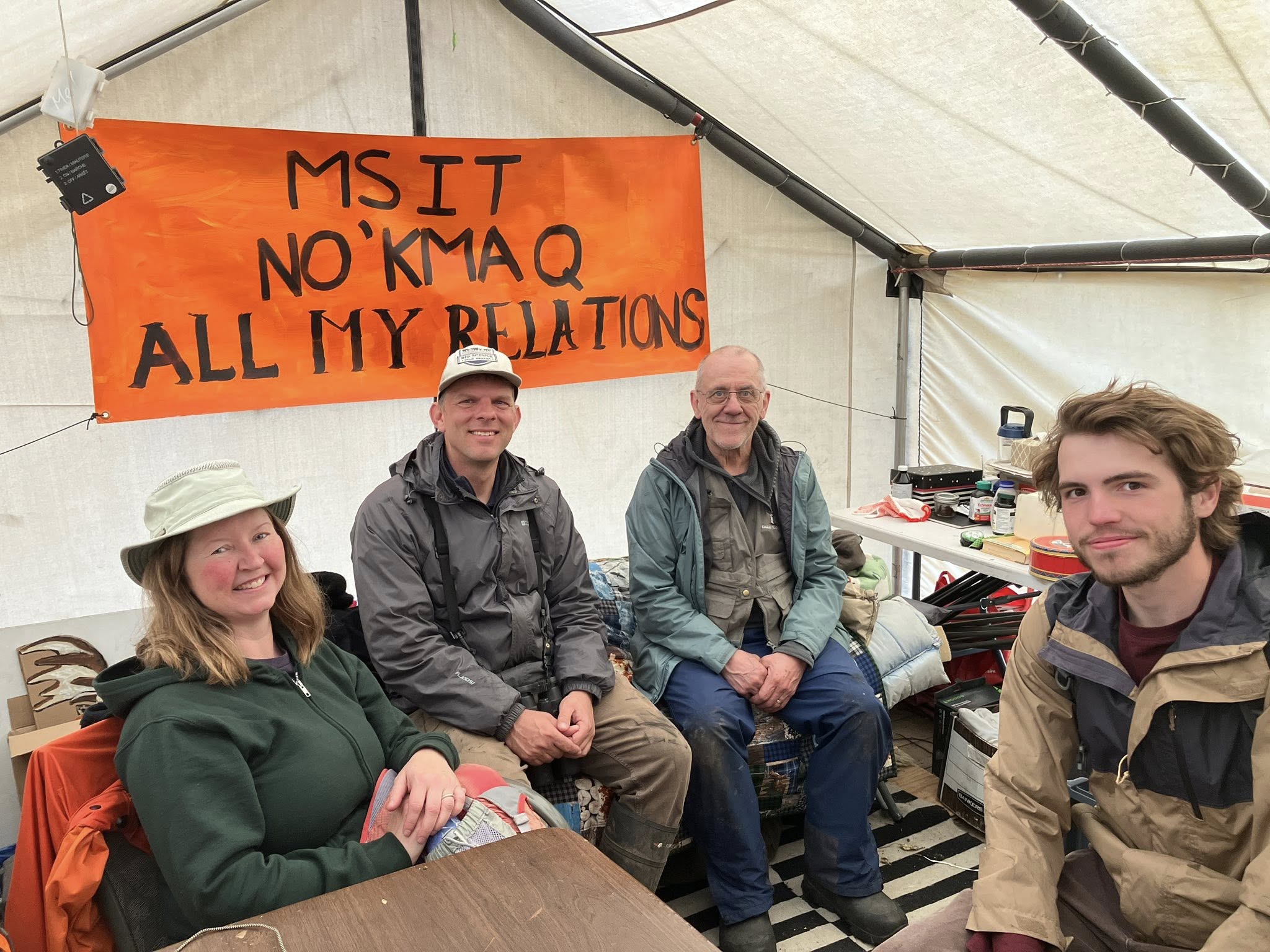
Post-fire fungi researchers visiting camp
Yesterday a team of fungi researchers stopped in for tea. They’re studying post-fire fungi, had just been out to last year’s Long Lake fire site. The cup fungi that specialize in burned areas were already up, a profusion of orange covering the charred forest floor. Had they been biding their time in the soil or did they grow from spores freshly parachuted in?
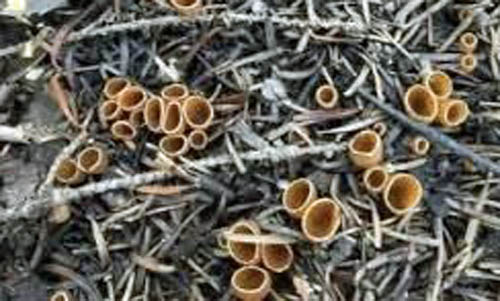
Geopyxis carbonarua doing the heavy lifting after fire, Photo by Dr Allison Walker
The researchers came to the Corbett peninsula to identify an unburned control area. We talked about looking – for specific fungi or lichens – and the brain’s uncanny ability to lock onto a ‘search image.’

Goshhawk nest sighted on April 16, 2025
But then it’s not so easy to shift your attention. I described how, in the woods west of Goldsmith Lake, in April 2025, I went looking for a Northern Goshawk’s nest in the old growth forest where I had been divebombed by a pair the previous spring. The Goshawks are unusual for hunting inside the forest canopy. They build biggish stick nests about 2/3rds of the way up a tall tree. My eyes kept travelling to the lower trunks of maple and yellow birch, looking for the damage that creates the conditions where tiny Frosted Glass Whisker lichens can grow.
‘Look up,’ I told myself, ‘Look up’, but my eyes wandered downward. It was only when I stopped and closed my eyes and summoned the photograph I had seen of a goshawk nest up in the crotch of a hardwood tree that something changed. I looked at the image in my mind’s eye in detail then opened my eyes and started looking. Two minutes later I saw an odd bulge high up in an old yellow birch. Circling for a better view I saw it was indeed a nest of sticks set between a branch and the main trunk. The birds weren’t back yet but there was the nest.
What you’re looking for shapes what you see.
Marcus Zwicker, General Manager of WestFor back when we first camped on the logging road into the Corbett Peninsula, now General Manager of Freeman Mills, is known for his ability to look at a forest and calculate how many board feet of lumber will come out of it. Or is it metric tonnes of fibre? You get the picture.
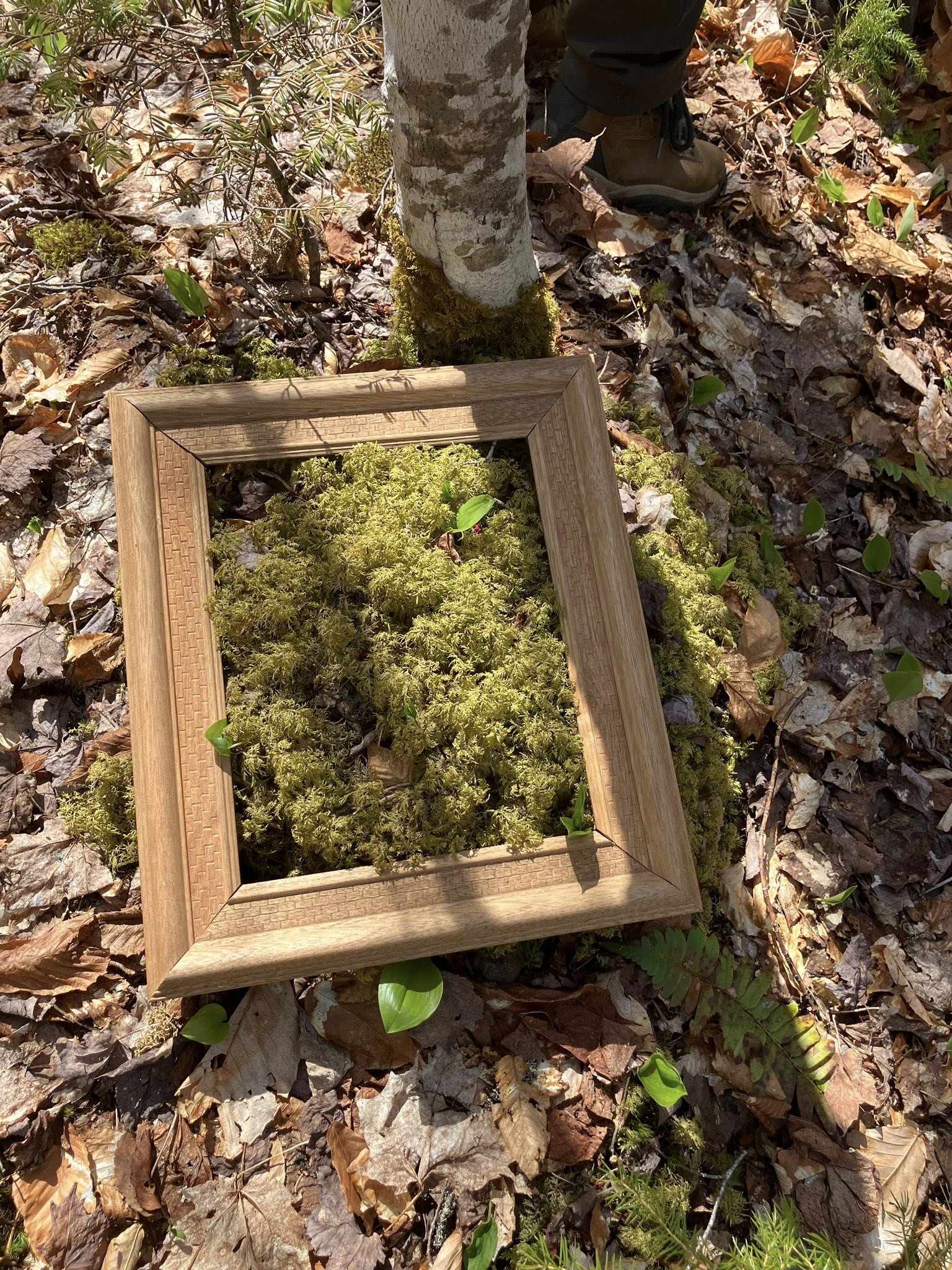 Last Sunday SOOF held a lovely event, the Artful Forest, just down the logging road from camp, an event calling for a different kind of looking. Lisa Proulx and I dreamed this one up. Participants took empty picture frames into the forest, accompanied by flute and fiddle. They went, not to learn the names of lichens or tree species, but to see what beauty caught their eyes. Frames were laid around patches of moss, propped to display a bright medley of lichens, hung with pushpins to draw attention to an arrangement of bark.
When people meandered back out to the logging road, artist Bonnie Baker showed us how to capture still life images on photographic paper using the light of the sun and a developer (I think) made of spruce gum. It was magical to watch the images emerge and change and change again. All the while, musicians Karen Achenbach and Carolyn Buck played Irish tunes from inside the screen tent they had wisely brought and set up on the logging road.
Then we went on a short gallery tour in the woods, admiring and retrieving frames.
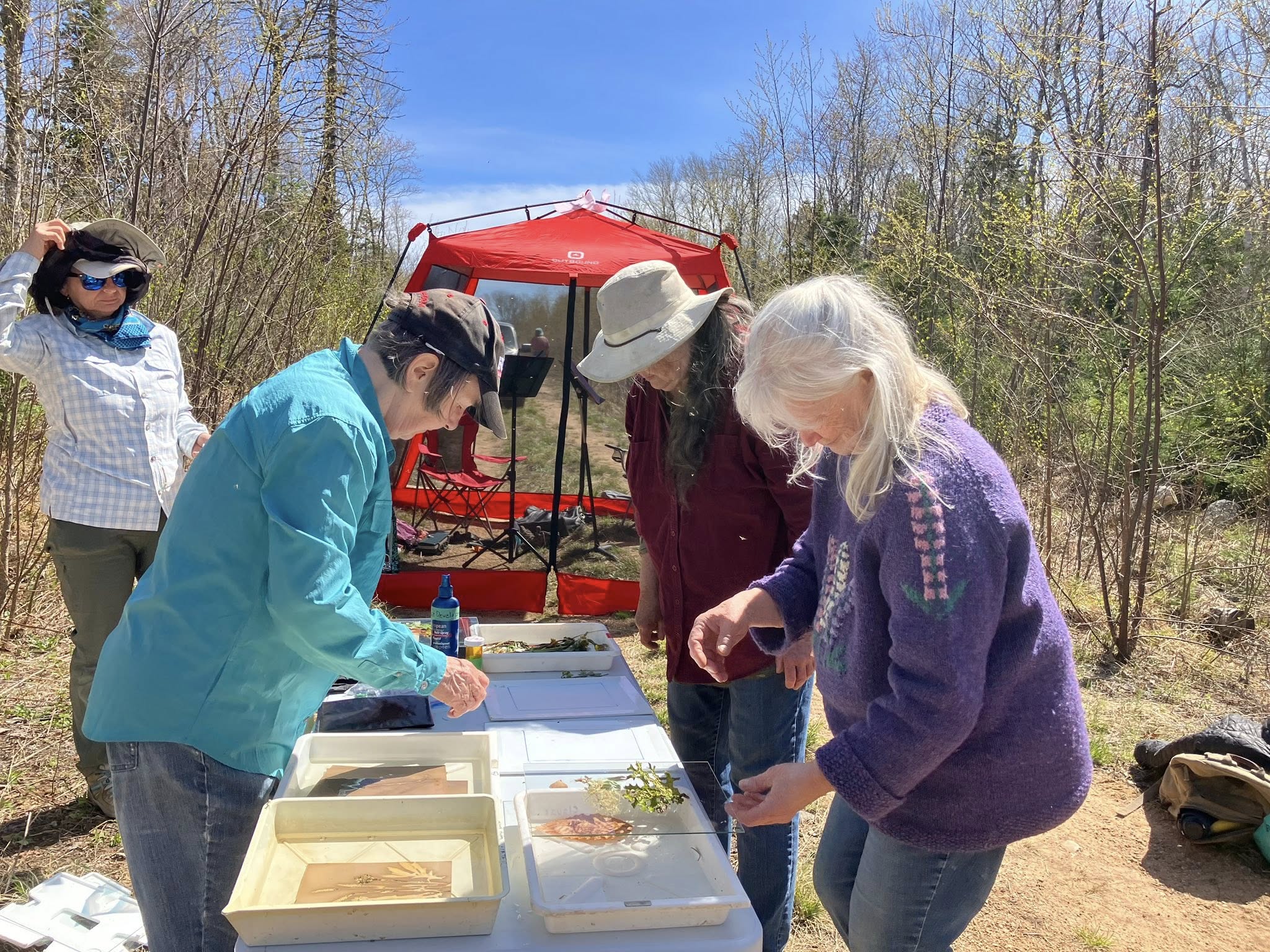
On the logging road, musicians’ tent and Lumen print set up.
It was fun, the event. Intentionally unproductive. We advanced neither scientific understanding nor the task of adding species at risk lichens with buffer zones to the map of the peninsula. Art is, at least as it is defined in western culture, intentionally useless. (Otherwise it is craft, but let’s not go down that rabbit hole.)
But art is only useless from the point of view that values forests in board feet and metric tonnes.
Art teaches us how to see. Artists do the work of shedding what we already know, what we expect to see. It takes much less effort to glance at the world through familiar lenses than it does to shed those lenses, those habits of seeing. It’s the job of artists in every genre to let go of what is known – what we already know how to see – and instead come freshly to the world. To see, as much as possible without preconceptions. To allow the unknown to become visible. The unknown may be new, but it can also be ancient. The point is to be open.
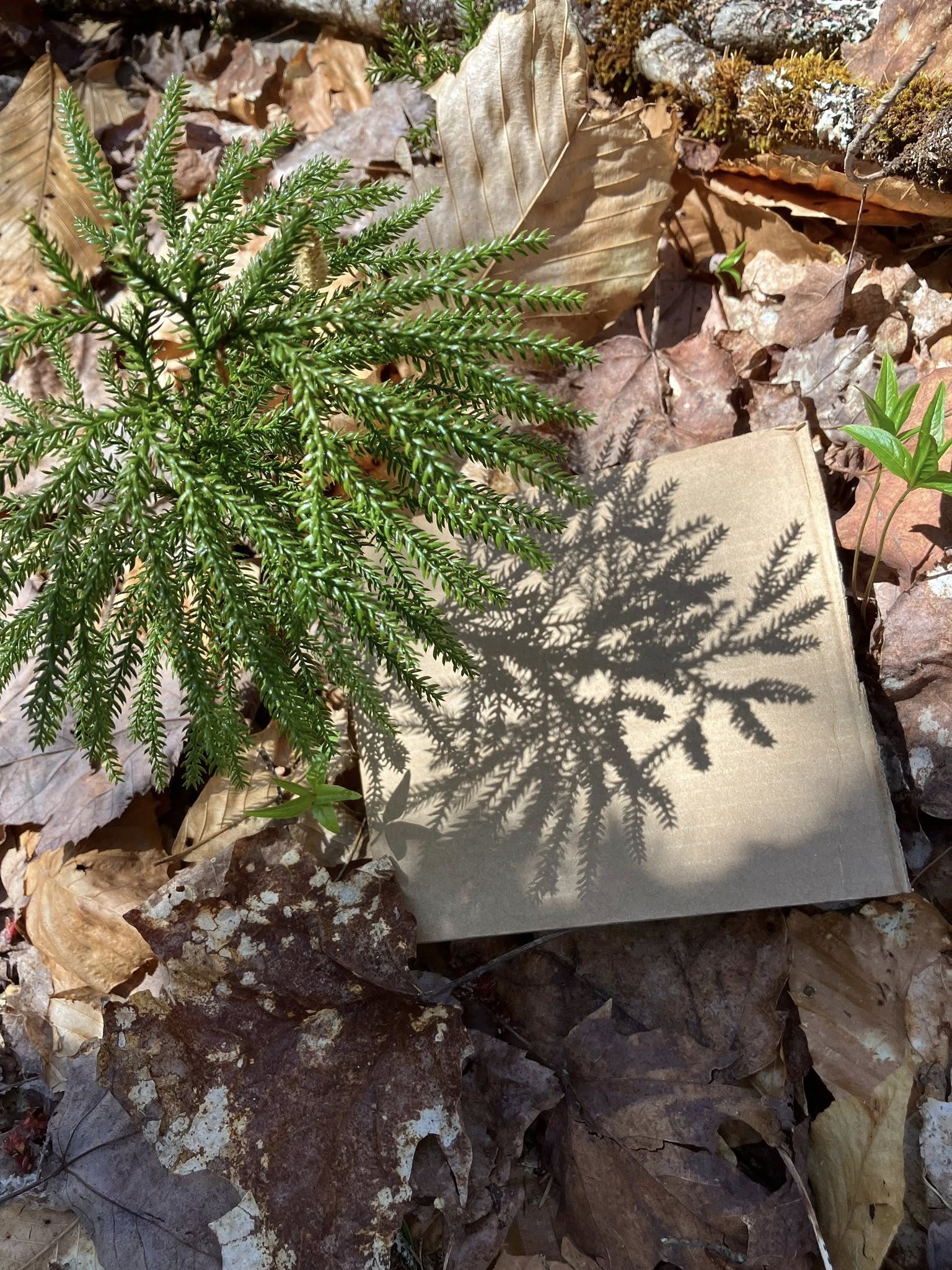
Capturing shadows
The best parallel I know in nature to the role of artists in western society is the role of the eccentric bees in honeybee hives. When a scout bee returns to the hive and dances directions to a nectar source, almost all the bees follow the directions and fly to the apple tree in blossom, or the bramble patch. Whatever it may be. But a few, the eccentric bees, fly off in other directions. Their job is to find sources of nectar that aren’t yet known.
If ever there was a time when we need eccentric bees, this is it.
The huge, extractive system we are in has spread around the planet. It is in the process of destroying our only home. But many of us are so used to being inside this system, to seeing the world according to its operating system, that it is hard to imagine other ways of being. “It is easier to imagine the end of the world than it is to imagine the end of capitalism.” I forget who said that, but I keep coming back to it.
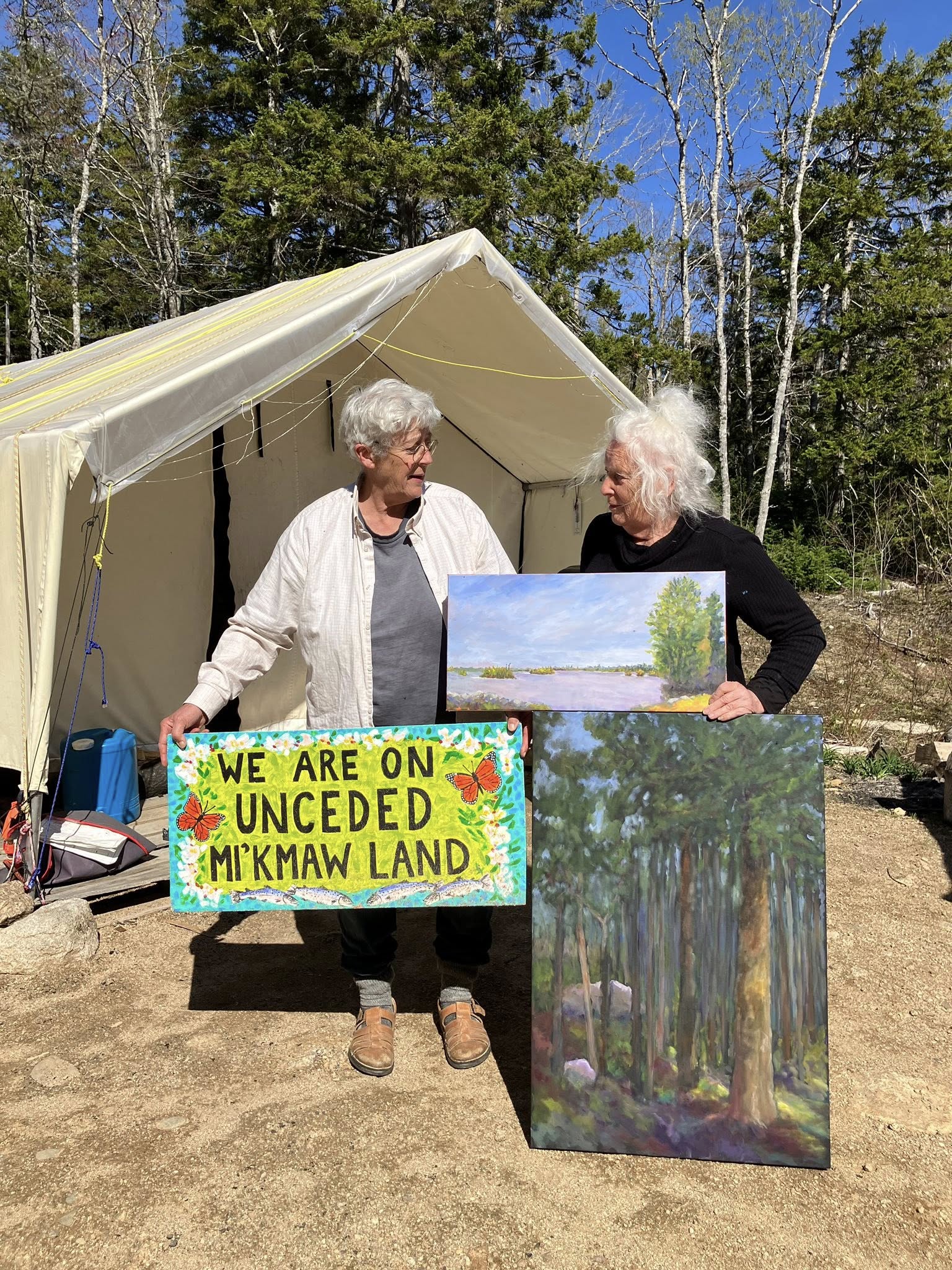
And all the while artist Sally O’Grady was painting down by Corbett Lake. She hastened to add, ‘These aren’t finished.’
It matters enormously that, here on Turtle Island, and elsewhere around the world, Indigenous peoples have, against dire odds, preserved entirely different ways of seeing the world. Learning about these helps to unsettle our settler vision. But we cannot appropriate our way to a new understanding of our place in the living world. We need artists. Artists in the broadest sense of the word. The people who choose to shed the old habits of seeing, or, often, can’t help but see differently.
And the art they make, in all its different forms, reaches different places in us, wakes us up to possibility. As much as we are straining to see the answers, the way forwards out of this deadly mess, part of the answer may be to let go of those “sight images.” To let go of focused searching. To loosen our vision, pay attention to the margins, the little image that draws us, notes that haunt. That’s the way of the eccentric bee. Don’t go to what we know.