NAVIGATION. This page is a subpage of In the News – Wildfire/Extreme Weather on the website Nova Scotia Forest Matters (www.nsforestmatters.ca)
What happens to the wood from this burnt forest?
CBC News Video, Dec 5, 2025. “The cleanup of the Long Lake wildfire in Nova Scotia’s Annapolis County has begun. So what happens to the thousands of hectares of forest that was burned? The CBC’s Aly Thomson went to West Dalhousie to find out.”
ROUGH TRANSCRIPT (NSFM)
CBC Aly Thomson:
I am in a part of NS that was devastared by wild fire just a few months ago. This mihjt look like a typical forestry operation but here’s why it’s not. The NS government is working with the forestry industry to salvage wood from the Long Lake wildfire, a first of its kind project for the province, and they invited us to see what they’re up to. Despite being burnt, the province says this wood has market value and will be turned into lumber and siding; what’s unique about all this is that most of it sits on Crown land.
Ryan McIntyre, Resource Manager, Department of Natural Resources:
The idea here is to try to turn something devastating on the landscape into something positive. We can capture some of the dead and dying timber turn into lumber and maybe rebuild homes that’s that’s a positive thing.
CBC Aly Thomson:
More than 8500 hectares were burnt in the wildfire which is still not fully extinguished. The bulk is licensed to Westfor which manages forestry in western Nova Scotia. This forest was in various stages of growth and destined to be harvested anyway. Officials say the project ensures the wood doesn’t go to waste.
Marcus Zwicker, Freeman Lumber:
Why would you cut a tree over here today that green, has green needles and can live for tomorrow when you have one right beside it that’s already on the ground dead and burnt; like that’s just straight common sense.
CBC Aly Thomson:
The wood is headed to various mills in western Nova Scotia. Natural Rresources says some parts of the tree are intentionally left behind to decompose providing nutrients to the forest soil, but time is of the essence, the wood does start to decay after 8 to 12 months.
Harvesting wood for sale after a wildfire does happen in other jurisdictions including British Columbia. The Nova Scotia government says this project has a patchwork approach, meaning younger trees will be left and protected areas will remain untouched.
The province pays a stumpage fee for the wood harvested on Crown land, those fees are expected to amount to more than 3 million dollars which goes to provincial coffers.
Breck Stuart, General Manager, WestFor Management Inc.:
We will have this cleaned up, we will have it regenerated, and we will have a much healthier forest than if we don’t do anything with this.
CBC Aly Thomson: Salvaging operations will take place over the next several months to make way for new trees that will be planted in the coming years Allie Thompson CBC News West Dalhousie
========
Some Context
From Hfx Examiner Morning File Dec 9, 2025
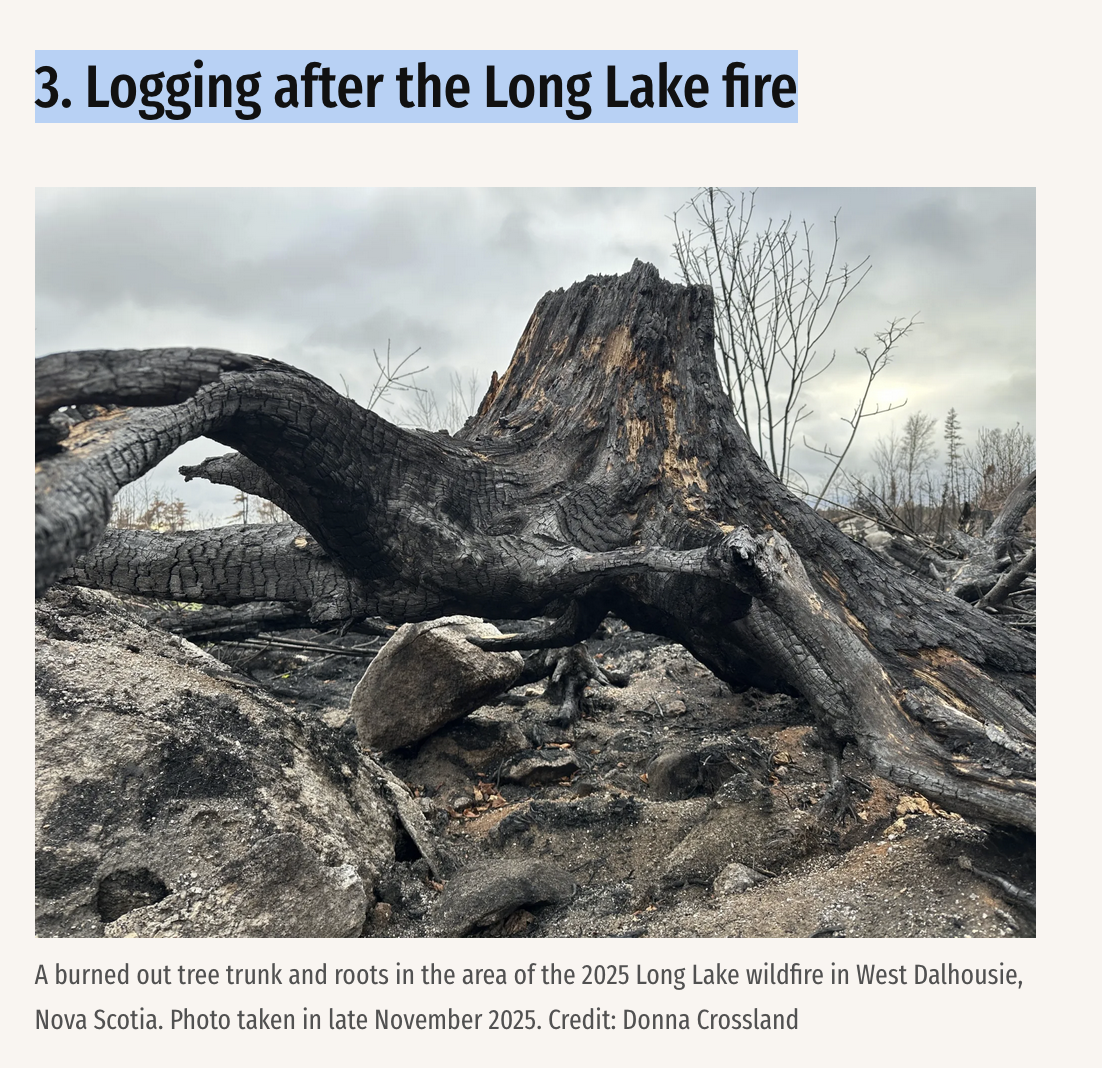
Last month, Joan Baxter learned that logging operations were in place in the area devastated by the Long Lake fire, so she contacted soil scientist Kevin Keys for an interview. On Dec. 1, we published “After the wildfires: Forest soil scientist offers insights into what we should – and shouldn’t – do to help healthy forests regrow.”
Keys gave us a primer on soil science and how the forest recovers after a fire, then offered a nuanced view about post-fire logging:
KK: This is not an all-or-nothing decision. Having dead wood on the ground in various stages of decay is natural and necessary to enhance biodiversity and maintain forest health. Yes, there is an increased risk of fire after wind-throw events, but this decreases with time as the wood accumulates moisture and starts to decay. We can also salvage some dead wood to lessen the fuel load, since not all this material is needed to maintain ecosystem health. Higher volumes of dead wood can also be removed near common ignition sites where fire risk is higher, such as around woods roads and rural homes.
Removing most or all the wood every time there’s a wind-throw or fire event is not ecologically sustainable, and the rush to salvage this wood can cause additional soil damage when operations are conducted during wet fall and winter months. There’s a balance that can be struck that both reduces fire hazard and maintains ecosystem health. It just requires good planning.
Yesterday, after she finally heard back from DNR, Baxter updated the article as follows:
The Examiner sent DNR questions about salvage work in the area of the Long Lake wildfire on Nov. 24, 2025, requesting a reply by Nov. 26. At that point, there had been no media coverage of a salvage operation, although the Examiner had been tipped off that one was imminent.
When no answers came by the deadline, we sent a reminder email on Nov. 28, asking when we could expect them. Our plan had been to report on the salvage operation, and include quotes from Dr. Kevin Keys – and possibly also a forest ecologist – on best management practices for soil restoration and forest regrowth after a large and hot wildfire like the one at Long Lake.
Because we had no reply from DNR or confirmation of the salvage operation, we eventually decided to go ahead in the meantime with this interview with Dr. Kevin Keys, published on Dec. 1.
We still wanted to report on DNR management plans for the area and any salvage work, so on Dec. 3, we sent yet another email to DNR asking if or when we should expect answers. We received no reply.
At this point, there had still been no media coverage of this story, and we were still waiting in vain for answers from DNR. Then, on Dec. 5, CBC picked up the story, and a reporter had gone to the site to see the salvage operation. Not only did she give it an extremely positive spin, as a “first-of-a-kind” operation in the province being run by the government and the forestry industry. She clearly stated that the government and forestry industry had “invited” her to report on the operation.
She interviewed Ryan McIntrye, regional manager at DNR who is responsible for Crown lands; Breck Stuart, general manager of WestFor, the industry consortium that gets to manage – and harvest – public woodlands in Nova Scotia; and, Marcus Zwicker of Freeman Lumber (formerly general manager of WestFor). They made all kinds of wonderful claims, including that they were making sure the wood wouldn’t be “wasted,” that they would plant a better forest after clearing the trees.
Because no one outside DNR or industry was interviewed, these claims went unquestioned by forest ecologists or biologists. They contradict much of what Keys said in his interview with the Examiner.
CBC’s credulous and unquestioning report on the salvage operation – aired on radio and television – went out the morning of Friday, Dec. 5.
At 3:15 that afternoon, two weeks after our initial email inquiry, DNR finally and belatedly sent this reply, which did not answer several of our specific questions:
From DNR:
The Long Lake wildfire is considered under control. We don’t expect it will be fully extinguished before spring. Rainfall and cooler temperatures are keeping everything very quiet.
How much we monitor the site over the winter depends on conditions. If there is snow/rain, then we wouldn’t need to monitor. If it’s dry, we will.
There are about 7,200 hectares of Crown land within the 8,468-hectare active wildfire zone.
A salvage operation is underway to clear downed and dying trees from Crown land in the area. A lot of this wood does have value for the sawmills within the province, but only for a limited time. Salvaging it from the area makes sure it doesn’t go to waste and keeps money in our rural economy. As part of the salvage operation, we will be leaving material behind to help reforest the site, this could also include the planting of seedling to help reforest the area.