DRAFTING!
– Land & Sea: The uncertain future of Maritime forests (Video)
CBC Nov 16, 2025, 22 min
“In the Maritimes, the majority of forested land is in private hands, often as small woodlots are passed down through generations. Those forests have sustained families and communities for centuries but many aging woodlot owners face an uncertain future. Now, some are offering a new way to safeguard those forests by harnessing their ability to store carbon.”
 CBC Links to Chapters:
00:00 Welcome to Land & Sea
01:04 Future of woodlot owners
04:15 What are carbon offsets?
05:56 Measuring carbon in forests
09:04 Not enough to offset emissions
10:07 Pulling carbon out of the atmosphere
11:10 Pitching carbon offsets to landowners
13:40 Stewardship of land
16:21 Tackling a changing forest
18:35 Coping with climate change
NSFM: The video provides a good intro. to the complex topic of forest carbon credits (carbon offsets and the like) and to some related forest ecology – notably how tree species composition and “Assisted Migration*” affect carbon sequestration, all with specific reference to the Wabanaki/Acadian Forest and to Nova Scotia woodlots.
*Not named as such in the video, but a commonly used term to describe “the intentional establishment of populations or meta-populations beyond the boundary of a species’ historic range for the purpose of tracking suitable habitats through a period of changing climate….” (Wikipedia)
These notes are intended to provide a quick overview of whats talked about in the video, and a bit about the backgrounds of the participants – the latter to illustrate why their perspectives are worth listening to, and to provide some links to finding out more about their perspectives.
Quotes From & Notes About the Participants
1. CBC: Writer/director: Moira Donovan; Videography: Jeorge Sadi; Land & Sea Host: Tom Murphy
| 2. DALE PREST
Select quotes “50% of the province, like 5 million hectares* is owned by something like 30,000 small private wood lot owners, these are families like mine and that have had land for generations and increasingly with out-migration of youth in rural areas the next generation just isn’t there to pick up from the older generations, and so a lot of aging land owners will find themselves in a position where they don’t know what they’re going to do with their land…” *See Land Ownership table below, “In every rural community of Nova Scotia there’s always someone there whether it’s a logging contractor or a broker who’s known that if you’ve got a wood lot and you need cash quick you can go to them… that’s driving a lot of the clear-cutting.” When I went into university…what I wanted to get down to was, “what does a forest ecosystem need to really be healthy?”…And the one the one component of a forest that is most connected to forest health, it would come up again it again really, was carbon. 4:15 “It became pretty clear to me that if we could compensate landowners and forest managers, for the amount of carbon that there forest stored, then it would counteract that economic incentive to go out and cut all your trees down and ship them off to the mill.” CBC: “During the pandemic, Dale and a few friends founded a company called Growing Forests based on a pretty simple idea: save the forest with the trees. They do this by selling credits to polluters for the carbon stored in a standing forest. With that money, Dales company could purchase land that would otherwise be clearcut – forests like the one Dale is standing in now.” 5:17 About Dale Prest Dale Prest , ” about the 8th generation in my family to work in the forestry sector” has both practical and formal scientific familiarity with NS forests and forestry. The topic of his 2009 Honours thesis for a BSc in Environmental Studies from Dalhousie University was “Carbon Storage in the Acadian Forest: Estimating carbon storage and associated dynamics of a privately owned small woodlot in the Acadian Forest Region“; the topic of his 2013 thesis for a Masters degree in Earth Sciences from St. Francis Xavier was ” Exploring the Effect of Clearcut Harvesting on Soil Carbon and Nitrogen Levels 35 Years Following Harvesting”. From 2011 to 2018 Dale worked with Community Forests International where he was the chief Developer of the Whaelghinbran Carbon-Forest Initiative. Since 2018, he has been self employed as the “Passionate founder and operator” of the Climate Forest Company.* Growing Forests described on LinkedIn Posts, news items about Dale Prest/Growing Forests – Dale Prest on “Climate Forests” – Citizen investors helping buy woodlots to prevent clearcutting in Nova Scotia – Forests can add value without being clearcut –‘It’s literally life’: Protecting private woodlots (Audio) |
3. ANTHONY TAYLOR
Select quotes
“…the Acadian //Wabanaki forest is a it’s a forested region that encompasses the Maritime provinces of Nova Scotia, New Brunswick, and PEI but it also extends into the north/ northeastern US Maine, New Hampshire, Vermont…one of the reasons it’s unique, it’s what we call an ecotone or transitional zone where we have this mixture of cold-adapted boreal species at their southern range limit mixing with warmer-adapted temperate tree species at their nortnern range limits”
CBC comments” Taylor’s research suggests forests with different tree species that are particularly good at sequestering carbon and mature forests with that kind of variety have an important role to play.” ANTHONY. TAYLOR: To put that in the context, if you were to clearcut this [old forest] site, you would be exporting most of that carbon from the site and old forests represent natural large reservoirs of carbon, much more so than a young forest…where most of that carbon is stored within the forest is in the soil itself…in forest like that we’re standing in right now I’d say up to half I’d say up to half 7:26
s”Forests, while they do contain carbon, there’s a lot of variability and the carbon that’s here within a forest. And a lot of uncertainty in that carbon. The whole carbon offset system, you know I’m not against the idea of carbon credits completely, what I’m against is the usage of carbon credits from forest managed to offset polluters, you know the oil and gas sector. I think for us to legitimately tackle the climate change issue…we need to make deep cuts at the source of emissions in terms of the oil gas production”
About Anthony Taylor…
Like Dale Prest, Anthony Taylor grew up in a forestry/wood business family, one recognized as progressive and pursued forest ecology in university… high-level research etc. Often consulted by NSGov, a member of the group reviewing progress of Triad forestry…
“Anthony Taylor is an associate professor of forest management at the University of New Brunswick who hails from the Musquodoboit Valley in Nova Scotia.. “Forest management practices during the 20th century and up to today have contributed to a younger Acadian forest and one with a higher abundance of spruce and fir,” Taylor says. “But it’s really tricky to say by how much as we have poor data on what the baseline pre-European settlement forest was like.” Taylor sees tree diversity as important in mitigating climate change. He is co-author of a recent paper published in Nature, which shows “conserving and promoting functionally diverse forests” promotes storage of carbon and nitrogen. That means the benefits are two-fold; a balanced mix of trees in a forest keeps more carbon in the ground and also increases soil fertility…“We know a certain amount of climate change is going to take place no matter what,” Taylor says. “In this region, the average annual temperature is expected to warm a couple of degrees in the next 30 years.”” – cited in *The NS wildfires are not ‘natural’ disasters: climate change, forest management, and human folly are all to blame
Joan Baxter in the Halifax Examiner, June 12, 2023
– PhD thesis (Faculty of Forestry and the Forest Environment Lakehead University, 2009): Concepts, theories and models of succession in the boreal forest of Central Canada
– MSc thesis (Faculty of Forestry and the Forest Environment Lakehead University, 2005): Carbon stock estimates for red spruce (Picea rubens) forest in central Nova Scotia
https://www.nsworkingwoodlandstrust.org/
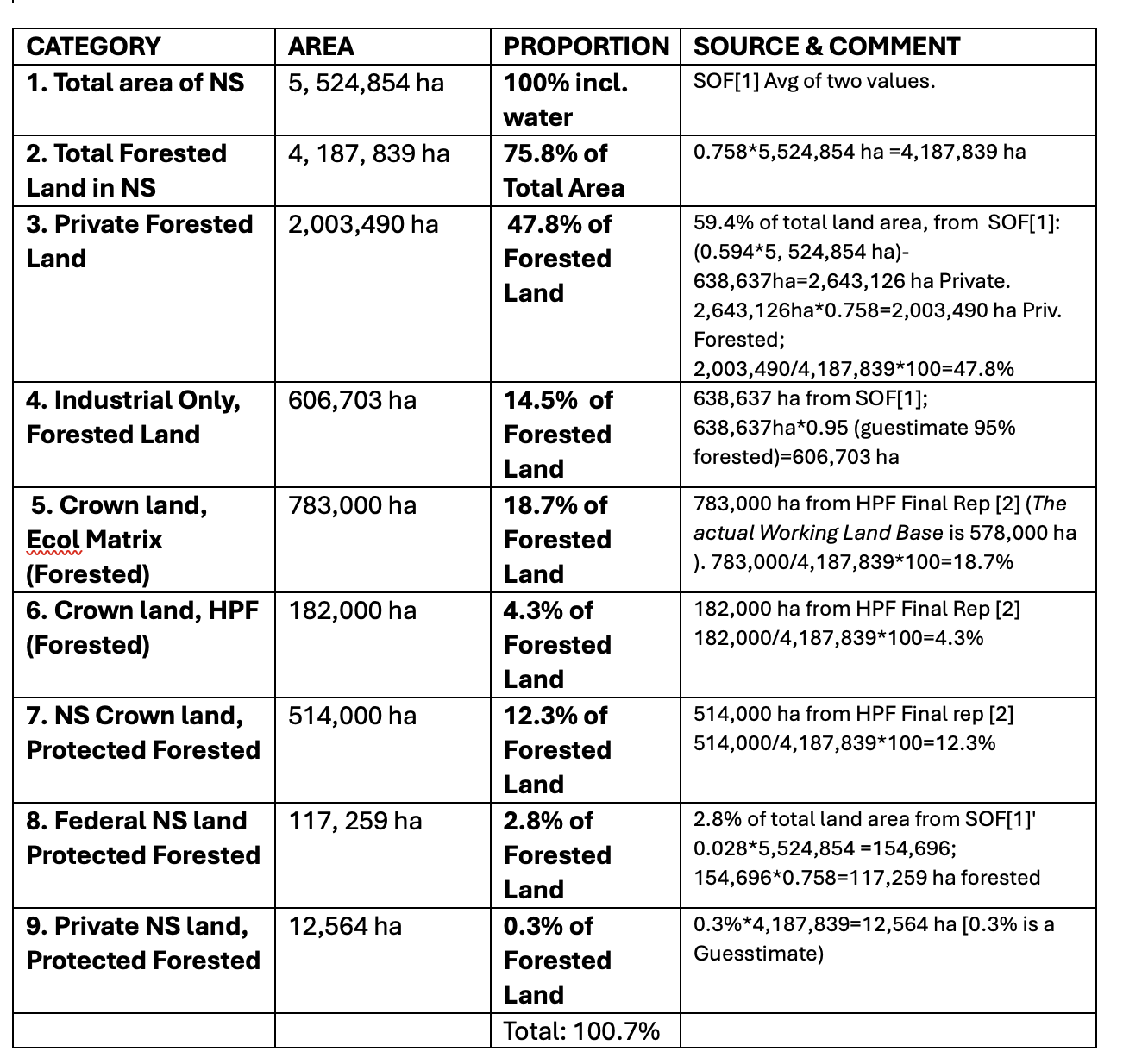
1: Nova Scotia Total Land Area, 2: Total Forested Land Area and 3-9: Forested Land Area by Ownership. Notes [1] SOF: NS State of the Forest Report 2016 [2] HPF Final Rep: High Production Forestry in Nova Scotia Phase 1 Final Report (July 2021) File –LandArea