| Climate Change is a subpage of www.nsforestmatters.ca/Ecol. Forestry & Conservation. Subpages: – Climate Change Impacts on NS Forests – Climate Stories Atlantic docs – Carbon/GHG
Also view: |

Exposures at Five Islands Prov. Park NS can help us to understand the significance of anthropogenically-induced climate change. “Currently, human activities are causing carbon dioxide levels to change more rapidly than volcanoes, asteroids, or anything else in Earth’s 4.5 billion year history.” – Putting it in perspective: Climate change yesterday and today (evolution.berkeley.edu)
Links to select items particularly pertinent to NS
– Nova Scotia’s Changing Climate
Page on novascotia.ca (Gov website) Topics: Rising temperatures, Changing precipitation patterns, More frequent and intense storms, Rising sea levels, Changing oceans
– Climate of Nova Scotia
Wikipedia/Needs updating, but useful stats on avg rainfall etc.
– How Soon Might the Atlantic Ocean Break? Two Sibling Scientists Found an Answer—and Shook the World
Sandra Upson in Wired, July 25, 2024. “A gigantic, weather-defining current system could be headed to collapse. Peter and Susanne Ditlevsen had a simple yet controversial question: How much time might we have left to save it?…The AMOC transports a staggering amount of energy. Like a million nuclear power plants. It is such a core element of the Earth system that its collapse would radically alter regional weather patterns, the water cycle, the ability of every country to provide food for its inhabitants… The two scientists made a plot of the numbers and a neat cluster emerged. Yes—2057. But that’s just the middle point: In 95 percent of the model’s simulations, the AMOC tipped sometime between 2025 and 2095… In footnote 4 of the IPCC’s latest big report, “very unlikely” meant that, in the panelists’ view, the AMOC had less than a 1-in-10 chance of collapsing before 2100. One in 10. Those odds didn’t strike him as “very unlikely.” Russian roulette is one in six, and we all agree that’s a bad idea. Plus, the IPCC had given its prognosis only a “medium confidence” rating. To Ditlevsen, that sounded a lot like “we have no clue.”
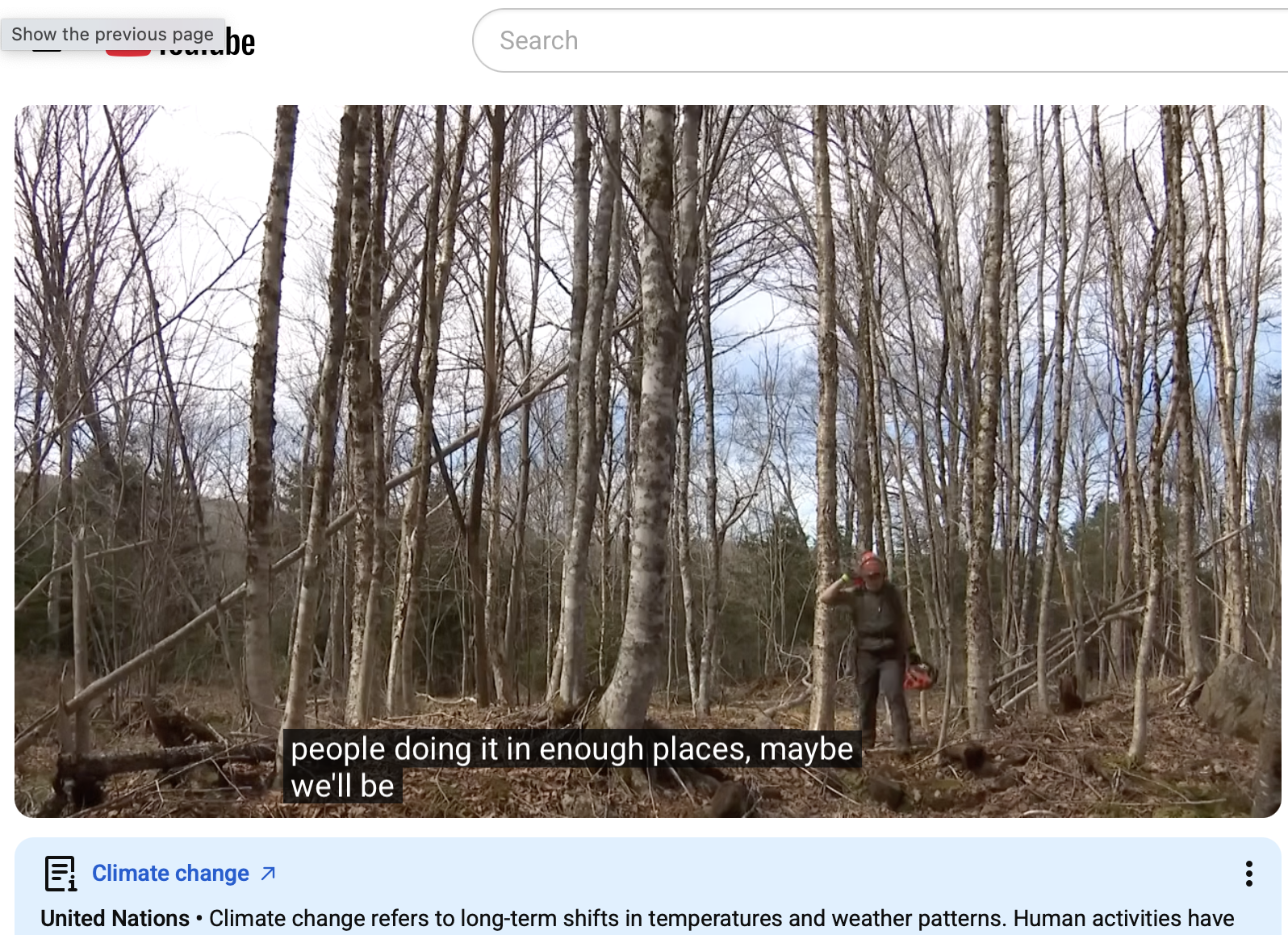 – Land & Sea: The uncertain future of Maritime forests
CBC Nov 16, 2025
In the Maritimes, the majority of forested land is in private hands, often as small woodlots are passed down through generations. Those forests have sustained families and communities for centuries but many aging woodlot owners face an uncertain future. Now, some are offering a new way to safeguard those forests by harnessing their ability to store carbon.
– Is There Robust Evidence for Freshwater-Driven AMOC Changes? A Synthesis of Data, Models, and Mechanisms
Sophia K.V. Hines et al. 2025 in Oceanography “The Atlantic Meridional Overturning Circulation (AMOC) transports heat to high latitudes and carbon to the deep ocean. Paleoceanographic observations have led to the widely held view that the strength of the AMOC was significantly reduced at two intervals during the most recent glacial-to-interglacial transition, with global climate impacts. Climate models predict that the AMOC may decline in the future due to anthropogenic forcing, but the time periods for modern observations are too short to detect recent trends with high confidence. To understand the likelihood of future changes in the AMOC, it is important to understand the mechanisms that drove past changes in AMOC strength. In this paper we review (1) the paleoceanographic proxy data that have led to the widespread view that the AMOC sharply decreased for periods of several thousand years during the last deglaciation, (2) climate model simulations of the last deglaciation, with particular attention to their use of fresh water to alter the AMOC, (3) the physical mechanisms that could have driven past changes in the AMOC, and (4) how insights from past ocean change can inform our understanding of what may happen in the future.”
– Climate Change Adaptation Guidebook for Forest-Based Communities
by E.C Fraser-Reid & J. Krakowski for Natural Resources Canada, issued July 16, 2026. 74 pages. “Canada’s climate is changing. Rising temperatures, shorter winters, more intense storms, and different precipitation patterns are already affecting ecosystems, businesses, and communities across the country. Small forest-based communities can be particularly vulnerable to these changes because of their proximity to the forest and the close relationship their residents often have with nearby natural areas and the products and values these areas provide. This guidebook was developed to empower residents of small forest-based communities to develop a Community Climate Change Adaptation plan. It describes a flexible step-by-step process, explains key concepts, and includes links to resources and examples from across Canada. Using this guidebook will help you understand which climate changes are likely to happen in your region, how those changes could affect the places and things valued by residents and stakeholders, and how your community can realistically deal with these changes… having science-based, realistic plans in place is the best and most cost-effective way for small communities to prepare.
– Wild Wild Weather
On the Nature of Things, released Nov 11, 2025 “Worldwide weather systems are starting to break. How air, ocean and even lava currents are changing in unprecedented ways thanks to a hotter planet.”
– Waters off Scotian Shelf are cooling, but scientists can’t say for how long
Paul Withers · CBC News, May 08, 2024
Lower temperatures have scientists wondering if decade-long warming trend is over
– Climate change: Correlation between wildfires, flooding in Nova Scotia
Hina Alam, The Canadian Press, July 25, 2023, on cp24.com ” There is a correlation between rising temperatures, wildfires and heavier rainfall, said Kent Moore, an atmospheric physics professor at the University of Toronto.”
–Business Critical: Can Companies Inspire a Sustainable Future?
Video documentary on Al Jazeera’s Earthrise Series 7Jan2023, 25 min. “Earthrise explores how businesses are helping transform the legacy of the Industrial Revolution and leading the way to a sustainable future.” ‘Recommend in particular section beginning at 10:30.
– Alligators in the Bay of Fundy?
by David Patriquin in Rural Delivery, April 1983
It offers a perspective of the early days of public awareness of climate change. I was horrified at the time that DVL, editor of RD, titled the article as such, but 40 years later, it does not seem so outlandish – david p “During the balmy days of last fall and early winter, we may have wondered whether winter as we have traditionally known it was ever to arrive. That winter may have been a “normal anomaly.” Alternatively, it could represent the begining of a distinct warming trend that many scientists expect will begin in the eighties, and that will stay with us at least until our fossil fuels are exhausted…”
Land & Sea: The uncertain future of Maritime forests (VIdeo, 22 min)
CBC News Nova Scotia, Nov 16, 2025: “In the Maritimes, the majority of forested land is in private hands, often as small woodlots are passed down through generations. Those forests have sustained families and communities for centuries but many aging woodlot owners face an uncertain future. Now, some are offering a new way to safeguard those forests by harnessing their ability to store carbon.Chapters: 00:00 Welcome to Land & Sea; 01:04 Future of woodlot owners; 04:15 What are carbon offsets?; 05:56 Measuring carbon in forests; 09:04 Not enough to offset emissions; 10:07 Pulling carbon out of the atmosphere; 11:10 Pitching carbon offsets to landowners; 13:40 Stewardship of land; 16:21 Tackling a changing forest; 18:35 Coping with climate change” COMMENT, Very informative interviews in the field with Dale Prest, Anthiny Taylor and others.