
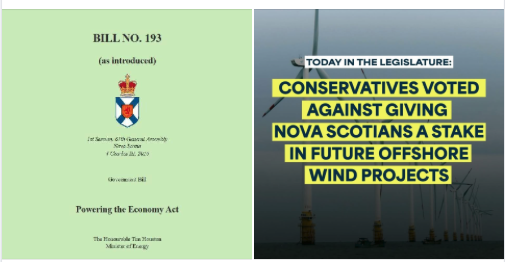
 Post by Ulrich Vom Hagen on Facebook Apr 7, 2026
Bill 193 is about who profits from our renewable energy resources.
Premier Tim Houston has framed Bill 193 as the Powering the Economy Act. It’s a compelling title, but Nova Scotians should be asking a more precise question: Whose economy is this bill designed to power?
Bill 193 does something important. It creates the legal framework to unlock large-scale offshore wind energy development in Nova Scotia. That matters. Offshore wind could be a generational opportunity — one capable of reshaping the province’s energy system and economy for decades. Yet, enabling development is not the same as shaping its outcomes. And that’s where this bill falls short.
For all its ambition, Bill 193 is striking for what it does not do. It does not guarantee lower power bills for Nova Scotians. It does not require that new energy be used here at home before being exported. It does not secure a public ownership stake or ensure that communities share directly in the wealth generated offshore, however, key decisions — including procurement, targets, and system planning — are heavily concentrated in ministerial discretion.
Instead, the bill establishes a framework where large-scale projects can proceed, utilities can be directed to purchase power, and the province collects revenues through fees and levies. Early estimates suggest those revenues could reach tens of millions annually in the first decade, potentially rising over time, but in the context of a provincial budget approaching $19 billion, and against the scale of the resources being developed, those returns are modest.
This raises a fundamental issue: Nova Scotia is not short on energy potential. What it risks being short on is leverage. Around the world, jurisdictions are approaching offshore wind not just as an energy project, but as a nation-building opportunity. They are securing public equity stakes, requiring community benefit agreements, and structuring projects so that long-term value stays local. They are using policy — not hope — to ensure that energy development translates into public wealth and system affordability.
Bill 193 does not do that. It leaves the most important questions unresolved: who owns the projects, who captures the profits, and who bears the risks. Those decisions are deferred to future regulations, negotiations, and procurement processes after the core legislative framework is already in place. That sequencing matters because once a system is built around private, export-oriented development, it becomes far more difficult to retrofit public ownership or guarantee meaningful local benefits. Nova Scotia has seen this pattern before: public resources developed under frameworks that promise broad economic gains, but ultimately deliver concentrated profits and diffuse costs.
Offshore wind does not have to follow that path. Done right, it could give Nova Scotians a real stake in their energy system. It could stabilize electricity costs over the long term. It could support communities, strengthen public finances, and anchor a more resilient, locally rooted energy economy, but none of those outcomes are automatic. They are the result of deliberate choices — about ownership, governance, and whose interests come first. Bill 193 makes some of those choices by omission.
As it stands, it opens the door to development without clearly defining the public return. It prioritizes speed and flexibility over certainty and accountability. And it asks Nova Scotians to trust that benefits will follow, rather than building those benefits into the system from the start. This is the moment to decide whether offshore wind will be built as a public-interest energy system — or as a private, export-driven industry that leaves Nova Scotians on the sidelines. In the end, this isn’t just about powering the economy. It’s about who profits from our wind energy resources.