
Also view on this website: Maps
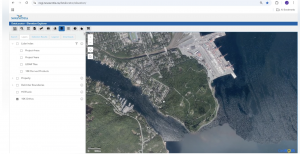
Click on image to go to Video
Accessing LiDAR in Nova Scotia. Video by Archaeology in Acadie (FB Group) Apr 2, 2026.
“There is no doubt whatsoever that LiDAR has been an immensely powerful development for archaeology. The acronym stands for Light Detection and Ranging, in the same way that radar (now a commonly understood word in its own right) was originally an acronym for Radio Detection and Ranging. Whereas radars employ radio waves to measure the distance to objects, LiDAR uses lasers, usually the near-infrared kind, which are not visible to the human eye…. It has a variety of uses, but one of the most common for archaeologists is to visualize the “bare earth” by digitally removing buildings, trees, and other obscuring vegetation. This is possible because LiDAR reflection data, in the form of a “point cloud,” can be classified according to elevation. A landscape so classified in digital form can be edited, so to speak. And most of us, being interested in archaeology, would like to edit out the tree canopy to expose the surface beneath as a starting point. The Province has made a great deal of data available through its Elevation Explorer website:
https://nsgi.novascotia.ca/datalocator/elevation/. Below [above] is a short video describing how to access basic LiDAR bare earth / hillshade imagery for Nova Scotia. It assumes neither significant expertise on the part of the user, nor access to specialized software. You can zoom in and move around the surface of Nova Scotia with this website almost like you can with Google Maps or similar products… LiDAR is also a powerful tool for monitoring landscape change (e.g. coastal erosion), predicting the extents of flood events, and a host of other applications.)…”