This page is a subpage of nsforestmatters.ca/
Ecol. Forestry & Conservation
DRAFTING
Also view on this website: Natural Disturbance Regimes
– Forest structure more important than topography in determining windthrow during Hurricane Juan in Canada’s Acadian Forest
Taylor, A. R., et al (2019) in Forest Ecology and Management, 434, 255–263.
Highlights
• Wind speed had highest influence over stand vulnerability to windthrow.
• Following wind speed, stand structure most important in determining windthrow.
• Tall stands dominated by spruce and balsam fir were most vulnerable to windthrow.
• Topographic exposure ranked low in overall influence on windthrow.
• Contrary to expectations, mesic soils were most vulnerable to windthrow.
Related article: How logging left Atlantic Canada’s trees vulnerable to Hurricane Fiona By Haley Ritchie in the Narwah, Nov 22, 2022 “A century of overplanting money-making species helped Fiona ravage east coast forests. Can woodlots bring back biodiversity while also turning a profit?”
– The Effects of Hurricane Juan on Managed Stands Commercially Thinned in Central Nova Scotia
Tim McGrath & Jan Ellingsen. 2009. NS Natural Resources Report FOR 2009-4, No.89 “Many commercially thinned (CT) stands in Nova Scotia were severely damaged by hurricane Juan in September 2003. Despite this it was observed that some commercially thinned stands were not impacted. In an attempt to determine whether stand conditions affected damage levels in commercially thinned stands, a survey was made in the winter of 2003/2004 with assistance from several Nova Scotia Forest Industry firms and the Nova Scotia Department of Natural Resources (NSDNR). A relationship was discovered to exist between the number of trees removed in the thinning, the slenderness of the trees and the wind damage. Stands with an average slenderness ratio of between 80-85 were damaged by Juan when removal levels exceeded 40% of the trees (30% of the basal area) . When stands had stouter trees with H/D ratios averaging between 70 and 75, tree removal levels could be up to 50% (40% of the basal area) before wind damage occurred.”
– The Growing Impact of Wind
Marlie Knowlton for Forest Nova Scotia “There’s no doubt that a changing climate impacts the forestry sector. From heavy snow and ice to droughts and wildfires, it can feel like we’re always trying to recover. The growing frequency of wind events is the latest to impact our forests. David McMillan of McMillan Forestry says, “Because we’re in a province that gets way more wind events, we’ve had significant blow down occur in the last two big winds that we had this winter. Those were not hurricane-rated winds. When you listen to the experts, they’ll talk about how Nova Scotia, PEI, we get 150 more wind events than New Brunswick or Maine.” While not always classified as hurricanes, high wind storms can cause severe damage, particularly in the form of blowdowns where entire sections of forests are felled by strong winds. Because Nova Scotia is, essentially, stuck in the Atlantic Ocean, McMillan says, “We’ve got to modify what we’re doing and come up with a model to manage our forests sustainably and ecologically in such a way that it’s hurricane-proof.”…
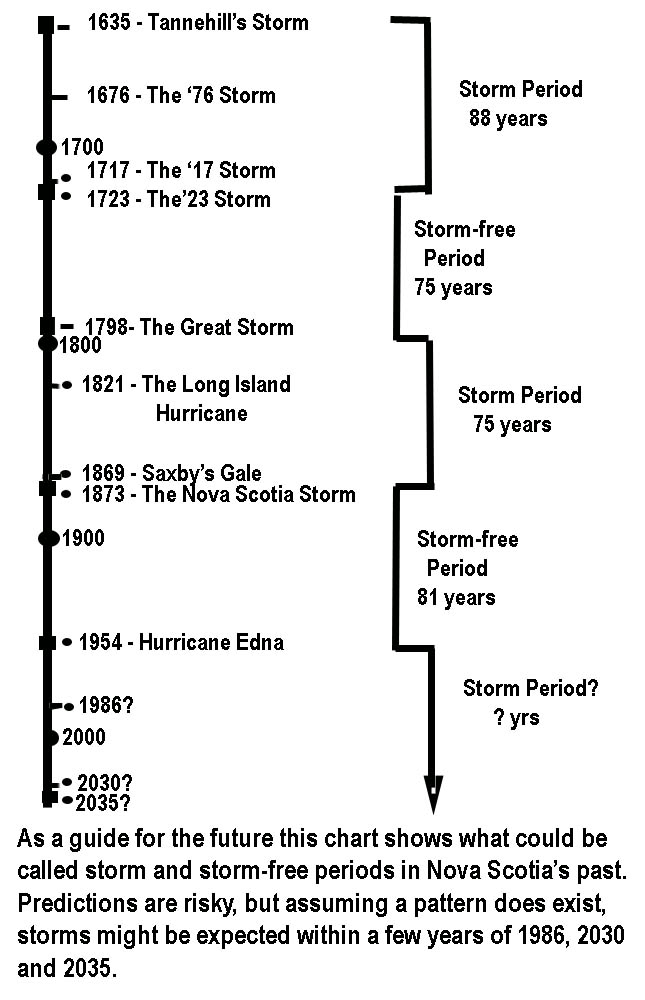
Diagram redrafted from Dwyer, 1979. Click on image for larger version
– Woodlands shaped by past Hurricanes
By David Dwyer, Forester on www.novascotia.ca/natr/; originally published in Forest Times November 1979)
“Many of our forest stands in Nova Scotia are a result of past hurricanes. Mounds on the forest floor -the result of uprooted trees – indicate this.The age of trees growing on these mounds give a good indication of when the storm occurred. These stand ages compare well with the written records of past storms… A common age of forest stands in Nova Scotia is 100 years. The origin of many of these stands is the blowdown resulting from Saxby’s Gale.[1869] No doubt the Nova Scotia Storm of 1873 is a contributing factor too. George MacLaren writes in his Pictou Book that the storm of August 24, 1873 “… was probably one of the most severe and destructive that has visited our coast in years”. He calls it “The Big Blow.””
On the significance of historic blowdowns and Pit and Mound topography
Post By DGP on nsforestnotes.ca, Dec 5, 2021 (“Comment 2 on the draft Nova Scotia Old Growth Forest Policy” “There are many old forest stands in Nova Scotia that developed following blowdown of Old Growth in the Saxby Gale (1869) and the Nova Scotia storm (1871) and thus have maximum possible ages today circa 140 years…”

Recruitment dates of individual trees in the DNR Lawler Lake study (from Bush 2018) ordered left to right from earliest Recruitment Date to the most recent. Dates in red correspond to storms cited by Dwyer 1979. The envelopes circle plateaus suggestive of a suite of recruitment associated with (A) the 1821 storm, and (B) the 1869 and 1873 storms together. The orange circles to the left are trees that would be included if a few years were added to the recruitment dates to allow the time required to breast height. All of these trees were hardwoods – yellow birch, sugar maple, red maple. (Click on image for larger version). Plot of Recruitment Date/Indiviudal trees constructed from data given in Appendix 4 in *Old Forest Assessment in the Lawlor Lake Area of Guysborough County, Nova Scotia by Peter Bush. May 9, 2018. Forest Technical Note No. 2018-01 Nova Scotia Department of Natural Resources.
POST FIONA
Northern Nova Scotia forestry operators left reeling from Fiona
By Staff, PNI Atlantic, Oct 14, 2022 ““Devastating” is a word that is often repeated as forestry experts talk about the fallout of Fiona. Marshall Bateman is the owner of ABL Timber Ltd. and has a number of woodlots in Pictou County. He said he has done his best to follow sustainable forestry practices, but none of that seemed to matter in the high winds. “A lot of stuff is manageable if you’re smart and you do the right thing, but you can’t control a hurricane with winds up to 176 km/hr.””
North Nova Forest Owners Co-op Ltd.: Videos on woodlot mgmt post Fiona
From North Nova FB Page. “North Nova is a private woodlot owners co-op using eco-system based forest management.”
– Part 1: Ecological considerations with continued Fiona harvests
Aug 1, 2024.
– Part 2: Ecological considerations with Fiona harvests and tree growth and development
Aug 2, 2024
– Part 3: Ecological considerations with Fiona harvests and successional pathways
Aug 3, 2024.
– Introduction Definitions General Retention Levels (Post Fiona).
Provided by the Association for Sustainable Forestry
“Tropical storm Fiona caused widespread wind disturbance damage across central and eastern regions of Nova Scotia. This has led to requests from private woodland owners for salvage guidelines that allow for removal of blown down trees while still considering nutrient sustainability, soil health, and biodiversity concerns. The guidelines presented below are derived from recent publications and research related to ecological forest management by the Department of Natural Resources and Renewables (Department).”
Eye of the Storm Forestry in a Changing Climate (Video)
Community Forests Interbational & NSWOOA, Nov 7, 2022
“If you are interested in the impact of climate change on the woodlands of eastern Canada, take a few minutes to watch this new video. In it, forest professionals talk about the problems caused by Hurricane Fiona and offer thoughts about how woodland stewards can make their forests more resilient in a changing climate. The video was produced by Nova Scotia Woodlot Owners & Operators Association and Community Forests International, which are working together to promote the adoption of ecologically sensitive forest practices on non-industrial woodlands in the Maritimes.”
– Post-tropical storm Fiona decimated Nova Scotia’s woodlots. These ecological foresters tell us what cleanup should look like
Part 1: by Greg Watson in the Halifax Examiner, May 15, 2023 “Unlike most other Canadian provinces where the Crown owns most of the land, in Nova Scotia just 29% is designated Crown land. Much of that private land is in the hands of 30,000 private woodlot owners. Since post-tropical storm Fiona, the provincial government has allocated millions of dollars for dealing with the damage the winds caused in woodlots. The Association for Sustainable Forestry is managing most of the Fiona cleanup funding and it provides guidelines for how it should be done ecologically. But what does that look like on the ground? The Halifax Examiner went into the woods to find out from forestry professionals and woodlot owners how they are handling the blow-down without destroying what is left. This is the first of two articles.”
– Post-tropical storm Fiona decimated Nova Scotia’s woodlots. These ecological foresters tell us what cleanup should look like.
Part 2 by Tom Miller “…On his woodlots, Miller says he always “thinned thickly,” leaving healthy and diverse stands of trees when he harvested, carefully selecting every tree he wanted cut or left standing. Fiona flattened many of the trees he had been nurturing for decades, and Miller tells me he’s been trying to get as much fallen wood out of his woodlots as possible before it’s lost its value for timber or firewood. “But here’s the rub,” he says. Miller’s tells me his son and the literature tell him to let a lot of the blow-down stay right where it is, on the ground, to nourish the soil so that the next trees that grow will be even better. “I’m not cleaning up my woods to be like a park,” Miller explains as we walk down a rutted path through a hardwood stand where the North Nova Forest Owners contractor has taken his machine, picking up the fallen trees that Miller has marked.”
– Nature Nova Scotia calls for second look at proposed timber cuts on eastern Crown land
Michael Gorman · CBC News, Mar 2, 2023. “Dealing with blowdown…The minister and Crossland are of different minds when it comes to the need for salvage cuts in areas affected by Hurricane Fiona. While Rushton said the wood needs to be removed while it is still of value and to prevent potential forest fires, Crossland said such concerns are overstated because of rapid decay in Nova Scotia’s humid climate. The removal of so much wood from Crown land also serves to depress values of wood on private lands, said Crossland. Leaving some of that blowdown in the woods creates an opportunity to teach ecological forestry practices and it can also nourish depleted soil, and create hummocks and hollow terrain which helps with water retention and diversification of the forest floor topography, she said.”