
“NSWOOA directors have concluded it is very unlikely the new federation would protect the forest or the interests of small landowners.”
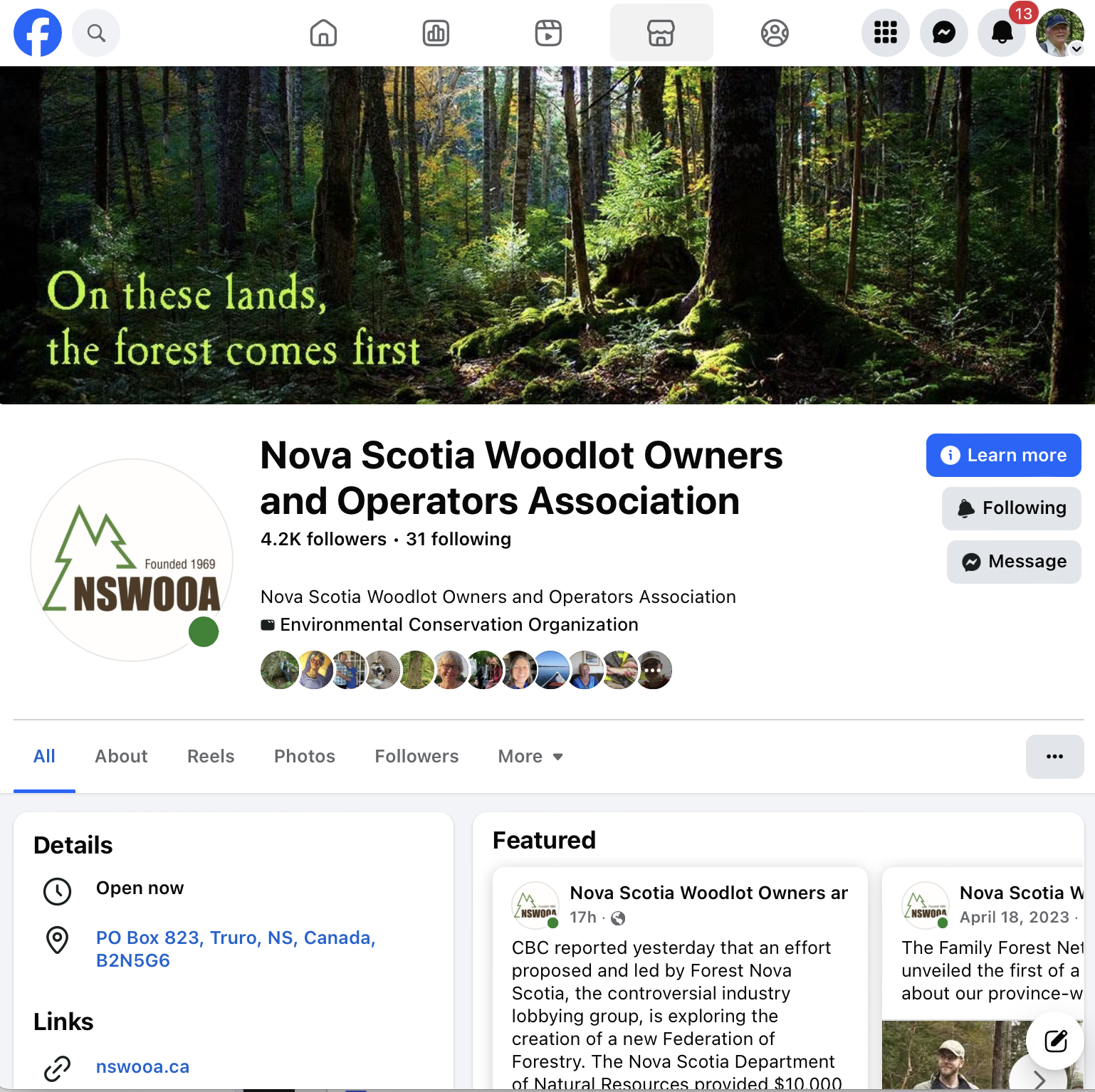
Screenshot of top of NSWOOA FB page, Nov 25, 2026. Click on image for larger version
NSWOOA is the Nova Scotia Woodlot Owners & Operators Association. From their website:
Research has shown that most of Nova Scotia’s 30,000+ forest landowners are interested in sustainably managing their woodlands, but they want to explore alternatives to clear-cut harvesting. NSWOOA has been a leader in promoting environmentally centered, socially responsible, and economically balanced forestry for more than 55 years. We believe that forest practices should mimic natural processes in the native Wabanaki-Acadian Forest…NSWOOA members are people throughout Nova Scotia who support and practice ecologically sensitive forest management and who are willing to share their knowledge and experience with others.
Three days ago (Nov 23, 2026) CBC published an article by Michael Gorman: “Some in N.S. forestry industry consider a new way to represent themselves“. It begins:
Some people in Nova Scotia’s forestry industry are wondering whether a new way of organizing could help them succeed over the long term despite ongoing challenges.
This past summer, representatives from about 30 groups, including mills, woodlot owners, contractors and lumber companies, were invited to five meetings to discuss creating a federation that could speak for the wider industry.
“We’re at this point in time where a lot of us are just hanging on and the question is do we want to have a sector in 10 years,” Freeman Lumber chief operating officer Marcus Zwicker said in an interview last week.
Apparently NSWOOA was not among the invitees.
On Nov. 24, 2026, NSWOOA Executive Director Andrew Kekacs wrote a critique of this process in a post on the NSWOOA FB page. Some extracts, bolding inserted:
“NSWOOA has been aware of this process for many months. We wrote to DNR on July 24 to learn more about the idea, but we were told that the department had “selected a cross section from the sector (trying to keep it to 20-25 people) to work on this strategy.” It invited us “to join a [future] session and see what has been formed.”
“NSWOOA is glad that the effort is finally out in the open. We have grown increasingly concerned about the real motives and likely impact of the proposal.
“In his July 30 response to our inquiry, a DNR staffer told NSWOOA that the federation was about “coming together and having one voice for the entire sector and to reduce duplication, strengthen alignment, and help position the Nova Scotia Forest for the long run.”
“The words “balance” and “one voice” are repeated again and again by supporters. While that sounds laudable, the federation is really the latest in a long string of initiatives by the Conservative government of Premier Tim Houston to backtrack from the commitment that all three parties made to support and implement the recommendations of the Independent Review of Forest Practices in Nova Scotia. The review, commonly known as the Lahey Report, concluded that “protecting ecosystems and biodiversity should not be balanced against other objectives and values as if they were of equal weight or importance … [because] ecosystems and biodiversity are the foundation on which the other values, including the economic ones, ultimately depend.
“Behind-the-scenes lobbying against that conclusion by elements of the forest sector began immediately after Lahey’s report was released in mid-2018.
“Supporters of the new federation say it would be modelled after the Nova Scotia Federation of Agriculture. NSWOOA has many members who are part of NSFA, however, and they say that comparison is self-serving claptrap.
“….Very few organizations in Canada and the United States claim to jointly represent the interests of small woodland owners, mills and logging contractors. That’s no surprise, for two main reasons:
• First, both countries have free-market economies. Prices for commodities like timber are set by negotiation between growers and users. Landowners are always going to want higher prices, while mills are always going to seek lower costs. Achieving “balance” in the new federation does not change that reality, it just muffles the voices of woodlot owners.
• Even more important is the question of who gets to decide how small woodlands are managed. For more than 40 years, a large and growing body of research has shown that selling timber is only one of small landowners’ many priorities. Protecting wildlife habitat, growing a healthy and diverse forest, creating a family retreat, securing a source of firewood, and many other goals are deeply important to small landowners.
“More generally, the 33,000 Nova Scotia families who own small woodlots want to build a legacy by increasing the value of their forestlands – however they choose to define value, and not only by harvesting timber to make money. Mills and logging contractors largely are focused on getting timber to market, now and in the near future. That’s also reality, which “speaking with one voice” does not acknowledge.
“To be clear, NSWOOA believes in cutting trees when and where it’s appropriate. We work with sawmills and logging contractors who support the right of small landowners to make individual decisions about how to manage their lands, who value natural and productive forest ecosystems, and who know that their ability to buy timber from small woodlots depends on treating the forest and forest landowners with respect.
“Our board believes this proposed federation is an attempt by some parts of the forest sector to capture control of the $6 billion investment that these 33,000 forest-owning families have made, and to use it for the benefit of industry without having to actually buy the land. NSWOOA directors have concluded it is very unlikely the new federation would protect the forest or the interests of small landowners.”
Thx, Andy Kekacs/NSWOOA for Speaking Truth to Power.