This page is a subpage of www.nsforestmatters.ca/In the News
See In the News for other subpages.
Selected news, articles etc. on Climate & Biodiversity beginning August 1, 2026
Climate & Biodiversity News items for the period Oct 3, 2024 to July 31 2026 are on a separate page: In the News – Climate & Biodiversity-2
Oct 15, 2026:
 – Endangered species in Canada face extensive delays receiving protection
Article on The Conversation “For more than 20 years, Canada’s Species at Risk Act (SARA) has protected wildlife that are at risk of being lost from Canadian lands and waters. Once a species is listed as extirpated, endangered or threatened under the act, it becomes illegal to kill, harm or capture it or damage its residences. Its critical habitat must also be protected, at least on federal land. Nevertheless, these protections are routinely delayed for years. Our recently published research has found that since 2017, species that need SARA protections have waited nearly two and a half years on average to formally receive legal protections, well beyond the timelines the federal government set for itself…”
Oct 5, 2026:
– New Supreme Court term begins with justices stumped by climate change case
By Lawrence Hurley for NBC News “WASHINGTON — The Supreme Court kicked off a new term Monday, with the justices wrestling with an attempt by oil companies to throw out lawsuits alleging they should pay damages for the impacts of climate change. Although the case concerns a specific lawsuit the city and county of Boulder, Colorado, brought against Exxon Mobil and Suncor Energy, the ultimate decision could have broad ramifications for more than two dozen similar lawsuits brought by cities and counties around the country. The justices — lacking a ninth member because Justice Samuel Alito recused himself — asked tough questions of both sides as they tackled broad legal questions raised in the case. Alito’s absence raises the possibility of a 4-4 split ruling that would leave the legal issues unresolved while allowing the Boulder case to move forward. Boulder officials say they face increasing costs because of the impacts of climate change, including efforts to minimize risks from wildfires. Just this summer, Colorado has experienced extreme heat, drought and multiple fires…”
Oct 2, 2026:
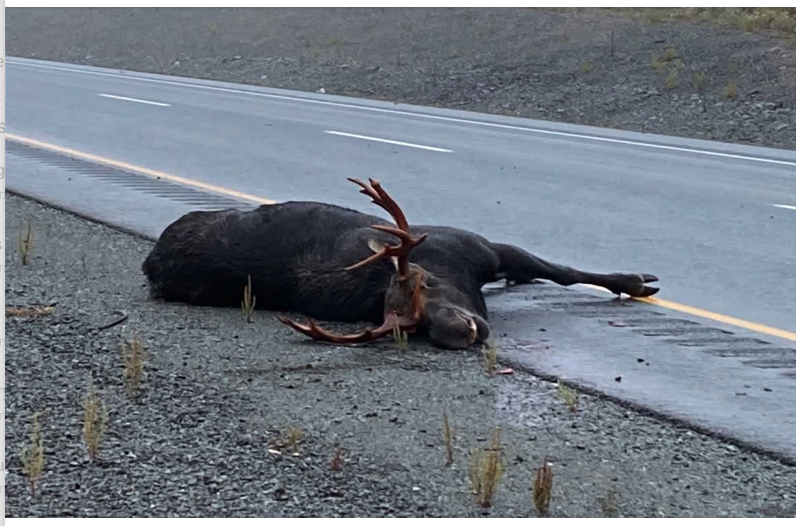 Moose Conservation Association of Nova Scotia issues Press Release After the September 29th death of a bull moose on on highway 104.
Post/Press Release by Al Muir on MCANS FB page. Also available on this website “After the September 29th death of a bull moose on highway 104 in Weavers Mountain, near Antigonish, the Moose Conservation Association of Nova Scotia (MCANS) has written Nova Scotia’s public works and natural resources ministers asking for a Wildlife Toll to be enacted at the tolling station on the Cobequid Pass…”
Oct 1, 2026:
Offsetting for habitat loss almost never works. Ottawa wants more of it
Zoe Mason in the National Observer “Tucked inside a new federal law meant to speed up project approvals are changes to critical habitat protection that experts say could weaken an already struggling system. Last week, the federal government tabled Bill C-39, the latest piece of legislation aiming to expedite major projects. Buried among its many changes are amendments to the Fisheries Act that would allow developers to pay outside parties to make up for habitat loss they caused. Experts say it would undermine a framework already failing to protect dwindling homes for wildlife. “This is our worst fear,” said Misty MacDuffee, a biologist with the environmental advocacy group Raincoast, in an interview with Canada’s National Observer…”
Sep 28, 2026:
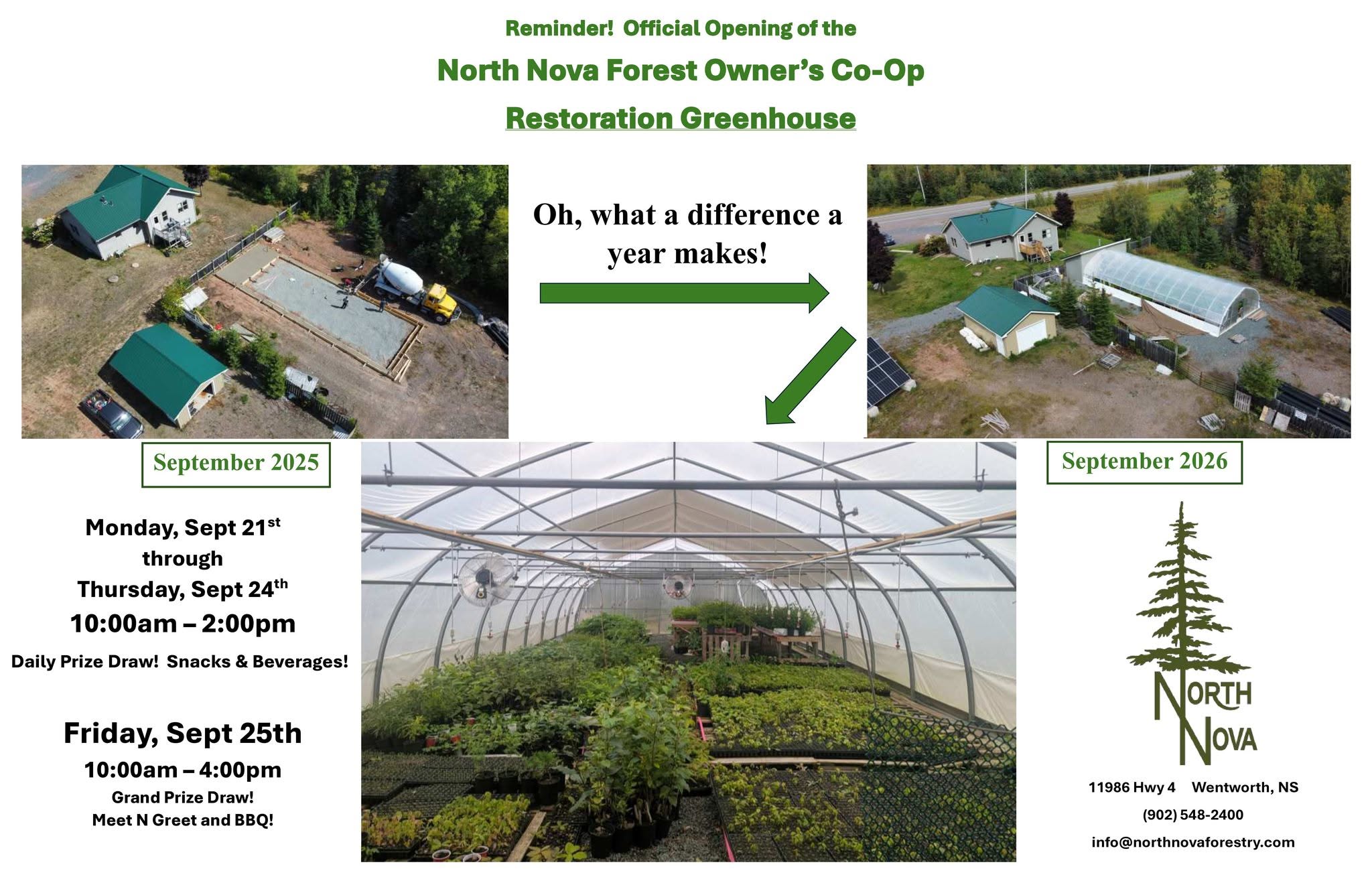
Recent Announcement by North Nova of the opening of their Restoration Greenhouse on Sep 25, 2026 (From their FB page)
‘Restoration greenhouse’ offers seedlings – and hope – for restoring degraded lands and woodlands in Nova Scotia
Joan Baxter in the Hfx Examiner, Intro in Morning File. “They’re calling it the “restoration greenhouse,” and inside are 23,000 seedlings of 25 different tree and shrub species, nearly all of them indigenous to the Wabanaki-Acadian forest ecosystem in Nova Scotia. These seedlings can be planted to enrich and diversify ailing landscapes and forests.Many are hardwood species that industrial forestry actors have tried to minimize (even eliminate) in woodlands in the province, given their preference for conifers for softwood lumber and fibre for pulp, which they propagate in giant nurseries. These conifers are planted after clearcuts, or allowed to regrow naturally, and the areas are often aerially sprayed with glyphosate-based herbicide to kill off broadleaf hardwood species and promote the growth of the softwood “crop trees.” Asked how and where he sourced all the seed for the greenhouse, Heatley told the Examiner he’s been a seed picker “for a long time, so we have a really good diversity of species of trees around, and helpful community members too, who point out trees that are loaded.” “Some are in townships, some are in the woods, some on our woodlot owners’ properties,” Heatley said. “I collect seed or take cuttings from sites that have a lot of regeneration, or a lot of seed-producing trees, and then collect them and grow them from scratch.”
Sep 23, 2026:
Nova Scotians among the 11 seniors from climate caravan arrested on Parliament Hill
Joan Baxter in Hfx Examiner, intro in Morning File “After travelling to Ottawa from all over Canada to deliver their urgent messages about the climate emergency and photos showing how it is harming Canadians, the seniors weren’t about to give up and go away when police officers on Parliament Hill told them they could not deliver the photos to MPs inside. As a result, this morning 11 members of the Seniors’ Climate Witness caravan – three of them Nova Scotians – were arrested at the entrance to the Confederation Building. Among the 35 who set out this morning was Nina Newington, president of Save Our Old Forests (SOOF) in Nova Scotia. Newington is also a member of Seniors’ Climate Witness, and she joined Canada’s first-ever climate caravan, driving herself and fellow seniors with deep concerns about the climate crisis to Ottawa in her electric vehicle (EV) In an interview shortly after her arrest, Newington told the Examiner that when they were told they couldn’t take their messages and more than 200 climate-impact photos concerned Canadians gave them as they made their way to Ottawa, the seniors told the police they were not willing to step back. Newington said two other Nova Scotians – Sue Adams of Antigonish and Niki Clark of Granville Beach – were also arrested. “We’ve been trying for 40 years to get action on climate change and we weren’t going to go off and stand in some more convenient place until there was time for them [the MPs] to start paying attention,” Newington told the Examiner.”
Sep 22, 2026:
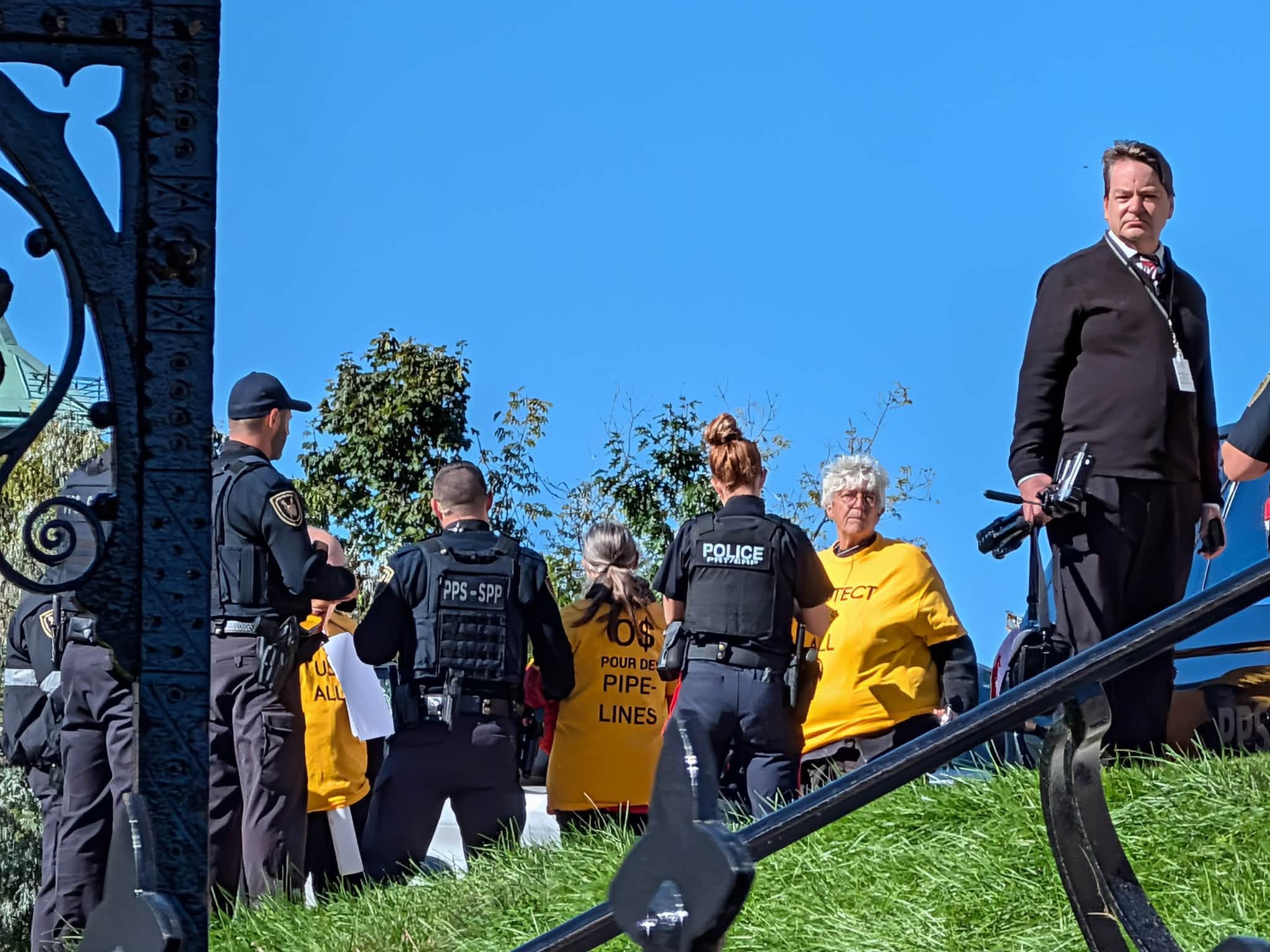 UPDATE (NSFM): Nina Newington was among those arrested. From Nina’s FB post: “It felt right, to stand together, singing ‘We shall not be moved’ as police prepared to arrest us. For forty years some of us have been calling for climate action. And here we are, going backwards while the country burns – or floods – or both. Our voices must grow stronger than the voices of the fossil fuel lobby and their bankers.”
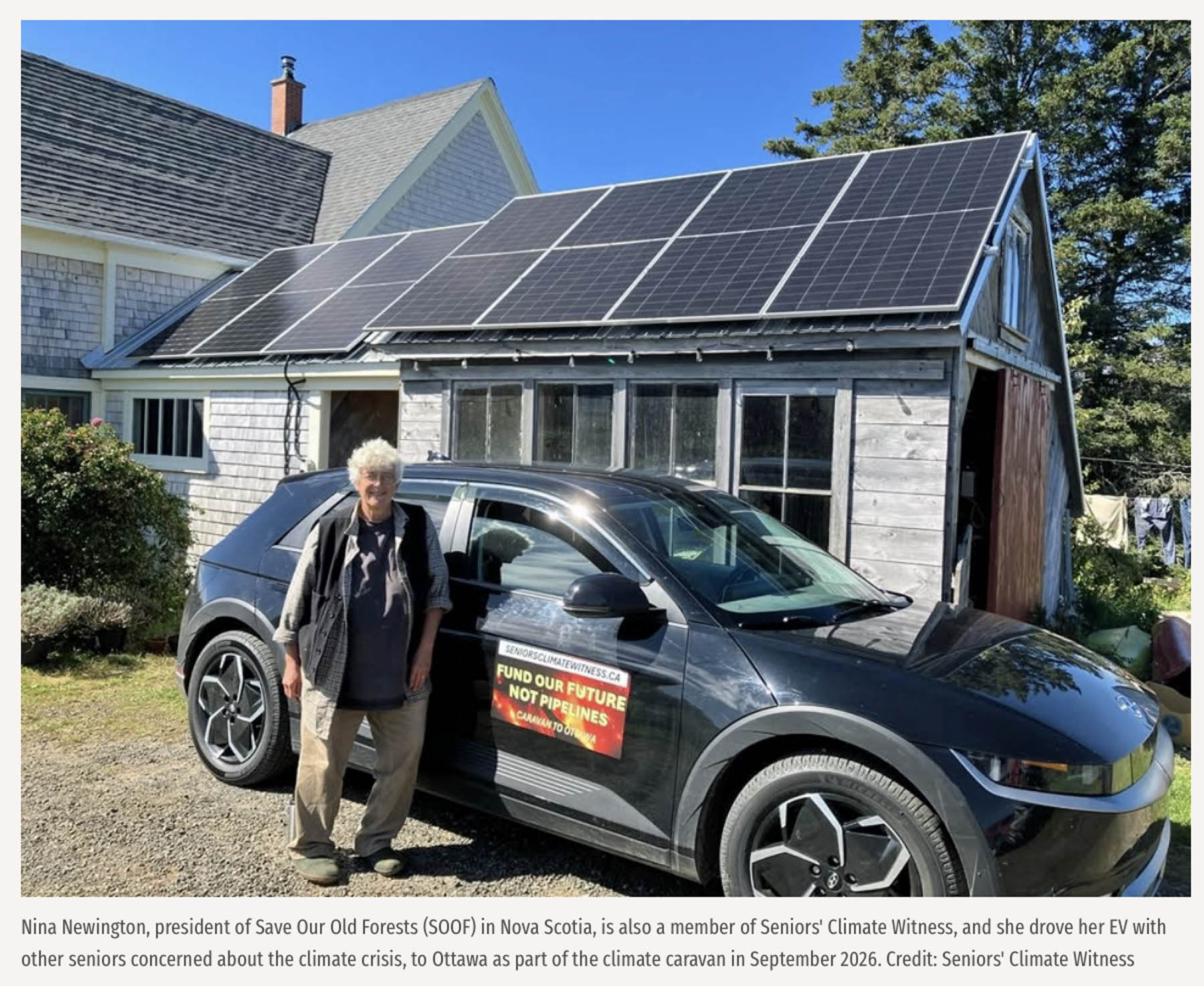
Hfx Examiner Photo accompanying Jaon Baxter’s Report. (Nina Newington in photo and story is also a writer for NS Forest Matters)
Seniors will ‘risk arrest’ to deliver climate-impact photos to MPs and Mark Carney
Jaon Baxter in the Halifax Examiner “Last week, seniors with deep concerns about the climate emergency set out from the west and east coasts of Canada in the first-ever “climate caravan,” heading for Ottawa to make their concerns known to Prime Minister Mark Carney and MPs in the House of Commons. The seven-person delegation from Nova Scotia headed off on Sept. 17 by electric vehicle and train, linking up with seniors from five other provinces in the nation’s capital. Among the climate champions and senior citizens involved in the caravan are renowned environmentalist and scientist David Suzuki, Greenpeace co-founder Bill Darnell, and co-founder of the Seniors’ Climate Witness that organized the caravan, Michael Polyani. Nina Newington, president of Nova Scotia’s Save Our Old Forests (SOOF), is a member of Seniors’ Climate Witness, and she headed to Ottawa last week in her EV. In a media advisory, Seniors’ Climate Witness says the seniors — many of whom are grandparents — will attempt to deliver climate-impact photos to MPs today. If they are unable to reach MPs to do so, “they are prepared to engage in non-violent civil disobedience and risk arrest.”
Sep 19-24 (Announcement):
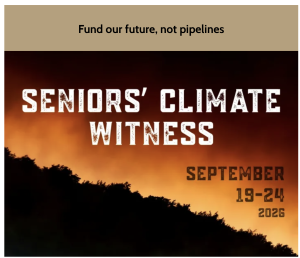 Seniors’ Climate Witness to be in Ottawa during the opening of Parliament
“Canada is at a crossroads. Even as fossil fuel-driven wildfires force thousands of people from their homes and harm millions across Canada and around the world, the federal government is planning to spend tens of billions of public dollars on new fossil fuel pipelines while backtracking on key climate commitments, and disrespecting Indigenous rights. This September, Seniors’ Climate Witness will bring together seniors, people of faith, and allies in a national climate witness culminating in Ottawa during the opening of Parliament. Together, we will call on the Government of Canada to reject new fossil fuel pipelines, uphold its climate commitments, respect Indigenous rights, and invest instead in a safe, clean and livable future for our children, grandchildren, and future…”
Sep 18, 2026:
Debunking a corporate climate ruse
OPINION by Michael Grunwald, Contributing Writer, NY Times. Extracts “It’s no secret that trees are good for the climate… But proposed revisions to the leading global standard for measuring and managing planet-warming emissions would make cutting down trees look good for the climate, as strange as it sounds. The changes to the widely used Greenhouse Gas Protocol would create a warped reality where companies could claim credit for cutting emissions when they harvest trees for paper, burn trees for energy or convert trees into other wood products. And the more wood they use, the more emissions they could claim to reduce. There’s a simple explanation for these perverse results: The process to rewrite the rules has been dominated by wood products companies that would benefit…Wood product companies are pushing an accounting approach that would declare their products climate-friendly as long as they’re logged from regions where tree growth exceeds tree harvest, which currently includes enormous parts of North America, Europe and Asia. It’s a bit like declaring that as long as the stock market is going up, every individual stock in that market is automatically up, even the stocks that go down… In practice, this would produce wacky outcomes… Tree-cutting companies could cancel out their emissions under the protocol by simply buying or even leasing additional woodlands…. IKEA could brag the more wooden furniture you buy, the better it is for forests and the climate. And recycled paper would look worse for the planet than virgin paper, because it doesn’t require additional trees…We’re living through a dispiriting moment of global climate fatigue, when companies worldwide are back-tracking on their climate commitments, but someday the pendulum will swing back toward climate action. The protocol will help define what counts, and it can’t be whatever actions companies are already taking. We’ll need to do a lot better than that.”
– Chemical Conversations Between Forests and the Sky Affect Air Quality, Clouds, and More
By Dennis Clark in Advancing Earth and Space Sciences – EOS “Trees release invisible gases that can create clouds, trap heat, and worsen pollution. Scientists are busy trying to unravel forests’ complex atmospheric contributions in a changing climate…Do forests cool the planet or warm it? It’s a deceptively simple question with no clear answer. The catch is that the same forest can push climate in opposite directions at once. Forests are widely viewed as climate change mitigators—and planting trees as a partial climate solution—because they absorb carbon dioxide. Yet that framing is incomplete. Trees also release reactive gases called biogenic volatile organic compounds (BVOCs) that can influence cloud formation, contribute to air pollution, and extend the atmospheric lifetime of methane, a greenhouse gas that can trap about 80 times as much heat as carbon dioxide. Although largely invisible to the public, BVOC emissions are significant. They account for roughly 90% of the global mass of nonmethane volatile organic compounds entering the atmosphere [Khan et al., 2025]. In natural habitats, forest trees are the dominant sources of BVOCs.The topic is further discussed under the headings
From Leaves to Clouds
A Climate Paradox
The Air People Breathe
A Gray Area of Greening Cities
Challenges for Atmospheric Modeling
Tracking the Chemical Pulse of Forests
Sensing Biogenic Volatiles from Orbit
Continuing to Reveal Ecosystem Influences “
Sep 17, 2026:
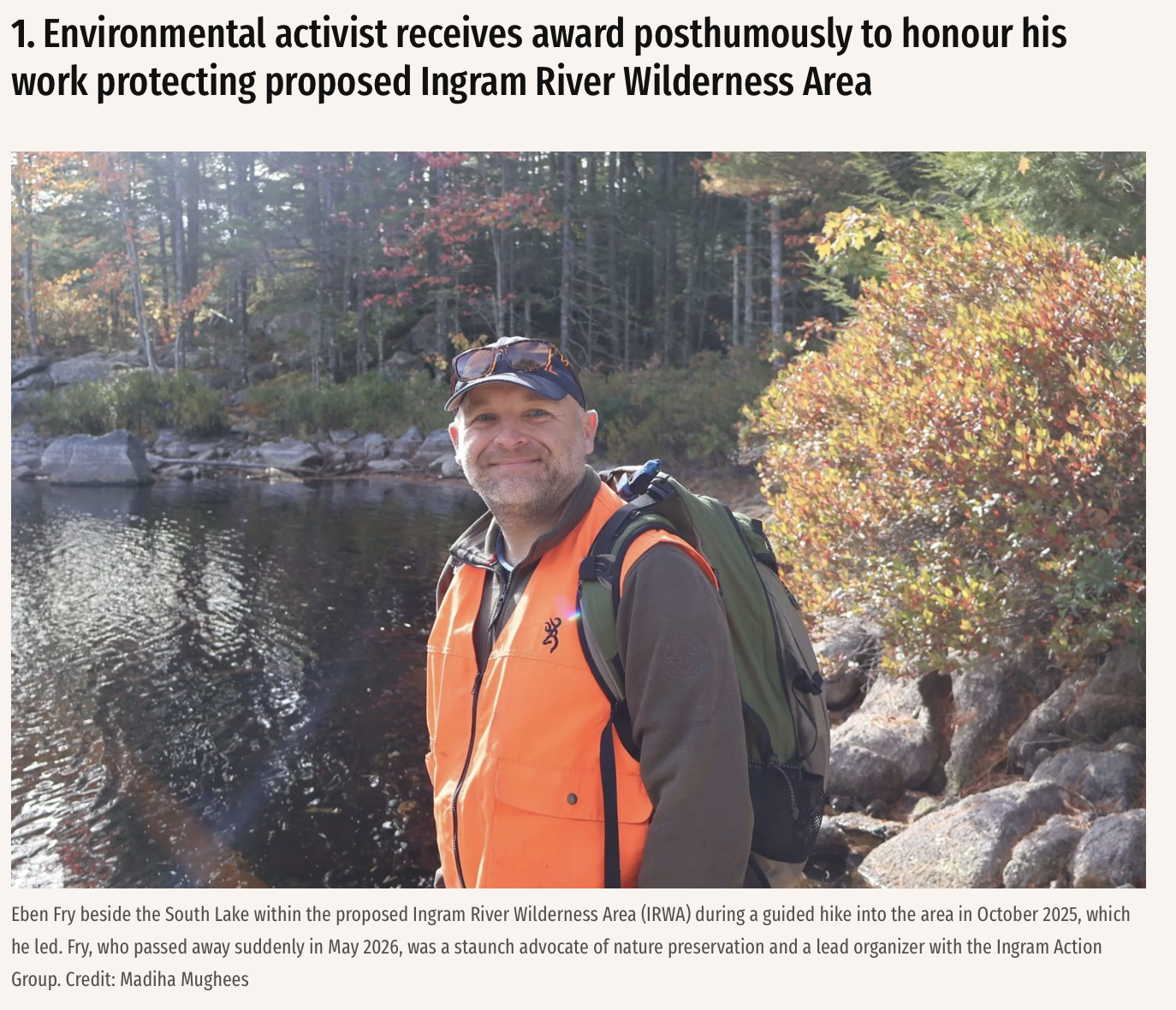 – Environmental activist receives award posthumously to honour his work protecting proposed Ingram River Wilderness Area
Madiha Hughes in the Halifax Eaxaminer, Intro in Morning File “Madiha Mughees reports on the Ecology Action Centre’s annual awards ceremony, which took place earlier this week. One of the prizes was awarded posthumously to environmental activist Eben Fry, for his work to protect the Ingram River Wilderness Area. Fry had a medical emergency and died on May 27, while walking his dog in the woods near his home.Mughees writes:“Eben had been working tirelessly on efforts to protect the Ingram River Wilderness Area, which is currently being decimated by our provincial government’s short-sighted forestry practices,” the EAC’s associate director of community engagement Joanna Bull said while announcing Fry’s award. “He is dearly missed, and his spirit lives on in all those who love the land and stand up for it.” Fry’s mother, Iren Hjelkrem, who accepted the award on his behalf and who was visibly emotional, told the Halifax Examiner in an interview that it feels “amazing” to see her son’s efforts honoured even after his death….”
Sep 11, 2026:
Click on image for larger version
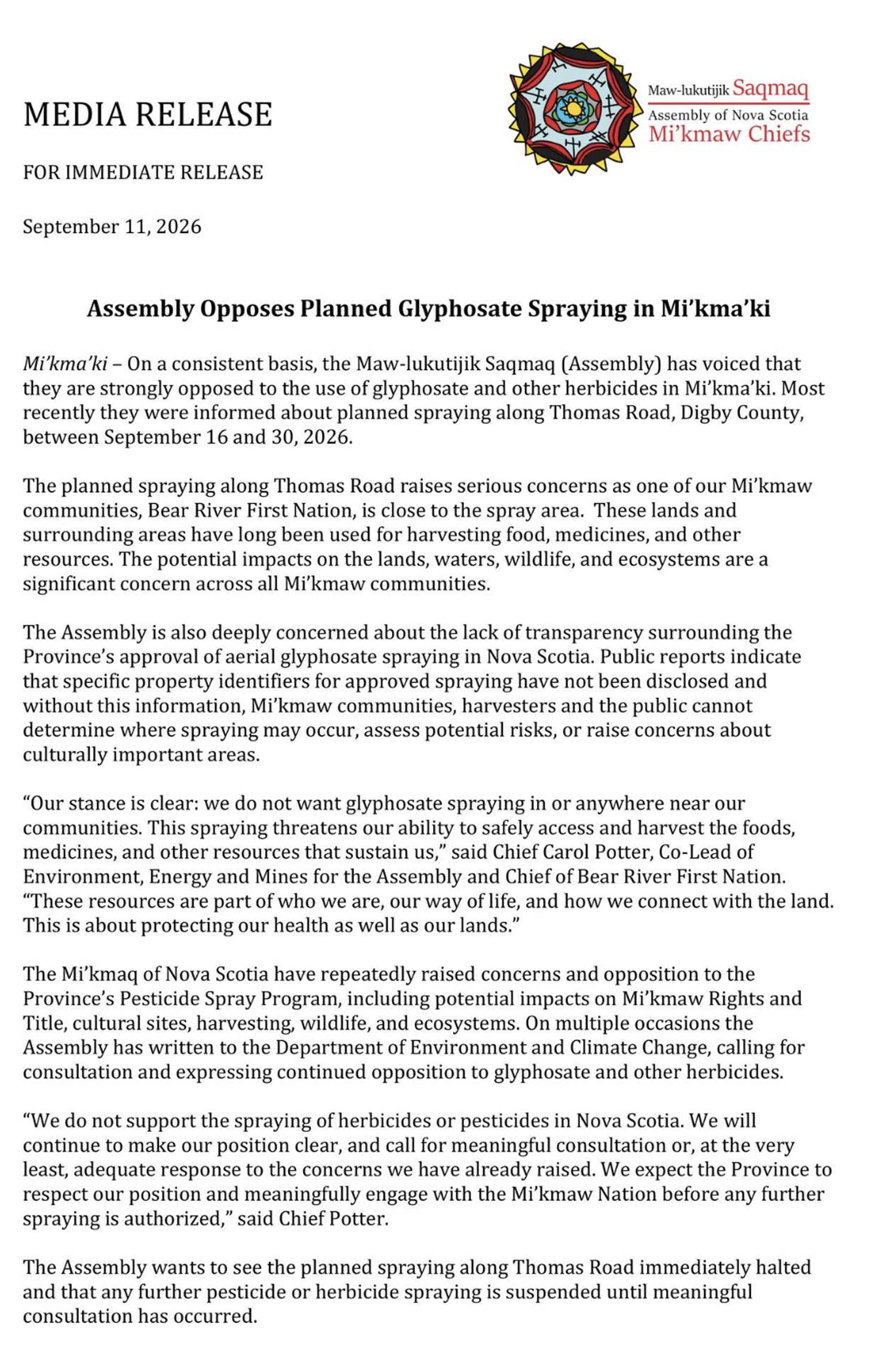
Assembly opposes spraying in Mi’kma’ki
Maw-lukutijik Saqmaq/Assembly of Nova Scotia Mikmaw Chiefs. Extracts: “On a consistent basis, the Maw-lukutijik Saqmaq (Assembly) has voiced that they are strongly opposed to the use of glyphosate and other herbicides in Mi’kma’ki. Most recently they were informed about planned spraying along Thomas Road, Digby County, between September 16 and 30, 2026. The planned spraying along Thomas Road raises serious concerns as one of our Mi’kmaw communities, Bear River First Nation, is close to the spray area. These lands and surrounding areas have long been used for harvesting food, medicines, and other resources. The potential impacts on the lands, waters, wildlife, and ecosystems are a significant concern across all Mi’kmaw communities…The Mi’kmaq of Nova Scotia have repeatedly raised concerns and opposition to the Province’s Pesticide Spray Program, including potential impacts on Mi’kmaw Rights and
Title, cultural sites, harvesting, wildlife, and ecosystems. On multiple occasions the Assembly has written to the Department of Environment and Climate Change, calling for consultation and expressing continued opposition to glyphosate and other herbicides. “We do not support the spraying of herbicides or pesticides in Nova Scotia. We will continue to make our position clear, and call for meaningful consultation or, at the very least, adequate response to the concerns we have already raised. We expect the Province to respect our position and meaningfully engage with the Mi’kmaw Nation before any further spraying is authorized,” said Chief Potter.”
Sep 10, 2026″
– ‘Super’ El Niño is now a near certainty. Here are 5 side effects you may not know about
Alix Martichoux. on The Hill “The chance of a very strong, or “super” El Niño grew to greater than 90% on Thursday. In fact, it may soon become one of the strongest El Niños ever, the Climate Prediction Center said. “During the October-December 2026 season, there is a 75% chance of a historic even that would exceed the strength of previous El Niño events dating back to 1950,” the national forecasters said in their latest release…“Now is the time to get ready,” said said Dr. Jeffrey Shaman, senior vice dean and professor at the Columbia Climate School.”
Sep 9, 2026:
– Global GHG emissions reached fresh high in 2025: Report
ArgusMedia.Com “Global greenhouse gas (GHG) emissions reached a record high of 55bn t/CO2 equivalent (CO2e) in 2025, up by 0.9pc on the year, data from the EU’s independent emissions database for global atmospheric research (Edgar) show.”
– PM Carney Is Gutting Canada’s Environmental Safety Net, and Hoping No One Notices
Environmental Defence News Release “…This latest attack on Canada’s hard-fought environmental rules came in the form of a quiet posting in the Canada Gazette which announced that some of the country’s most polluting projects will no longer be reviewed under the country’s Impact Assessment Act. This includes the country’s largest carbon bombs: oil and gas pipelines (including in national parks), in situ oil sands extraction and fossil gas plants…UPDATE: Shortly following the release of our statement below, the federal government put out a press release outlining the changes to the Impact Assessment Act.” Also view Feds quietly exempt oilsands and gas power plants from environmental impact assessments by Marc Fawcett-Atkinson for the National Observer, Sep 10, 2026
–
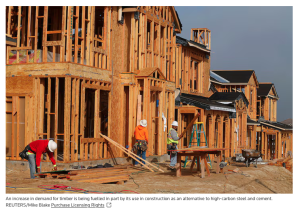
Caption: An increase in demand for timber is being fuelled in part by its use in construction as an alternative to high-carbon steel and cement. REUTERS/Mike Blake Purchase Licensing Right
As forest loss accelerates, can the world meet the rising demand for wood?
By Angeli Mehta for Reuters “With the impacts of climate change being felt across the globe, forests are under pressure as never before. While agriculture is the main driver of permanent deforestation, wildfires contributed 30% of tree cover loss and logging accounted for a 25% loss between 2001 and 2025, according to WRI. This loss may be temporary, but forests can take decades to recover and may never return to full health. Boreal forests have been ravaged to make toilet paper, while in Europe wood pellets are burned for energy. Five years after countries pledged to halt and reverse forest loss by 2030, there has been scant progress. At the same time demand for timber, which is expected to grow 37% by 2050, could rise even higher if more wood is used for construction – a climate solution to replace demand for high-carbon steel and cement. Against this bleak backdrop, the most ambitious regulatory solution on offer is the EU’s deforestation regulation (EUDR), which will come into effect at the end of this year after twice being delayed. The question is, how much can it do to move the dial?…One solution to deforestation risk promoted by the pulp and paper industry is to plant fast-growing hardwood species such as eucalyptus, particularly on the millions of hectares of land that have already been degraded by intensive cattle farming or agriculture. Read more…” COMMENT: A lot in this article, about where we get wood in the future, plantations versus natural forest etc. and the broader environmental costs, and questions of sustainability. Those plantations would include the HPF on Crown lands in NS. Conversion of natural forest to plantation forest is forest degradation.
Sep 4, 2026:
– Wildfires are front-page news. Why isn’t their cause?
By Tara Mahoney. Opinion in the National Observer “The next time you hear a news story about a wildfire, try a small experiment. Listen for two words: climate change. Then listen for two more: fossil fuels. You will probably hear about hectares burned, evacuation orders, homes threatened, firefighters stretched to their limits and heartbreaking stories of loss. You may hear about drought, lightning, wind, “poor forest management” or even suspected arson. But there is a good chance you won’t hear references to either climate change or fossil fuels as the primary cause of ongoing, unprecedented weather events. We are surrounded by reporting on its consequences even as the crisis itself, particularly its primary cause, remains conspicuously absent…I have been leading a campaign calling on CBC to connect extreme weather, climate change and the fossil fuels driving it….This is not only a CBC or Canadian problem. Across Western media, extreme weather is routinely reported without adequate climate context. Across the Atlantic, researchers and climate scientists are raising the same alarm. Climate News Tracker, working with the University of Exeter, found that 79 per cent of UK TV and radio programs covering extreme weather during the summers of 2024 and 2025 made no mention of climate change…There is a term increasingly used to describe this phenomenon: climate hushing, the downplaying, omission or avoidance of climate change in public communication.”
Sep 2, 2026:
– Global heating will hit at least 1.8C, UN warns, and there are ‘no good outcomes’
Adam Morton in The Guardian “Global heating will reach at least 1.8C under even the most optimistic future, well beyond the Paris agreement goal of 1.5C, according to a UN report that warns every fraction of temperature rise intensifies destructive extreme weather, glacier melt, ecosystem loss, and island and coastal city submersion.The report by the Nairobi-based UN Environment Programme confirmed overshooting the 1.5C goal inscribed in the landmark Paris agreement of 2015 was now “unavoidable” and, despite some progress in addressing the human-caused climate crisis driven by burning fossil fuels, likely in the next few years.”
 View UNEP Report: Limiting Overshoot: Navigating exceedance of 1.5°C and pathways towards return
Abstract
A new spotlight report by the UN Environment Programme finds that as global temperature rise gets set to cross 1.5°C, pushing climate risks and impacts to dangerous new heights, the world must strive to return to below 1.5°C as soon as possible and simultaneously reduce the vulnerability of societies, communities and economies to climate impacts. The report, Limiting Overshoot: Navigating exceedance of 1.5°C and pathways towards return, finds that the world can achieve this goal by acting now to get on an ‘overshoot, peak, and decline’ pathway.
– Farewell black spruce? How climate change and pests are reshaping North America’s forests
By Alex Walls, University of British Columbia “More than 80 per cent of North American forests could face greater threats from pests and diseases by mid-century, finds study led by UBC researchers.”
Aug 27, 2026:
– El Niño climate patterns supercharged by burning of fossil fuels, study finds
Oliver Milman for The Guardian “…“Our findings suggest El Niño can supercharge global warming but also global warming can supercharge El Niño – that is what we are seeing,” said Julia Cole, a climate researcher at the University of Michigan, who led the new study, published in Science.“We are seeing a trend of stronger El Niños and the one we have now is consistent with that trend – it’s not a fluke. We are seeing a shift where El Niño doesn’t look like what it did prior to industrial times. That is bad news for climate hazards and for people, particularly those who are badly impacted and yet have done little to cause climate change.”As the world has heated up due to the use of fossil fuels, a string of recent “super” El Niño events has provided extra acceleration, with intense events causing the global temperature record to fall in 1998, then 2016 and then further in 2024.”
– ‘A very Canadian challenge’: How cities like Halifax can learn to adapt as climate change impacts push wildlife into our urban spaces
Suzanne rent in Morning File (Hfx Examiner)
Aug 23, 2026:
– Data centres and democratic decline could lead to more water conflict in the future
Ryan Durante in The Conversation ” …Analysis from the Intergovernmental Panel on Climate Change shows that climate change’s most pressing impacts in the coming decades will be on water resources, with implications for governance. This isn’t just an issue for rivers like the Nile: these impacts are happening everywhere, including North America. Current analyses of water conflict do not properly consider the 21st-century landscape. My doctoral research focuses on transboundary water governance, climate change and water conflict. I believe there are three distinct factors that may increase the likelihood of conflict over shared waters in North America and Europe in the coming decades: an increase in generative AI-driven data centres, a decline in democratic processes and debate, and climate-related uncertainty…”
 Aug 21, 2026:
– Public Consultation Opens on New Protected Areas
NS Gov/Environment and Climate Change News Release “Part of the Margaree River watershed and old growth forest in Cape Breton, a coastal area along the Eastern Shore, and a mix of forest, coastline and lake shoreline in Halifax are set to become Nova Scotia’s newest wilderness areas. Public consultation opens today, August 21, on protecting 5,100 more hectares of Nova Scotia’s land and water, including: three new wilderness areas, additions to seven existing wilderness areas, an addition to one existing nature reserve…Nova Scotians can provide input until October 20 at: https://www.novascotia.ca/nse/protectedareas/ The Province has protected about 14.56 per cent of its land and water, covering about 800,000 hectares. If designated, these sites represent an additional 0.09 per cent towards the Province’s goal of 15 per cent by December 31.”
Aug 20, 2026:
– 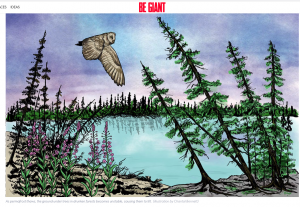 What drunken forests can teach us about Canada’s thawing permafrost
By Rebecca Gao, illustration by Chantal Bennett for www.begiant.ca “It may look like they’re recovering from a wild night out, but these trees are a climate change red alarm…How a tree gets “drunk” all comes down to the unique topography of the Arctic, where up to 80 per cent of the land includes permafrost, a frozen layer of soil and rock that can start anywhere from 0.5 metres to two metres beneath the surface of the soil. (The technical definition of permafrost is ground that remains at or below 0ºC for at least two consecutive years.) The layer of soil between the permafrost and the surface is relatively shallow, so the root systems for Arctic trees like black spruce grow horizontally, making them particularly vulnerable to any sort of instability.As permafrost thaws, the ground under these trees becomes unstable, causing trees to tilt or even sink into the newly boggy ground. And when drunken forests eventually die, the disruptive impact on the ecosystem extends to water quality, because dead trees falling into nearby bodies of water release carbon and mercury as they decompose…As the black spruce forest has seemingly melted into the wetlands, he notes that the vegetation has also changed to favour shrubs in this part of the Arctic, which has a knock-on effect of changing animal habitats, greenhouse gas flow and water storage and movement. That’s why drunken forests are such a valuable research tool. Using old aerial photos to figure out past forest coverage, Quinton and his team can track the loss of permafrost going back decades. In the 1950s, he says, about 70 per cent of the land by Scotty Creek sat on permafrost. Today, it’s just 30 per cent. It’s not just science for science’s sake. The work being done at Scotty Creek is in partnership with nearby Indigenous groups who use the findings to improve their communities’ climate resiliency. “
– As Canada burns, it’s time to rethink what national security means
Shane Gunster, Opinion in the National Observer “As wildfires force thousands of Canadians from their homes, Canada is launching one of the biggest increases in defence and security spending in our nation’s history…The scale is extraordinary. It represents a choice to devote a huge share of Canada’s economic resources to protecting the country. Which raises the question: What will actually make Canadians safer?…For many of us, climate disruption is already among the most persistent and predictable threats that we face. Wildfires, floods, extreme heat and smoke force people from their homes, cut transportation links, damage infrastructure that supplies water and power and leave communities dependent upon emergency evacuation. We know that these risks will grow as warming continues. But these impacts are largely invisible in how we think and talk about national security…If Canada is willing to spend more than $150 billion per year in the name of national security, then a significant share of that investment should build the capacity we know we need as climate disasters become more frequent and severe. To do that, we need a much smarter, more expansive and more realistic approach to what counts as investing in our safety and security. If provincial and municipal agencies need more stable funding to expand wildfire, flood and emergency response capacity, provide it. If Ottawa should develop a national Canadian-built water bomber fleet (as a recent Canadian Senate report recommended), do it. If Canada needs a dedicated federal civilian disaster response organization, create it. And where investments in military technology, engineering, communications, surveillance, transportation or logistics can serve both defence and climate-security needs, prioritize those…Looking after each other is at the core of what national security should mean. Shane Gunster is professor in the School of Communication at Simon Fraser University. His research and teaching focus upon media and communication about the politics of energy and climate.”
Aug 19, 2026:
– A looming disaster threatens to drown one of Canada’s northernmost communities
Natasha Bulowski & Jimmy Thomson in the National Observer “Resolute Bay, Canada’s second-northernmost community, is facing a little-known threat as the Arctic continues to warm. On a sunny afternoon in late June, Inuit kids are riding their bikes along the dirt roads that encircle Resolute Bay, Nunavut, Canada’s second-northernmost community. They’re silhouetted against the ocean as the 24-hour sunlight glances off the sea ice…Behind them, a short distance away across the water, a cliffside looms, looking solid as the sea ice beneath. But just like the ice, the ground holding the cliff in place is warming and, if it were to let go, it could hit the community with a wall of water the height of a low-rise apartment building….A wave triggered by a landslide on Griffith Island could reach the small Inuit hamlet on Cornwallis Island 10 to 15 minutes from the instant the steep eastern cliff slides into the Parry Channel, he [Ioan Nistor, a professor of Hydraulic and Coastal Engineering at the University of Ottawa] said…As climate change continues to increase global temperatures, permafrost thaw will accelerate and the likelihood of such landslides will increase, Nistor said. The impacts of climate change are felt acutely in the Arctic, which is warming at two to four times the global average. Last August, glacier retreat caused a large landslide in the Tracy Arm fjord in southeast Alaska and triggered an impulse wave that travelled 1.6 kilometres across the channel and ran 480 metres up the fjord wall opposite. To put that number in context, the Eiffel Tower is 330 metres tall…Nistor and his research team are trying to identify slopes at risk of sliding and how an incident would impact communities in the Canadian Arctic.”
Aug 16, 2026:
– Tiny, beautiful species are going missing from restored forests and wetlands
Emily Chung · CBC News “When larger animals and plants return, minuscule algae, mosses and lichens may not”
Aug 13, 2026:
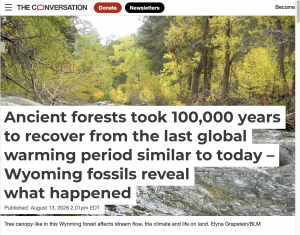 – Ancient forests took 100,000 years to recover from the last global warming period similar to today – Wyoming fossils reveal what happened
By Regan E. Dunn in The Conversation “…Lessons for today
This sequence carries an important lesson for today. Higher carbon dioxide levels like the world is experiencing now can stimulate plant growth, but only while temperatures and water remain within the limits that trees can tolerate. Beyond those limits, heat, drought, insects, pathogens and wildfire can overwhelm any fertilization effect that would boost growth. Around the world, many forests are already showing signs of diminishing as temperatures rise, in addition to deforestation for timber, crops and rangeland that further reduce their resilience.”
– Forest canopy decline under elevated CO2 during the Paleocene-Eocene Thermal Maximum
RE Dunn et al., in Science VOL. 393, NO. 6812 :Abstract Uncertainty remains regarding the impact of rapid anthropogenic warming on forest ecosystem structure, biodiversity, and function. As an analog, we reconstruct forest canopy density and compositional change in Wyoming, USA, through the Paleocene-Eocene Thermal Maximum (PETM), an interval of abrupt carbon increase and warming ~56 million years ago. We develop a proxy to quantify leaf area index and assess shifts in floral composition using palynomorphs. Forest canopies opened abruptly at onset of PETM warming, landscape erosion increased, and vegetation shifted from broad-leaved angiosperm to fern- and palm-dominated ecosystems. When combined with regional data, these patterns suggest that continental-scale changes in plant communities cause landscape destabilization. These shifts also have implications for multimillennial-scale hydrologic and carbon cycle feedbacks in the climate system.”
– Record drought threatens future of New Brunswick’s balsam firs
Danielle McCreadie · CBC News “Balsam fir trees in New Brunswick are turning red and dying after last summer’s record-breaking drought, raising concerns about the future of the provincial tree. University of New Brunswick forestry researcher Prof. Anthony Taylor says he has been hearing from woodlot owners and seeing the damage firsthand, as the crisp evergreen trees — favoured for Christmas trees — slowly turn red, dry out, and die. He said the pattern is consistent with what he has observed following other hot, dry summers… He says similar balsam fir die-offs followed unusually hot, dry summers in 1986 and 2018…Taylor explains the trees will stop the photosynthesis process early in reaction to drought conditions, which stops them from growing…The trees also have very shallow roots, meaning it’s harder for them to access water during dry months…Peter McKeil first noticed damage to balsam firs on his woodlot in June. He said they’re turning red from the bottom branches upward. And he is noticing new red spots every day, so the die-off is not over yet…Taylor hopes his research continues to reach the right people, and inspire change. “It should send a signal to society that we need to stop burning fossil fuels. We need to get off fossil fuels. We need to stop cutting too much forest,” he said.”
– Retrofitting Atlantic Canada’s buildings to achieve net zero will cost billions
Glenn MacDonald for Saltwire “…ReCover, an Atlantic Canadian deep retrofit accelerator based in Dartmouth, estimates that bringing the region’s residential building stock to a substantially higher level of performance could require about $187 billion through 2050. Commercial and institutional buildings would require another $55 billion. It is a staggering price tag, but Lorrie Rand, senior adviser and co-founder of ReCover, argues the investment needs to be viewed as infrastructure spending rather than simply an energy-efficiency expense. Atlantic Canada has little choice but to tackle the existing building stock if it wants to meet its climate commitments, Rand said. Nova Scotia, New Brunswick and Newfoundland and Labrador have targets to reach net-zero emissions by 2050, while Prince Edward Island has set a 2040 target. “That is a very short amount of time,” Rand said. “Emissions from buildings are a significant percentage. There’s really no viable route to achieving our net-zero ambitions unless we do deep retrofits to buildings.”…”
– Dispute Over Counting Forest Carbon Roils Global Standard-Setter
Olivia Raimonde for Bloomberg News/ “A scientist has resigned from the World Resources Institute amid disagreement over how to tally forest carbon in accounting rules that are under development. Those rules, which are being drafted by Greenhouse Gas Protocol (GHG Protocol) — a global standard-setting body overseen in part by the non-profit — will shape how companies in the forest industry report their carbon footprints. Tim Searchinger, a senior research scholar at Princeton University’s School of Public and International Affairs, told Bloomberg News and non-profit newsroom SourceMaterial that he will be leaving his role as technical director of land-related issues at the World Resources Institute this month because of what he said are shortcomings in the GHG Protocol’s process in drawing up the new rules…The argument centers on two competing approaches to calculate carbon stores and emissions from forests. Both approaches seek to account for how forests absorb, store and release carbon, but they differ in how those changes should be attributed. Activity-based accounting seeks to distinguish changes caused by humans from those resulting from natural processes. The managed land proxy approach instead generally treats any changes on managed forest land as the result of human activity. Some experts have raised concerns that managed land proxy would allow companies to essentially double count carbon removals and take credit for those occurring naturally, regardless of their business operations…“We are extremely opposed to the application of [managed land proxy] in the Greenhouse Gas Protocol because it will result in the opposite of what it tries to do, which is climate change mitigation,” said Miguel Mendonça Reis Brandão, who served on the body’s technical working group for forest carbon accounting and is associate professor of industrial ecology and life cycle assessment at KTH Royal Institute of Technology in Sweden. “It’s counterproductive.” A spokesperson for the GHG Protocol said the matter is still under review. This is the first time the group will publish guidance on forest carbon accounting; it is accepting comments through February and won’t make a decision until after its standards board evaluates the feedback. Until then, companies can use either accounting approach but must be transparent, the representative said. The issue has split experts and stakeholders involved in the GHG Protocol, with most academics supporting the first approach and most representatives of industry the second, reporting by Bloomberg and SourceMaterial found.”
Aug 11, 2026:
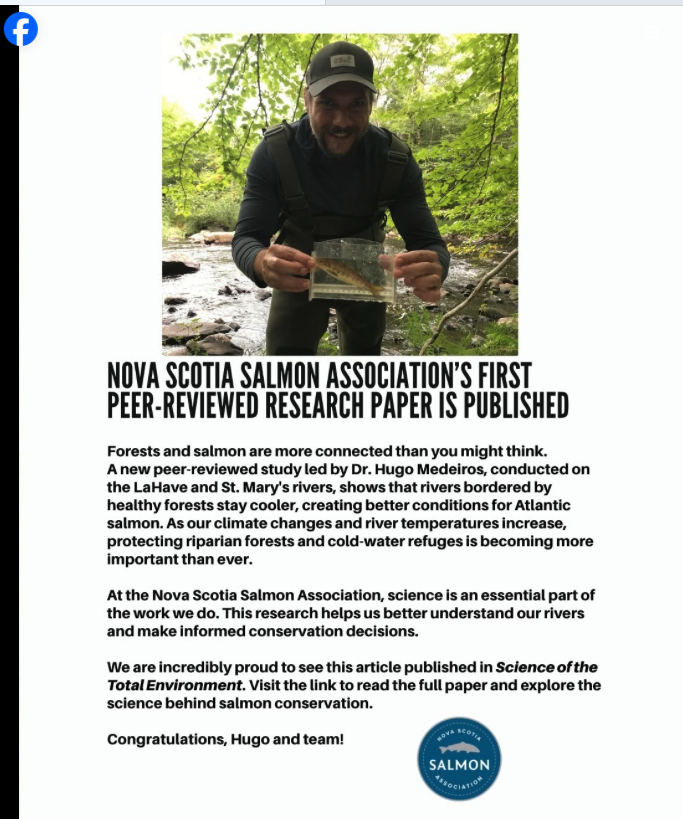
NS Salmon Association announcement on their FB page, July 28, 2026
– Land cover and natural riverscape heterogeneity shape in-stream thermal regimes: Implications for Atlantic salmon (Salmo salar) conservation
Hugo Reis Medeiros et al., 2026 in Science of the Total Environment “Abstract. Atlantic salmon (Salmo salar) populations continue to experience significant declines across the North Atlantic due to a myriad of factors including acidification, invasive species, and warming waters related to climate change. Temperature is a key habitat metric for salmonids but the underlying factors that drive riverine thermal regimes, and the fine-scale thermal suitability of ecologically significant salmon watersheds in the province of Nova Scotia, Canada, remains largely unknown. Here, we combined field data with a machine learning approach to: (i) identify the main environmental factors driving riverine thermal variability in two large watersheds in the Nova Scotia Southern Uplands region; and (ii) examine thermal habitat suitability for Atlantic salmon in the ∼2313 km of river network that comprise the studied watersheds. We found that riparian forest cover, landscape forest cover, and elevation had a significant cooling influence on water temperature, whereas slope, wetlands and developed areas had a warming effect. Our predictions and thermal suitability maps suggest that 55% (∼ 666 km) of the LaHave River (1214 km) and 22% (∼235 km) of the St. Mary’s River (1072 km) are predicted to have stressful average temperatures for adults during the summer. Daily maximum temperature exceeded 20 °C for more than 40% of the study period in 89% (∼ 1084 km) of LaHave River, and 84% (∼ 903 km) of St. Mary’s River. Daily maximum temperature exceeded 23 °C over 40% of the study period in 26% (∼ 318 km) of LaHave River, and 10% (∼ 110 km) of St. Mary’s River. Significant reaches of both river networks are approaching stressful conditions for adult Atlantic salmon in the warmer months, while thermal conditions are more tolerable to juveniles. Such scenarios underscore the importance of protecting high-quality habitats and thermal refugia, without which salmon populations in this region are unlikely to recover.”
– What these salamanders could tell us about the health of Nova Scotian forests
Giuliana Grillo de Lambarri · CBC News “…Hemlock woolly adelgid (HWA) has been wreaking havoc on forests in southwestern Nova Scotia for almost a decade. To fight its spread, Parks Canada, the province, local organizations and private landowners have been using insecticides, namely imidacloprid and dinotefuran. But Mathilde Christjansen, a master’s student at Mount Allison University in Sackville, N.B., said little is known about if and how woolly adelgid and the insecticides used to fight it are impacting other species. “[Imidacloprid] is intended to affect insect nervous systems, but they can also affect nervous systems in other animals,” she said. “It has been found in the brains of other animals like fish and tadpoles.” Rather than studying all species in all hemlock forests one by one, Christjansen said the team is using one small amphibian to get a snapshot of the ecosystem. The eastern red-backed salamander is a really good bioindicator species because it’s sensitive both to environmental conditions and to pollutants,” she said. “So if anything is happening with our eastern red-backed salamanders, that could be a really good indicator of how the forest is doing as a whole.”..”
Aug 8, 2026:
Indigenous seed program protects N.B. forests, culture and species at risk
Polina Kozlova | CBC News “For Indigenous communities, a seed can represent much more than the beginning of a plant It can carry language, culture, traditional knowledge and a connection to the land. That is why the National Tree Seed Centre in Fredericton is working with Indigenous communities across Canada to collect and preserve native seeds through its Indigenous seed collection program. The program, launched in 2022, aims to protect plant species that could be threatened by climate change, invasive species or other environmental pressures. Mary Knockwood, the Indigenous programs manager at the Atlantic Forestry Centre, said the program is based on collaboration between scientific and Indigenous knowledge…”
Aug 5, 2026:
–  Report shows N.S. government returned $5M in unspent federal funding for land protection
Michael Gorman · CBC News “The Nova Scotia government returned $5 million in federal funding earmarked for land protection because it did not spend it, and it made no measurable progress in reducing greenhouse gas emissions in the last year. Those are some of the details in the most recent provincial update on progress to achieve goals related to addressing climate change, released last week….” Also View Comments by Nina Newington
– Nearly 80% of N.S. residents oppose private development in protected areas: poll
Danielle Edwards · CBC News “A new poll suggests most Nova Scotians do not want the province to permit private development in provincial parks and protected areas. According to an online survey commissioned by the Ecology Action Centre, nearly 80 per cent of respondents were opposed to things like golf courses, hotels and spas being built in legally protected areas. Just under 60 per cent of respondents were “completely opposed” to allowing development, compared with four per cent who fully supported it.”
************************************************************************
Climate & Biodiversity News items for the period Oct 3, 2024 to July 31 2026 are on a separate page: In the News – Climate & Biodiversity-2