
Navigation
www.nsforestmatters.ca
…Ecol. Forestry & Conservation
… … HWA & Other Invasives
… … … Ticks/Lyme (This Page)
Drafting.
Click on images for larger versions
| Life Cycle of Lime Disease Ticks Extracts from CDC Brochure*: *CDC is the Center for Disease Control, USA; the link no longer works (2026)Knowing the complex life cycle of the ticks that transmit Lyme disease bacteria can help in understanding the risk of getting the disease and how to prevent it.The complete life cycle of Ixodes ticks requires 2 years. 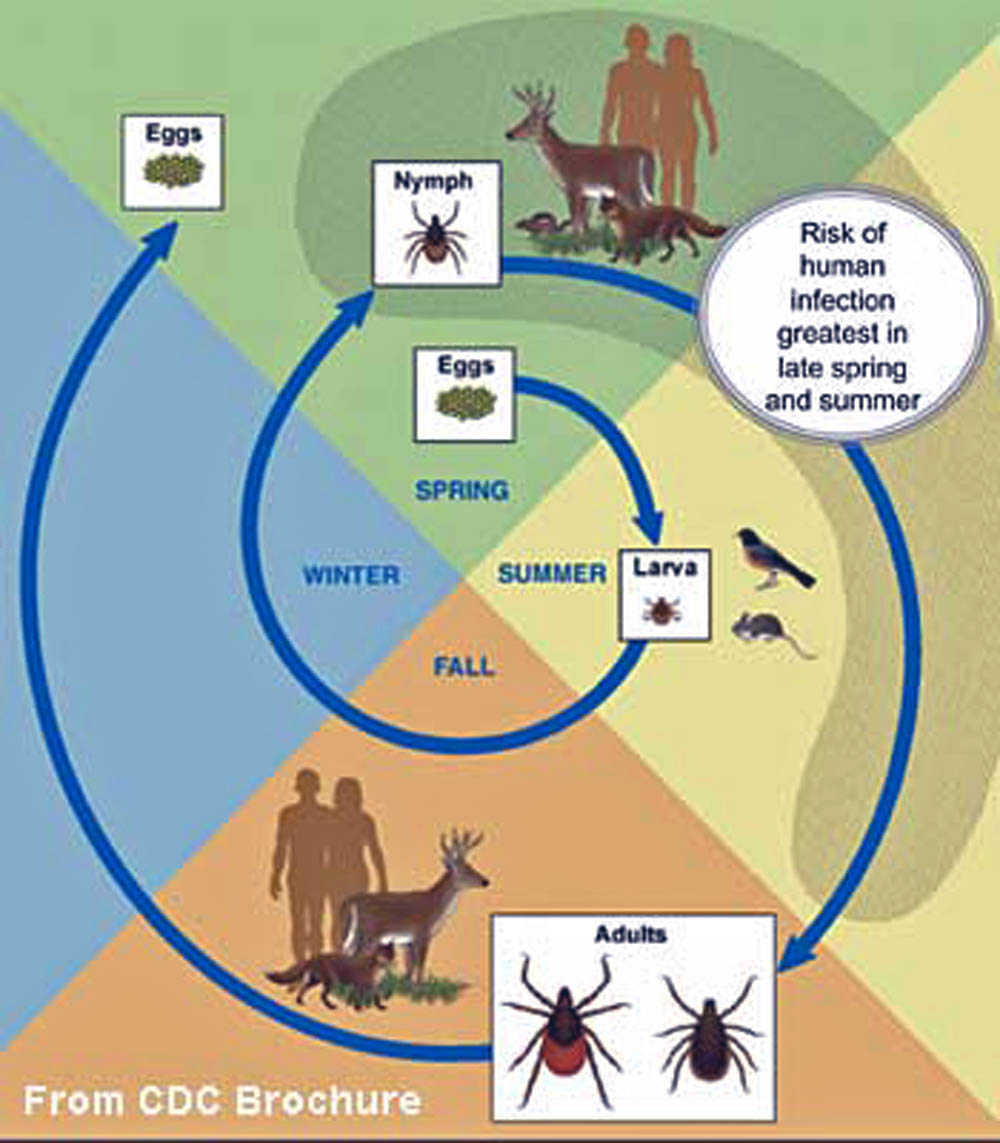 Tick eggs are laid in the spring, and hatch as larvae in the summer.Larvae feed on mice, birds, and other small animals in the summer and early fall. The larvae may become infected with Lyme disease bacteria when feeding on these animals.Once a tick becomes infected, it stays infected for the rest of its life and can transmit the bacteria to other hosts.After this initial feeding, the larvae usually become inactive until the following spring, when they change into nymphs. Tick eggs are laid in the spring, and hatch as larvae in the summer.Larvae feed on mice, birds, and other small animals in the summer and early fall. The larvae may become infected with Lyme disease bacteria when feeding on these animals.Once a tick becomes infected, it stays infected for the rest of its life and can transmit the bacteria to other hosts.After this initial feeding, the larvae usually become inactive until the following spring, when they change into nymphs.
Nymphs seek blood meals in order to fuel their growth into adults. Nymphs feed on small rodents, birds, and other small mammals in late spring and early summer. Nymphs will also feed on humans, and if previously infected with Lyme disease bacteria, they can transmit the disease to humans. Nymphs molt into adult ticks in the fall. In the fall and early spring, adult ticks feed and mate on large animals, such as deer. Adult female ticks will sometimes also feed on humans. In spring, adult female ticks lay their eggs on the ground, completing the 2-year life cycle. |
“Most humans are infected through the bites of immature ticks called nymphs. Nymphs are tiny (less than 2 mm) and difficult to see; they feed during the spring and summer months. Adult ticks can also transmit Lyme disease bacteria, but they are much larger and may be more likely to be discovered and removed before they have had time to transmit the bacteria. Adult Ixodes ticks are most active during the cooler months of the year.” -CDC Lyme disease transmission – CDC Lyme disease transmission (doc no longer posted, 2026)
– N.S. pharmacists reducing strain on emergency rooms by treating Lyme disease
Tori Fitzpatrick · The Canadian Press on cbc.ca. Oct 6, 2026 “Nova Scotia’s decision to allow pharmacists to provide preventive treatments for early signs of Lyme disease has led to a steep reduction in emergency room visits for tick bites, a new study says…Among Canadian provinces and territories, Nova Scotia has the highest ratio of ticks to people, with the province’s South Shore and Annapolis Valley regions reporting the largest tick populations.
In 2024, there were more than 2,300 cases of Lyme disease reported in Nova Scotia, according to federal data.”
 – Tick reports are surging in Canada. These areas are most affected.
ByDaniel Otis for www.cp24.com June 24, 2026 “Tick reports are surging across Eastern Canada this year – and especially in Ontario. Driven by climate change, migratory birds, and expanding mice and deer populations, experts expect the troubling trend to continue well into the future, increasing the risk of serious tickborne illnesses like Lyme disease. Data submitted to eTick.ca as of June 23 shows that confirmed tick reports are up 38.5 per cent in Canada so far this year compared to the same period in 2025….While national Lyme disease case data is not yet available for 2026, at least 1,072 cases have been reported so far this year in four provinces, according to figures provided to CTVNews.ca. Well over half were recorded in Nova Scotia (600 cases), followed by Ontario (296 cases), Quebec (155 cases) and New Brunswick (21 cases)...As climate change leads to shorter and milder winters in many parts of Canada, tick populations are establishing themselves further north and outside of their historical ranges. There are now more than 40 different types of ticks in Canada. In addition to Lyme disease, other tick species can transmit bacteria and viruses that cause rarer but potentially fatal conditions like Rocky Mountain Spotted Fever and alpha-gal syndrome, which can also lead to an unusual red meat allergy…While better tick awareness and monitoring may be contributing to an uptick in reports, experts like McGill University infectious disease professor Dr. Michael Libman say environmental factors are the main drivers. “Ticks depend on both mice and deer for their life cycle, and it is the changes in these populations which are as important as the warm weather directly affecting tick survival,” Libman told CTVNews.ca. “For example, the deer population has been steadily increasing in southern Quebec, for a number of reasons, not all are climate related. Nevertheless, the number of infected ticks, and their northward movement each year has been relentless.””
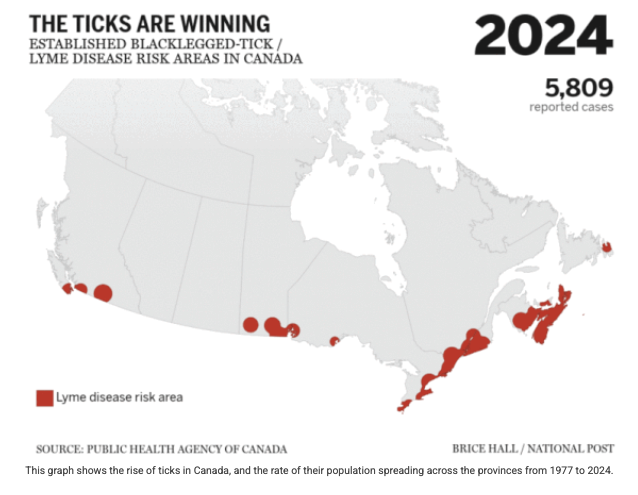
Invasion of the ticks: Watch their remarkably fast spread across Canada
By Mason Kossak for Saltwire June 8, 2026
“Three Canadian experts give their take on the current tick problem in Canada, how to avoid the insects and what happens when one bites you…Ticks are pushing farther across Canada every year, and the diseases they carry are coming with them. Reported Lyme disease cases climbed from 522 in 2014 to 5,239 in 2024, according to the Public Health Agency of Canada. National Post reached out to three experts for more information on where ticks are spreading, why and how to stay safe. Manisha Kulkarni is a professor at the University of Ottawa’s School of Epidemiology and Public Health. Virginie Millien is a biologist at McGill University. Luis Anholeto is a lab manager at the Canadian Tick Research and Innovation Centre at Acadia University…
How do people avoid getting bitten?
Kulkarni: People can avoid tick bites by staying on the trails in wooded areas where ticks live, and by wearing long clothing, using insect repellent that contains DEET or icaridin, or wearing permethrin-treated clothing.
Anholeto: Wear light-coloured clothing, it makes ticks easier to spot, and tuck your pants into your socks. After being outdoors, do a full-body tick check, paying special attention to under the arms, behind the knees, the waist, the groin and the scalp. Also, check children and pets.
If someone finds a tick on them, what should they do?
Anholeto: Stay calm, finding a tick early is actually good news. Ticks need to remain attached for hours before transmitting the bacteria. Use clean, fine-point tweezers to grasp the tick as close to the skin as possible and pull upward with slow, steady pressure. Do not twist or squeeze the tick.
What’s the biggest misconception about ticks or Lyme disease you’d want to clear up?
Anholeto: I have been seeing posts on social media lately about the lone star tick in Canada. This tick is associated with alpha-gal syndrome, the so-called red meat allergy from a tick bite. It’s a real condition, but the risk of locally acquired alpha-gal syndrome in Canada is low because the primary tick responsible, the lone star tick, is not established here. Right now, if you get bitten by a tick in Canada, the realistic threats are Lyme disease, anaplasmosis, babesiosis and Powassan virus. Be wary of misinformation.
Anything else Canadians should know heading into summer?
Millien: They’re not that scary. The problem is that we become too comfortable. We need to be reminded, stay on the trail or wear long pants and then the tick check. It’s just a tweezer and 90 degree pull out straight, because you don’t want to leave the head in there.”
A ‘rapidly rising’ tick-borne disease is making rounds in Canada. It’s not Lyme disease
By Christl Dabu for CTV News Jul 13, 2026 “Canadians exploring the outdoors this summer are being warned about threats other than Lyme disease from tick bites as cases rise. While Lyme disease is the most common concern about ticks, health officials are increasingly worried about another tick-borne disease called anaplasmosis. Experts reported their concerns about the “rapidly rising” incidents of anaplasmosis, the second most common disease spread by the arachnids in Canada, in an article published Monday in the Canadian Medical Association Journal (CMAJ)..Experts say symptoms can include fever, weakness, headache and gastrointestinal distress… Anaplasmosis can damage vital organs, causing hospitalization from health problems such as myocarditis, encephalitis, acute respiratory distress syndrome, and acute renal failure, though they are less common and death is rare, experts say…The current treatment recommended is 100 mg of oral doxycycline, twice a day for 10 to 14 days, researchers wrote. Patients typically improve within 24 to 48 hours of treatment, they added, but if there is no change, health-care providers should consider “alternative diagnoses.”
On Tick-repellant clothing
 I wear tick-repellant clothing when I figure on the basis of habitat, area and season that I could be highly exposed to lyme-carrying ticks.
I made this pic a few years back (circa 2014) with the comment “4 reasons for cross-border shopping” – this clothing was not then available in Canada. It is now, e.g. at Marks, but in 2026 the PMRA has still not registered (allowed for sale) products that enable users to treat their own clothing. Read some of the sad history of the PMRA’s reluctance to register anti-tick products at https://versicolor.ca/noticks/ – david p
Page posted June 9, 2026