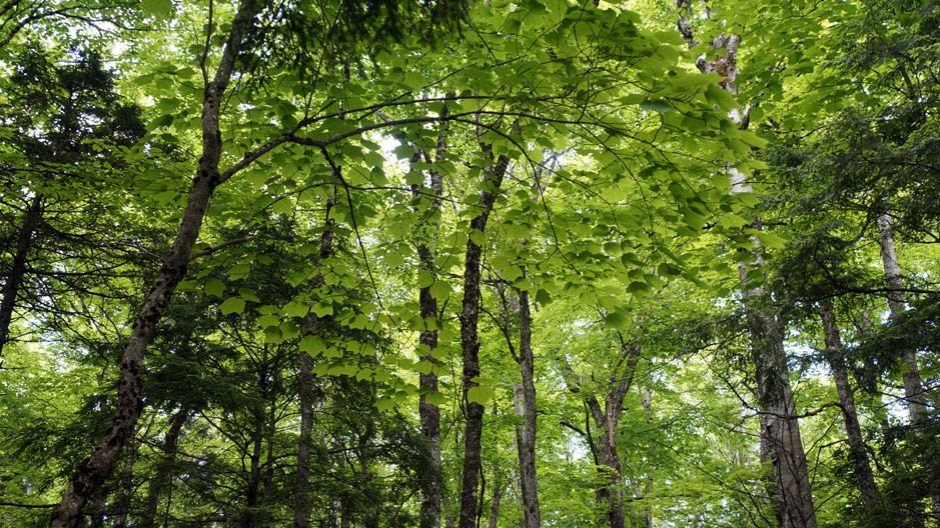
| An ecologist’s perspective on Nova Scotia’s model for high production forestry (Audio)
CBC Information Morning (Halifax), June 11, 2026: ”Is the Nova Scotia government planting the seeds for future wildfires? A forest ecologist says “yes”, as the province continues to allow forestry companies to cut down healthy forests and replace them with conifer trees, which are vulnerable to fire, and drought. Preston hears more about her perspective.” |
This Item is cited on NSFM under
– In The News – Climate & Biodiversity &
– In the News – Wildfire/Extreme Weather
ROUGH TRANSCRIPT (NSFM)
CBC: A forest ecologists says the province’s approach to High Production Forestry Is not going to work in our warming climate and could also burn a hole in our wallets.
Now this type of intense forestry is planned for 10% of Nova Scotia Ccrown land; it involves clearing any existing forests, planting fire prone conifer species, mostly spruce, and harvesting those trees in a 40 year cycles.
Donna Crossland has a Masters in Science in forestry from the University of New Brunswick. Good morning Donna…
How would you describe this, the high production forestry, as it’s currently practised in this province?
DC: Well it goes something like this. So high production forestry or HPF as we say is basically assigning certain areas of the public land to a permanent clear-cutting model. It’s converting forest to plantations, to crops ,and so the objective for that is to produce fast wood for the mill, a which was supposed to compensate for taking less wood from ecological forestry which is supposed to be taking place on our public forests.
CBC: How does the province choose which areas of crown land it wants to designate for HPF or high production forestry ? 1:16
DC: They have an HPF implementation paper that came out in 2023 and a list that they’re supposed to investigate: all existing plantation forests first, as well abandoned fields. And once those areas have been assessed across the province, if there are not enough, then they’re supposed to turn to naturally regenerated or managed forest.
So most of us read that implementation plan and went, OK, we guess that’s a good plan. But what we’re seeing now is that not all the plantations have been fully evaluated for continuing on to keep them as plantations, certainly not in the southwest.
So what they’re doing is converting a lot more naturally regenerated forests than we ever expected and many of them [are] in proposed protected areas and putting basically a fire-prone plantation in the middle of what is a proposed protected area.
And we didn’t integrate climate warming into this very high risk venture.
CBC: So these conifer trees you say are more flammable than most other trees in the forest? And you crunch some numbers to figure out how much it would cost to plant thousands of hectares of spruce seedlings. What did you find out? 2:39
DC: Well it’s an expensive endeavour, Preston.
First you clearcut the area, the mills are very happy doing that, but then it’s let lie fallow for about 3 years all the while it’s going to be emitting carbon stores from the from the soil. And so that’s not good for climate change.
And then there’s a fairly brutal mechanical scarification operation.
Then they finally buy the seedlings, transport the seedlings to the site, plant them often with very low survivorship, then they need to spray out the hardwoods, then they need to thin some years later, about year 25.
And then they harvest around 40 to 50 years – if the crop has not in the interim dried up or burned up or blown down or been killed by insects or fungal attacks.
And the cost of this it’s not cheap it’s it’s estimated to be about $3500 a hectare.
Here’s my numbers that I’ve crunched is that in this year alone we’ve proposed 7250 hectares of plantation forestry.
And at a cost of $3500 per hectare, that exceeds $25 million. It’s a lot of taxpayer dollars.
And we also have to manage the roads and bridges to get to some of these plantations which are located, they are proposed in very distant areas.
CBC: Where do the seedlings come from?
DC: I believe most of the seedlings will come from Strathlorne, you know over on the eastern end of the province.
7250 hectares is a lot of land base to plant, you know do we even have that kind of number of seedlings available? It’s a huge endeavour.
CBC: Why is the spruce trees so dangerous or so vulnerable to fire?
DC: Our conifers are more resinous, hey’ve got those fine needles, and very fine twigs and branches, and as well they are shallow rooted. 4:44
Spruce trees can often have limbs down quite low to the ground which allows the flame to be carried to the top of the crown.
And right now, as we drive around Nova Scotia, I would I encourage people to look out their windows and see how many dead standing spruce and balsam fir they see.
‘Cause there are a lot of them [that] died last year with the drought stress; they’re just not set up for these droughts that we received last year. And who knows what’s ahead with climate warming?
CBC: What happens to them when they when they suffer through a drought like that? Are they useless even for biomass?
DC: Well they’re probably not useless. Wood is wood but they do get stump rot fairly quickly, they’ll rot from the stump and and fall over and so they will decay fairly quickly.
So it’s not it’s not the best quality biomass out there. Personally I’m reluctant even to speak about biomass. I would really like to see Nova Scotia grow timber and high quality lumber.
CBC: Is there an alternative method that this province should be using for high production forestry that would help us adapt to climate change? 6:01
DC: So I think there is Preston, and a compromise out there as we all adapt and change, we pivot and change direction now that we know just how bad climate change appears that it will be and how quickly it’s coming on.
So a uniform shelterwood harvest would be a nice compromise instead of a plantation
… basically a shelterwood harvest is a method of harvesting a forest that allows the forest to naturally regenerate under mature healthy trees that are left standing.
So you just go in and you partially harvest the overstory, the existing mature trees but you leave enough of that canopy to shade the forest floor.
And that’s going to protect the forest floor from releasing its carbon stores. It’ll keep it more moist, it’ll keep it from drying out and becoming more fire-prone, it will shelter the new generation of seedlings beneath the standing trees.
Those seedlings come at no cost. This way, with the shelterwood harvest, we’re more likely to keep the soil biota in good health and healthy soil means healthy forests, and forests are the natural climate solution.
We need to abandon these outdated ideas of plantation forestry and move on.
CBC: Alright, ‘appreciate you explaining this Donna… Donna Crossland is a forest ecologist in Nova Scotia, she has a Masters of Science in forestry from the University of New Brunswick. 7:41