Navigation:
www.nsforestmatters.ca
…Ecol. Forestry & Conservation
… … Planetary Dynamcis & Boundaries
… … … Tipping Points (THIS PAGE)
… … … Planetary Boundaries
… … … Feedback Loops
… … … Key International Programs, Conventions
… … … More Info
TIPPING POINTS (DRAFTING)
– Tipping points in the climate system
Wikipedia. Clear, comprehensive
The first 3 paragraphs (copied Aug 30, 2026):
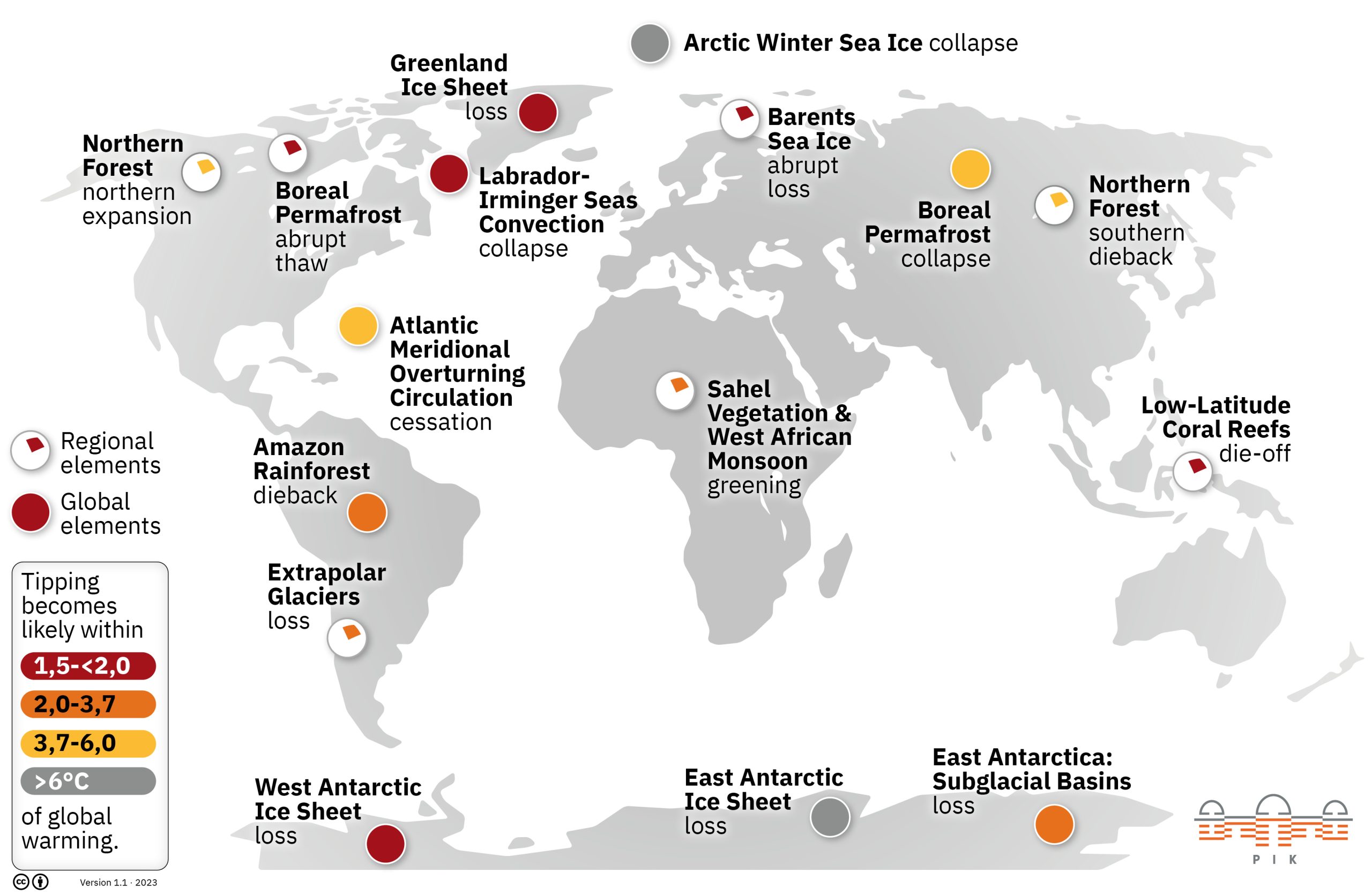 A map showing global and regional tipping elements: if the global temperature increases past a certain point (color-coded for temperature thresholds), this particular element would be tipped.[1] The result would be a transition to a different state.[2] In climate science, a tipping point is a critical threshold that, when crossed, leads to large, accelerating and often irreversible changes in the climate system.[3] If tipping points are crossed, they are likely to have severe impacts on human society and may accelerate global warming.[4][5] Tipping behavior is found across the climate system, for example in ice sheets, mountain glaciers, circulation patterns in the ocean, in ecosystems, and the atmosphere.[5] Examples of tipping points include thawing permafrost, which will release methane, a powerful greenhouse gas, or melting ice sheets and glaciers reducing Earth’s albedo, which would warm the planet faster. Thawing permafrost is a threat multiplier because it holds roughly twice as much carbon as the amount currently circulating in the atmosphere.[6] Tipping points are often, but not necessarily, abrupt. For example, with average global warming somewhere between 0.8 °C (1.4 °F) and 3 °C (5.4 °F), the Greenland ice sheet passes a tipping point and melts, but it would take place over millennia.[2][7] Tipping points are possible at today’s global warming of just over 1 °C (1.8 °F) above preindustrial times, and highly probable above 2 °C (3.6 °F) of global warming.[5] It is possible that some tipping points are close to being crossed or have already been crossed, like those of the West Antarctic and Greenland ice sheets, the Amazon rainforest and warm-water coral reefs. A 2022 study published in Science found that exceeding 1.5 °C of global warming could trigger multiple tipping points, including the collapse of major ice sheets, abrupt thawing of permafrost, and coral reef die-off, with potential for cascading system effects.[8][9] A danger is that if the tipping point in one system is crossed, this could cause a cascade of other tipping points, leading to severe, potentially catastrophic,[10] impacts.[11] Crossing a threshold in one part of the climate system may trigger another tipping element to tip into a new state.[12] For example, ice loss in West Antarctica and Greenland will significantly alter ocean circulation. Sustained warming of the northern high latitudes as a result of this process could activate tipping elements in that region, such as permafrost degradation, and boreal forest dieback.[3]
|
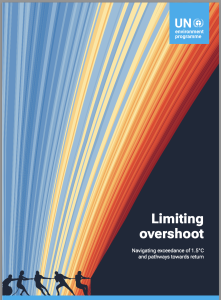 View UNEP Report, Sep 2, 2026: Limiting Overshoot: Navigating exceedance of 1.5°C and pathways towards return
Abstract
A new spotlight report by the UN Environment Programme finds that as global temperature rise gets set to cross 1.5°C, pushing climate risks and impacts to dangerous new heights, the world must strive to return to below 1.5°C as soon as possible and simultaneously reduce the vulnerability of societies, communities and economies to climate impacts. The report, Limiting Overshoot: Navigating exceedance of 1.5°C and pathways towards return, finds that the world can achieve this goal by acting now to get on an ‘overshoot, peak, and decline’ pathway.