Navigation: This page is a subpage of In the News – Climate and Biodiversity-1 on the website Nova Scotia Forest Matters (nsforestmatters.ca)
This Press Release is referred to on the page In the News – Climate and Biodiversity-1 as follows:
| Oct 2, 2026: Moose Conservation Association of Nova Scotia issues Press Release After the September 29th death of a bull moose on on highway 104. Post/Press Release by Al Muir on MCANS FB page. Also available on this website |
—————————
Post/Press Release by Al Muir on MCANS FB page Oct 2,2025:
Press Release
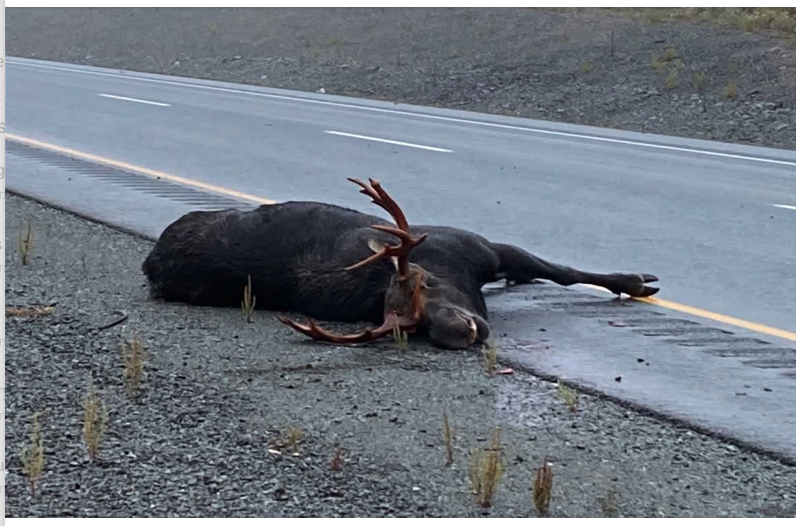 After the September 29th death of a bull moose on highway 104 in Weavers Mountain, near Antigonish, the Moose Conservation Association of Nova Scotia (MCANS) has written Nova Scotia’s public works and natural resources ministers asking for a Wildlife Toll to be enacted at the tolling station on the Cobequid Pass.
MCANS president Al Muir reported that the request was a follow up to a previous one sent to both ministers on February 14th 2025. The requested $1 fee would be applied to fencing and wildlife overpasses with plantings in highway sections of importance. MCANS has identified the Weavers Mountain area as the location requiring the most urgent necessary infrastructure additions.
Edward Dewtie, one of MCANS two resident experts on both moose populations and highway infrastructure in the area said, “ This moose was spotted three times in the Kenzieville area behind the fence trying to get to the other side last week and this was reported to DNR. The fence protected it but four or five days later it ended up on top of Weavers where there is no fence and got hit trying to cross. They fenced on both ends of the mountain but it puzzles me why they didn’t install fencing and overpasses in the main corridor for moose to cross from one mountain range to another”.
MCANS member Thomas Baudoux offered his opinion that, “There should certainly be at least one wildlife overpass in the fencing gap on the mountain. It should be placed with two objectives in mind, follow the best, most likely route of travel on the landscape as if it were in the setting of no human influence, for example ridge line, saddle, bench etc. and then look for evenly distributed distances from other existing passageways for other overpasses. In this case the Middle Brook bridge and West Barney’s River bridge under passages.”
For further information consult MCANS letter to the relevant government departments below or contact Al Muir at 902-616-4888 or by MCANS email.
For information on the circumstances surrounding the moose contact John Kennedy from the Antigonish field office of the Department of Natural Resources
Honorable Fred Tilly, Minister of Public Works
publicworksminister@novascotia.ca
Honorable Tory Rushton, Minister of Natural Resources and Renewables
mindnr@novascotia.ca
CC Honorable John Lohr, Minister of Finance, FinanceMinister@novascotia.ca
CC: Honorable Tim Houston, Premier Province of Nova Scotia premier@novascotia.ca
Dear Ministers Tilly and Rushton,
It is with profound sadness and hope that I write to you on behalf of the Moose Conservation Association of Nova Scotia (MCANS). We assume both of you are aware of the September 29th death of a mainland moose on the recently doubled Highway 104 on Weavers Mountain near Antigonish.
Thankfully the motorist involved did not suffer a similar fate. This incident serves as a reminder that both ensuring public safety on the highway and protecting endangered mainland moose is your shared responsibility.
The previous installation of fencing on some parts of that section of highway reflects an understanding that both wildlife and motorists are at risk in this area. Unfortunately that fencing was erected to impede moose crossings in the area, not to aid in safe crossing elsewhere. Given that understanding it is particularly disturbing that large expanses of the highway, including the one the moose died in, are devoid of fencing and offer very limited options for them to make a safe crossing. One of MCANS resident experts informed us that this moose was spotted three times last week in the Kenzieville area behind the fence trying to get to the other side of the highway and that was reported to the DNR. While the fencing in the area protected it, four or five days later it ended up on top of Weavers Mountain where there is no fencing or wildlife overpasses and tried to cross, getting hit in the process. There is fencing on both sides of the mountain by the highway but none in the main corridor for them to cross from one mountain range to another, leaving questions as to why that is the case.
The endangered Mainland Moose Recovery Plan is very clear on the issue of habitat connectivity. Historically moose moved through the areas on both sides of the highway and across the old highway more frequently when their numbers were more elevated. Wind turbine developments on both sides of the new highway have the potential of increased disturbances which might result in more frequent highway crossing attempts to avoid those disturbances. This would add to the normal increased movements precipitated by their fall mating seasons.
MCANS has written to you both previously on February 14th of 2025 requesting that a tolling mechanism be applied at the existing infrastructure on Highway 104 in the Cobequid Pass to finance both fencing and wildlife crossings. These additions would increase both public safety and animal welfare.
MCANS recognizes the increased fiscal restraints your government is currently operating under and the more limited monetary resources the general public is faced with. At the same time it is our carefully reasoned position that the public would support a $1 Wildlife Toll that would benefit both the public’s safety and endangered moose. Such a fund would provide the capital for improved habitat connectivity and access for all species anywhere in the province that it is applied to in the future. That the infrastructure to collect it is already operational and portions of that toll can be applied to the costs of any additional workload required at the tolling stations makes this option particularly attractive.
It is MCANS position that the Weavers Mountain area is the most urgent priority in this regard. Our two experts in that area on both the moose populations and the highway infrastructure stand ready to assist in any way they can in helping to make this a reality. It is our hope that you recognize both the necessity of this measure and the value Nova Scotia’s residents place on the wildlife we share this beautiful province with.
Respectfully,
Al Muir
President
Moose Conservation Association of Nova Scotia
@everyone
=========
There were 95 comments on Wed Oct 7m 8: 50 PM
Responded Al Muir in one of the comments, on Oct 3, 2026:
MCANS letter to the public works and natural resources ministers was met with broad support but also with two main points of contention by some. First that the death of one moose does not justify the infrastructure requirements recommended and second that a publicly funded toll is more taxation to be added to the excessive amounts the public already faces.
In regards to the first contention, with any species facing extinction the death of a single animal has a much more dramatic effect than the loss of a single one from a stable population. Added to that the possibility of any of the others meeting that same fate continues in the absence of that infrastructure. Finally, the goal of species recovery, if successful, will result in the elevation of population levels and by extension an elevation of the risk of further collisions in the absence of that infrastructure.
In regards to the funding of that infrastructure, in an ideal world the existing fencing in the highway doubling would have been extended to what MCANS is currently calling for. That would have been funded by highway taxes or from the government’s general revenue as was that that is already there. A toll in everything but name. MCANS has written twice to the two ministers suggesting/requesting a number of possible funding avenues. The allocation of a portion of the existing non- resident toll, a minor increase in that said toll, a voluntary public toll collection, a $1 general public toll, or any combination deemed appropriate. The other option is to accomplish it through those same highway taxes and general revenue as the original construction. That option, again, is still effectively a toll. The two Halifax bridges are a good example. Despite the tolls being removed, maintenance costs do not disappear; they are funded by other tax revenue, i.e. tolls.
MCANS remains committed to working towards the addition of the required fencing and overpasses for the reasons outlined. The source of the capital required to accomplish those additions is not written in stone.