
Navigation:
www.nsforestmatters.ca
…Ecol. Forestry & Conservation
… … Planetary Dynamcis & Boundaries
… … … Tipping Points
… … … Planetary Boundaries (THIS PAGE)
… … … Feedback Loops
… … … Key International Programs, Conventions
… … … More Info
PLANETARY BOUNDARIES (DRAFTING)
 – Planetary Boundaries: The safe operating space for humanity – Planetary Boundaries: The safe operating space for humanityStockholm Resilience Centre. “The planetary boundaries framework highlights the rising security risks from human pressure on nine critical global processes that regulate the stability and resilience of the Earth. Human activities have pushed Earth beyond its Safe Operating Space. The planet’s natural resilience is weakening: Global warming is accelerating, ecosystems are showing clear signs of degradation, and early warning signs of tipping points are emerging in key systems. We have entered the Anthropocene — an era where human activity dominates the Earth system. “To safeguard the Earth’s resilience and stability, we must bring the planet back into its Planetary Boundaries. Planetary boundaries are quantitative assessments of the safe limits for human pressure on these nine critical processes.””Scientifically defined guardrails 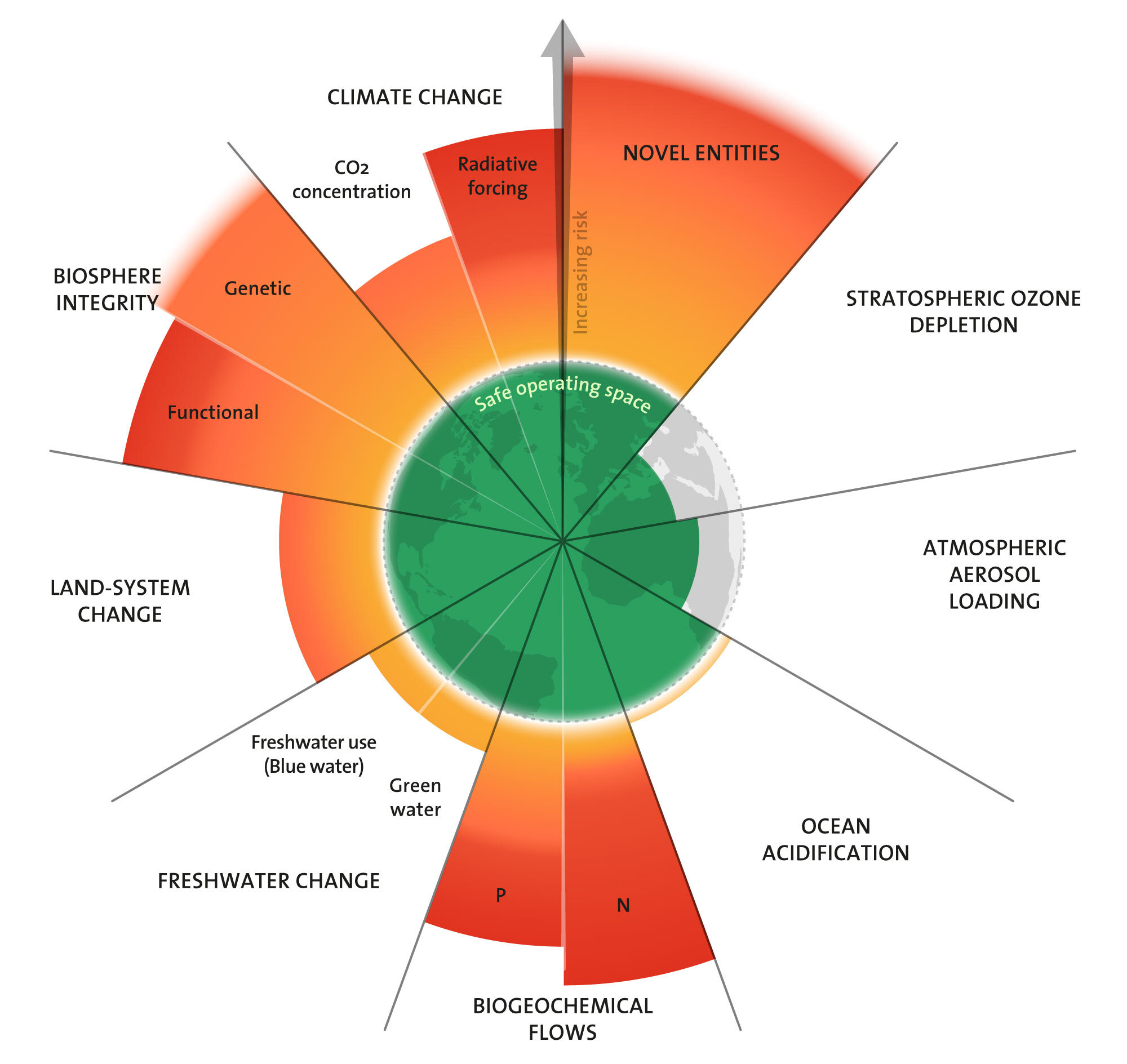 The 2025 update to the Planetary boundaries. Licensed under CC BY-NC-ND 3.0. Credit: “Azote for Stockholm Resilience Centre, based on analysis in Sakschewski and Caesar et al. 2025”. “They are scientifically defined guardrails that ensure the Earth’s health. Stay within them, and the Earth stays our dependable home — breach them, and we risk irreversible damage to our very own life support system. Today, seven out of nine boundaries have been transgressed. “Combining insights from many fields of global environmental change research, the framework highlights nine global change processes where human activities affect Earth system functioning. “Crossing boundaries increases the risk of generating large-scale abrupt or irreversible environmental changes. The impacts of these changes will not necessarily be immediate or drastic, but together the boundaries mark a critical threshold for risks to societies and the biosphere we are part of. “Planetary boundaries are interdependent. This means we cannot consider planetary boundaries in isolation in any decision-making on sustainability. Action that affects one process in the planetary boundaries framework will affect the risks of the other processes. Only by respecting all nine boundaries can we maintain the safe operating space for humanity.” Links to brief descriptions of each of the nine boundaries : – Climate
|
Not included as one of these boundaries: Human Population:
From Wikipedia Sustainable population
“A 2014 study published in the Proceedings of the National Academy of Sciences of the United States of America posits that, given the “inexorable demographic momentum of the global human population,” efforts to slow population growth in the short term will have little impact on sustainability, which can be more rapidly achieved with a focus on technological and social innovations, along with reducing consumption rates, while treating population planning as a long term goal. The study says that with a fertility-reduction model of one-child per female by 2100, it would take at least 140 years to reduce the population to 2 billion people by 2153.[28][29] The 2022 “Scientists’ warning on population,” published by Science of the Total Environment, states that “environmental analysts regard a sustainable human population as one enjoying a modest, equitable middle-class standard of living on a planet retaining its biodiversity and with climate-related adversities minimized,” which is estimated at between 2 and 4 billion people.[30]”